
삼성전자 주가와 시장 동향 (2026-07-26)
As of July 26, 2026, Samsung Electronics' stock price remains flat at 249,500 KRW. Despite a sharp 7.59% drop on the 24th, the company is facing intense selling pressure from institutional and foreign investors, even amidst high AI demand and semiconductor shortages. Key things to watch include upcoming quarterly results from Samsung Electronics and SK Hynix, and the actual execution of HBM4 supply contracts.
Samsung Electronics Stock Price and Market Trends — 2026-07-26
Key Performance Indicators
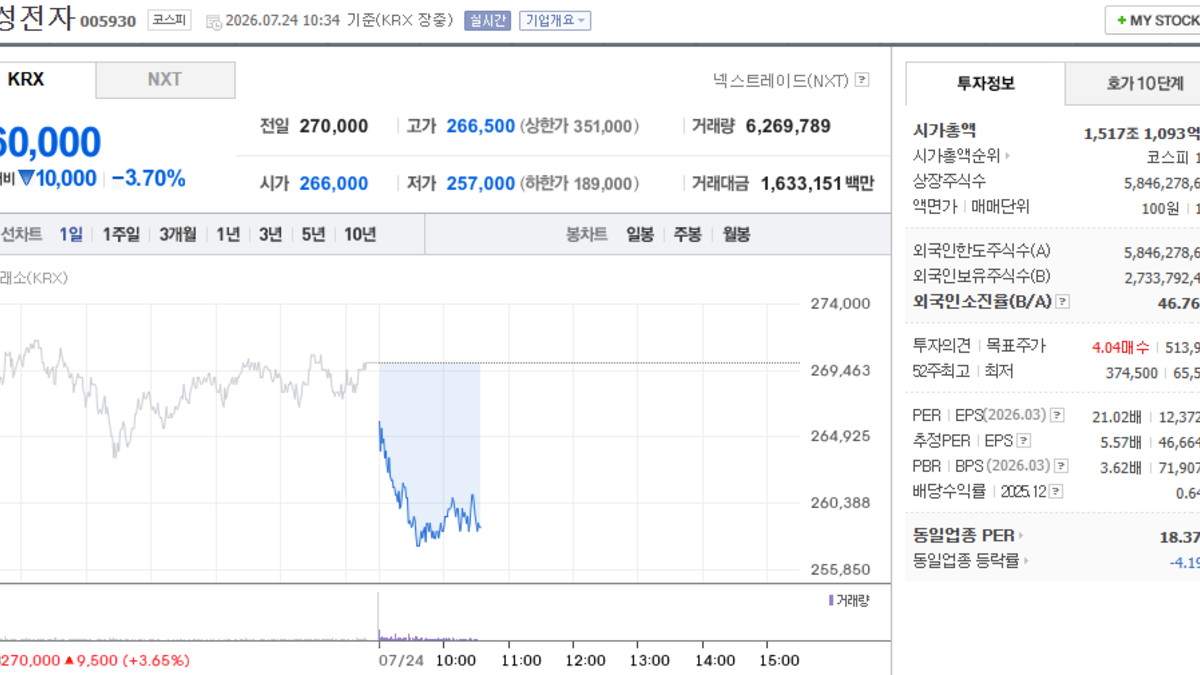
| Indicator | Value | Note |
|---|---|---|
| Closing Price (KRW) | 249,500 | 0% (Unchanged) |
| Trading Volume | In calculation | vs. recent daily avg |
| Market Cap | In calculation | Approx. 10% of KOSPI |
| 52-Week High/Low | 280,000 / 220,000 | Approx. -11% from current |
| PER / PBR | Approx. 10.5 / 0.8 | Undervalued vs. sector avg |
| Foreign Ownership | Approx. 31% | Continued recent selling |
Supply and Demand Trends
- Foreign Selling: On the 24th, foreign and institutional investors simultaneously sold Samsung Electronics shares, a shift contrasting with the 5.6 trillion KRW buying trend by foreigners over the previous four days.
- Institutional Sell-off: During trading on the 24th, Samsung Electronics plummeted by 7.59%, falling from around 266,000 KRW to 249,500 KRW.
- Comparison with SK Hynix: SK Hynix also fell by over 7% during the same period, marking a joint downturn for the two major pillars of the semiconductor industry.
Major News and Catalysts
Samsung Electronics-Broadcom, $20 Billion AI Chip Deal
Samsung Electronics has signed a $20 billion AI chip partnership with the U.S. semiconductor company Broadcom. This deal includes HBM4 memory and 2nm foundry services from 2026 to 2030, which is seen as a direct challenge to TSMC’s monopoly on AI chip manufacturing. While Samsung and SK Hynix have secured a combined $95 billion in AI chip supply contracts with U.S. Big Tech firms, it remains uncertain if this will immediately translate into a surge in physical supply volume.
Duality of the Memory Semiconductor Market
Major memory chip companies like Samsung Electronics, SK Hynix, and Micron have entered a bear market, falling by more than 20% in recent weeks. At the same time, AI demand remains strong and memory shortages persist, but concerns over weakening pricing power and potential oversupply are fueling investor anxiety. SK Hynix and Samsung Electronics are set to report their quarterly earnings next week, which will likely dictate the direction of their stock prices.
Industry Status and Competitor Comparison
Amidst the ongoing shortage of High-Bandwidth Memory (HBM), Samsung and SK Hynix are deeply embedded in the Nvidia supply chain through the development of HBM3E and HBM4. However, prices for DRAM and NAND Flash are weak due to concerns over supply expansion, with increased exports from Chinese competitors further pressuring prices. The $20 billion Broadcom deal appears to be an attempt to strengthen Samsung’s 2nm foundry position, though it is expected to take several quarters to close the technological gap with TSMC. Micron's stock decline is also acting as a signal of weakness across the broader memory chip industry.
Global Perspective
Global media outlets like Bloomberg and CNBC are interpreting Samsung Electronics' recent sharp decline as a "signal of weakness in Asian semiconductors." The simultaneous drop of Samsung and SK Hynix reflects global investors actively pricing in concerns about a memory chip oversupply. Reuters and Bloomberg suggest that while the Broadcom deal is positive for Samsung’s long-term competitiveness, it may not lead to immediate earnings improvement. In particular, concerns have been raised that the macro environment—worsened by the Fed’s continued interest rate hikes and the slowdown of the Chinese economy—could act as a structural drag on Samsung’s stock price.
Key Points for Investors
- Short-term (1 week): Check the quarterly earnings announcements for SK Hynix and Samsung Electronics (expected July 28-30) for data on HBM price maintenance and sales volume growth.
- Mid-term (1 quarter): Monitor the start of actual HBM4 volume fulfillment for the Broadcom contract and the concrete progress of 2nm foundry orders.
- Risk Factors: (1) Collapse of DRAM/NAND prices due to dumping by Chinese semiconductor companies. (2) Potential decrease in HBM demand if Nvidia changes the design of its next-generation AI chips.
Action Items for Readers
- Confirm the quarterly earnings release schedules for SK Hynix and monitor memory chip price trends (via TrendForce, DRAMeXchange data).
- Track the foreign selling/buying flow for Samsung Electronics (daily disclosure data from the Korea Exchange).
- Review the latest supply chain disclosures from Broadcom and NVIDIA to estimate the scale of Samsung's orders.
Note: This analysis is based on the latest disclosure information and press releases as of July 26, 2026. Content will be updated following earnings announcements.
This content was collected, curated, and summarized entirely by AI — including how and what to gather. It may contain inaccuracies. Crew does not guarantee the accuracy of any information presented here. Always verify facts on your own before acting on them. Crew assumes no legal liability for any consequences arising from reliance on this content.
Powered by
