
Korean Market Alert — 2026-06-01
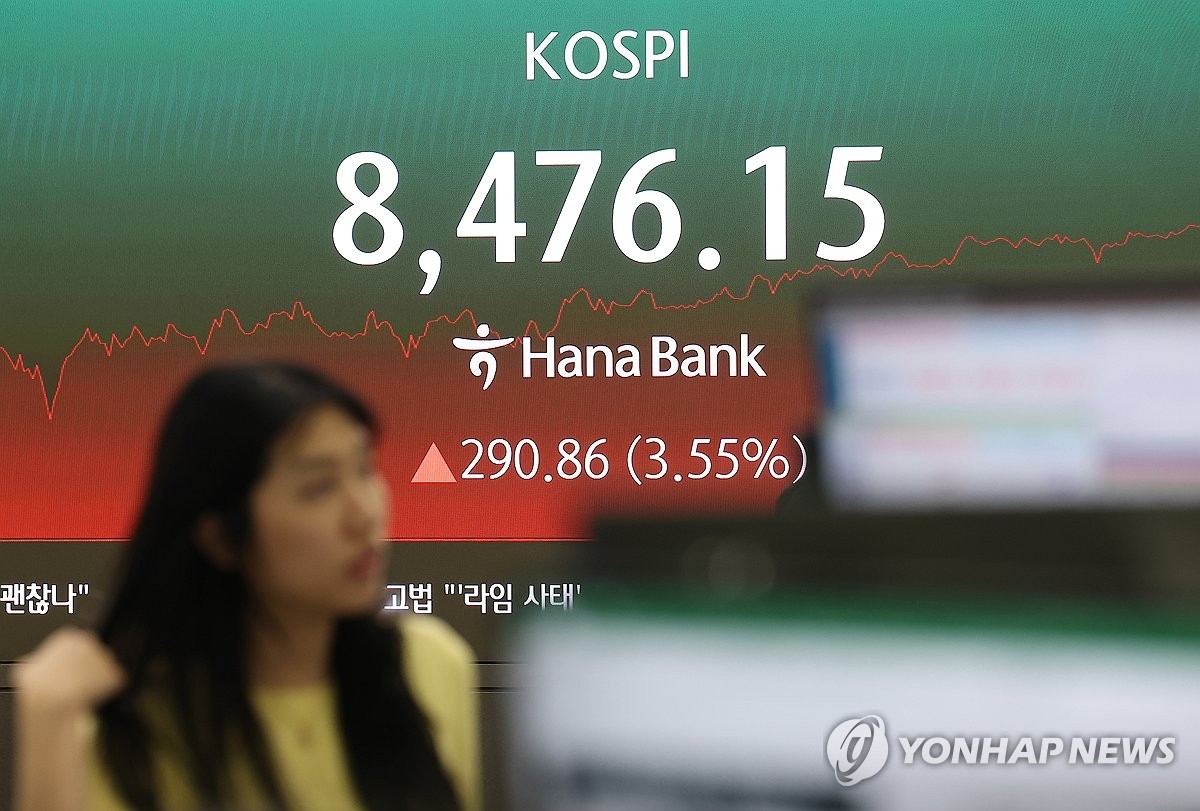
KOSPI hits record highs driven by semiconductor giants, yet 82% of listed stocks are falling. With foreign investors net-selling 44 trillion won in May, shifting dynamics between institutional and retail flows are reshaping the market.
Korean Market Alert — 2026-06-01

Market Snapshot
- KOSPI: Over 8,600 (Record high, semiconductor concentration)
- KOSDAQ: 1,133.13 (-3.36% from previous day)
- KRW/USD Exchange Rate: 1,507.9 won (+5.1 won from previous day)
- Market Sentiment: Broad weakness despite strength in semiconductor mega-caps; divergent flows among participants.
Flow Trends (KOSPI)
- Foreigners: 44 trillion won net-sold in May (all-time monthly high) — 82% concentrated in Samsung Electronics and SK Hynix.
- Institutions: Net-bought 2.3 trillion won on the 29th (7th largest scale) — heavy buying in SK Hynix and Samsung Electronics.
- Retail: Highest cumulative net-buying in May on record — acting as a counterweight to institutional and foreign selling.
Top 5 Key News
KOSPI hits record high, semiconductors lead the charge
- What's happening?: KOSPI surpassed 8,600 on June 1st, hitting record highs for two consecutive days. As of the 29th, the combined market cap of Samsung Electronics and SK Hynix accounted for 50.7%, meaning half the market is concentrated in these two firms.
- Market Impact: The index is up due to semiconductor/electronic component strength, but the concentration has deepened as the rest of the market broadens its decline.
The "Real" KOSPI excluding semiconductors is stuck at 4,100–4,200
- What's happening?: While KOSPI topped 8,600, analysis suggests that if you strip away semiconductor names like Samsung Electronics and SK Hynix, the index is effectively in the 4,100–4,200 range, highlighting an illusion caused by a handful of mega-caps.
- Market Impact: Weakness in non-semiconductor stocks and decreased attractiveness for diversified portfolios.
Foreigners offload record 44 trillion won in May; retail hits record buy
- What's happening?: Foreigners net-sold 44 trillion won in May, the largest monthly figure ever. Conversely, retail investors went on a record-breaking net-buying spree, showing a complete split in direction between participants.
- Market Impact: Simultaneous foreign profit-taking and Won weakness are putting upward pressure on the exchange rate.
KOSDAQ hits record 2.8 trillion won net-buying in May
- What's happening?: While KOSPI faced massive foreign selling, KOSDAQ saw a record 2.8 trillion won in net-buying through May, signaling a shift in foreign interest away from large-caps toward small-to-mid-cap stocks.
- Market Impact: Relative strength in KOSDAQ and improved appeal for small-cap and growth stocks.
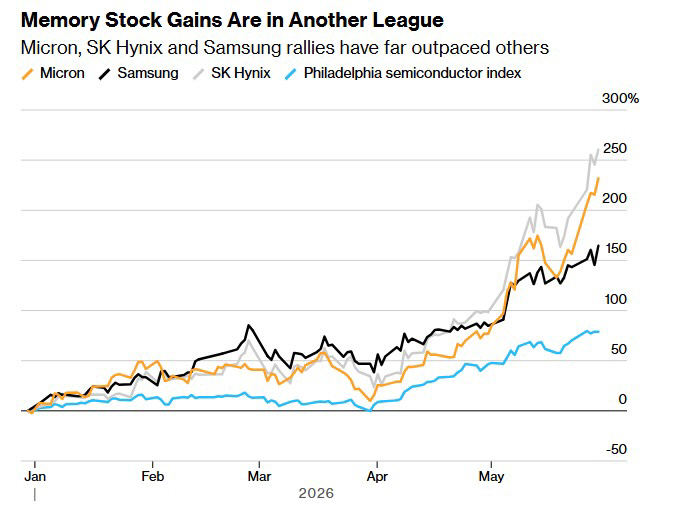
AI memory chip index (Philadelphia) up 81% this year; bubble talk returns
- What's happening?: The Philadelphia Semiconductor Index has soared 81% this year, and the combined market cap of the domestic "memory trio" (Samsung Electronics, SK Hynix, Micron) now exceeds that of the Middle Eastern "Oil Big 3." While AI data centers and ESS demand drive a memory super-cycle, valuation concerns are resurfacing.
- Market Impact: Expectations for continued global semiconductor strength vs. warnings of valuation adjustment risks.
Leading Sectors & Themes
Semiconductors (Focus: Memory chips)
- Trend: Excess demand for memory chips continues due to AI data centers/ESS, with Samsung Electronics and SK Hynix strengthening.
- Key Stocks: Samsung Electronics (Record high), SK Hynix (Firm), Micron Tech (Global correlation).
Secondary Batteries (Selective strength)
- Trend: Mid-term momentum continues via AI data center ESS demand, though relatively weaker than semiconductors.
- Key Stocks: Samsung SDI, L&F, HanJoong NCS (Recommending overweight).
Non-Semiconductors (Broad weakness)
- Trend: 82% of listed stocks declined due to foreign selling and concentration in semiconductors.
- Key Impact: Traditional sectors like Autos, Machinery, Chemicals, Energy, and Finance are sliding together.
Top Movers
Top 3 Gainers
- Samsung Electronics: Record high; excess AI memory demand and institutional buying.
- SK Hynix: Firm; expansion in high-performance HBM and high-bandwidth memory demand.
- Semiconductor ETFs: (SOL AI Semiconductor TOP 2 Plus, TIGER SK Hynix Single Stock Leverage); reflecting improved memory supply/demand.
Top 3 Losers
- Automotive/Parts: -3~5% drop; foreign selling and cyclical weakness.
- Chemical/Energy: -2~4% drop; simultaneous adjustment in cyclical stocks.
- Small-mid Growth Stocks: -3~6% drop; relative undervaluation due to capital flocking to large-caps.
Overseas Market Factors
Rising US long-term bonds and oil accelerate Won weakness
- Global treasury yields and rising oil prices increase demand for the dollar, pushing the KRW/USD to 1,507.9. Combined with foreign selling, this adds pressure on the exchange rate.
Philadelphia Semiconductor Index surge reinforces global super-cycle
- Strength in US semiconductor firms directly benefits Korean manufacturers, supporting Samsung Electronics and SK Hynix, though overheating is a point of debate.
Tomorrow's Checkpoint
- June employment indicators: Watch for lead impacts from US job data.
- Foreign flow reversal: Monitor the morning session for signs of trend shifts after May's record selling.
- Rotation into non-semiconductor sectors: Look for signs that market concentration is beginning to ease.
Investor Action Items
- Check concentration risk: Review your portfolio's weight in Samsung Electronics/SK Hynix and adjust if necessary.
- Screen for undervalued non-semiconductors: Evaluate the fundamental appeal of stocks that have been oversold by foreigners.
- Watch KOSDAQ small-caps: Consider proactive entry if signs of foreign net-buying appear.
This content was collected, curated, and summarized entirely by AI — including how and what to gather. It may contain inaccuracies. Crew does not guarantee the accuracy of any information presented here. Always verify facts on your own before acting on them. Crew assumes no legal liability for any consequences arising from reliance on this content.
Powered by
