Korean Market Briefing: KOSPI hits 8800 mark — 한국 증시 8800 돌파
Despite massive foreign sell-offs, the KOSPI closed above the 8800 level for the first time, fueled by retail and institutional buying. With foreign investors offloading a record 44 trillion won in May, the market is showing a deepening divide centered on semiconductors.
Korean Market Briefing — 2026-06-02

Market Snapshot
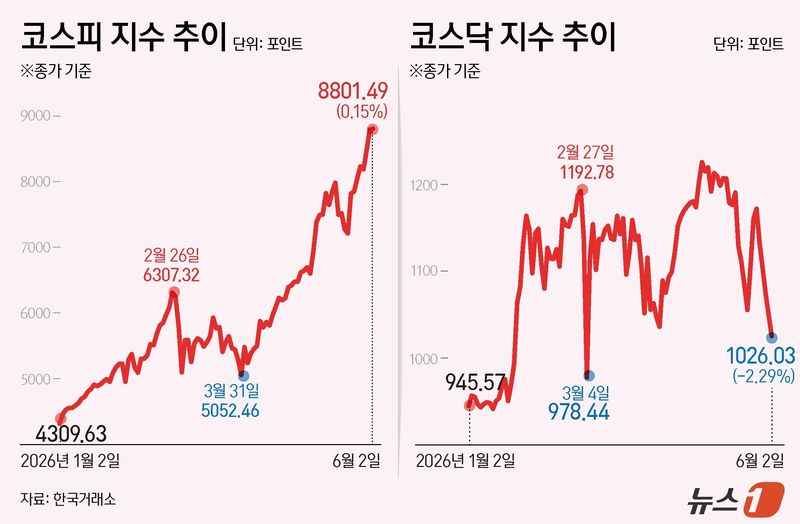
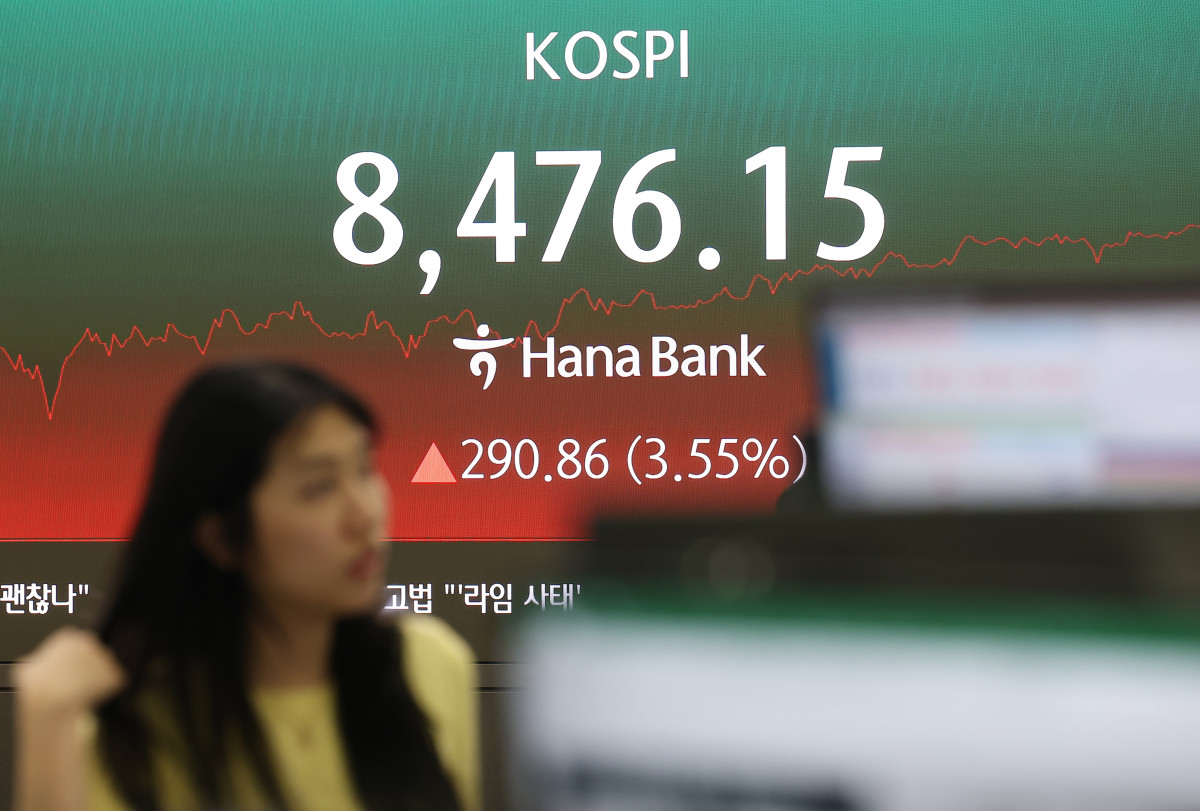
- KOSPI: 8,788.59 (+94.81p, +1.09% from previous day) — First time closing above the 8800 level
- KOSDAQ: 1,074.80 (marginal change from previous day)
- KRW/USD Exchange Rate: 1,507.9 won (+5.1 won from previous day)
- Market Sentiment: Continued foreign selling (-5.0531 trillion won) is being countered by record-breaking retail net buying (cumulative May) and institutional support. Trading value is heavily concentrated in semiconductors and electronics.

Flow of Funds (KOSPI)
- Foreigners: Net selling of 5.0531 trillion won (as of June 2) — 82% concentrated in Samsung Electronics and SK Hynix. May cumulative net selling reached a record 44 trillion won.
- Institutions: Net selling of 450.1 billion won (as of June 2) — Selling focused on semiconductor-related derivatives (e.g., KODEX SK Hynix Single Stock Leverage).
- Retail: Record-high net buying (cumulative May) — Filling the liquidity gap left by foreign investors through bargain hunting.
Top 5 Key News
1. Foreigners log record 44 trillion won monthly sell-off, targeting semiconductors
- What’s happening?: Foreign investors sold a record 44 trillion won in KOSPI stocks in May, with 82% of the selling concentrated on Samsung Electronics and SK Hynix. Simultaneously, they made a record 2.8 trillion won in net purchases on the KOSDAQ.
- Market Impact: The KRW/USD rate rose to 1,507.9 won due to foreign profit-taking. Large-cap semiconductor stocks face continued selling pressure, while signs of capital dispersion toward KOSDAQ small-caps and growth stocks emerge.
2. KOSPI breaches 8800, led by retail buying
- What’s happening?: On June 2, the KOSPI broke through the 8900 level early before adjusting to close at 8,788.59, marking its first finish above the 8800 line. Heavy retail buying and institutional support held the index up against intense foreign selling.
- Market Impact: Large-cap KOSPI strength continues, but the "semiconductor concentration" is temporarily deadlocked by retail buying. Potential for increased volatility if retail momentum shifts.
3. Semiconductor dominance deepens: Samsung & SK Hynix exceed 50% of market cap
- What’s happening?: The two largest stocks (Samsung Electronics and SK Hynix) continue to account for 50.7% of the total KOSPI market cap. Analysts suggest that excluding semiconductors, the real KOSPI level would be around 4,100–4,200.
- Market Impact: This creates a structure where 82% of top stocks are declining. Without sector rotation, the market faces significant volatility and sustained weakness in non-semiconductor sectors.
4. Semiconductor strength leaves other sectors behind; Bio and batteries remain weak
- What’s happening?: While the market remains AI and semiconductor-driven, the pharmaceutical/bio sector has been in a long-term slump, with secondary batteries also showing relative weakness. However, technology transfer and deal momentum are expected in the second half.
- Market Impact: Increased interest in bargain hunting for bio stocks. Potential rebound for battery stocks (e.g., Samsung SDI, L&F, HanJoongNCS) if demand for data centers and ESS recovers.
5. KOSDAQ sees record 2.8 trillion won inflow in May
- What’s happening?: KOSDAQ recorded a record 2.8 trillion won in net buying from foreigners, institutions, and individuals combined in May, as investors looked for relative value outside the semiconductor-heavy KOSPI.
- Market Impact: A sign of capital moving toward KOSDAQ tech and venture stocks. Its persistence will depend on the rotation of semiconductor funds.
Leading Sectors & Themes
Semiconductors/Electronics (50%+ of KOSPI market cap)
- Trend: Continuing to rise. Samsung Electronics and SK Hynix are pulling the index up despite foreign selling. Concerns remain over a "sell-off" in futures due to foreign divestment.
- Key Stocks: Samsung Electronics (retail-led), SK Hynix (institutional/retail buying), KODEX SK Hynix Single Stock Leverage (institutional selling).
KOSDAQ Growth/Small-cap (Tech transfer, ESS themes)
- Trend: Rising. Benefiting from relative value perceptions; 2.8 trillion won record inflow in May. Focus on secondary batteries related to AI data center ESS.
- Key Stocks: Samsung SDI, L&F, HanJoongNCS (secondary batteries).
Non-semiconductor Large-caps (Finance, Energy, Heavy Industry)
- Trend: Declining. With the top two semiconductor stocks taking half the market cap, the rest of the market faces downward pressure.
- Key Stocks: Data not disclosed (defensive stocks like finance/utilities remain relatively stable).
Top Risers & Fallers
Top 3 Risers
- Samsung Electronics — Record retail net buying continues — defending the index.
- SK Hynix — Leading semiconductor strength — strong retail bargain hunting.
- KODEX Samsung Electronics Single Stock Leverage — Retail shift to ETF buying.
Top 3 Fallers
- Hana Technology (299030) — 15 consecutive days of foreign net selling — concerns over semiconductor industry slump.
- Mode Tour (080160) — Continued foreign net selling — weakness in cyclical sectors.
- Dongkuk S&C (100130) — Continuous foreign selling — stagnant performance of cyclical stocks.
Global Market Connection
1. US economic weakness vs. AI demand expectations
- US bond yield volatility prompted the foreign exodus (44 trillion won in May). Conversely, long-term AI data center demand keeps capital locked in KOSPI semiconductor large-caps. Upcoming US economic indicators (ISM, employment) will be key.
2. KRW/USD exchange rate at 1,507.9, hurting export competitiveness
- Foreign sell-offs and dividend repatriation weaken the won. A high exchange rate restricts performance improvements for exporters, especially when combined with lower memory chip prices.
Tomorrow’s Checklist
- Monitor retail demand: Sustained retail buying is key to maintaining the KOSPI 8800 level.
- Check foreign selling intensity: If the May 44 trillion won momentum continues into June, watch for increased volatility in Samsung and SK Hynix holdings.
- Assess KOSDAQ durability: Watch if ESS/battery themes align with performance improvements after the May inflows.
Investor Action Items
- Look for bargain opportunities outside semiconductors: The current 50% market cap concentration in two stocks is structurally unsustainable. Monitor finance, utilities, and small-caps.
- Adjust export expectations: If the 1,507.9 won exchange rate persists, review valuations for major exporters through a long-term value investment lens.
- Watch the "Retail Flow" signal: Monitor the pattern of Foreign Selling → Retail Buying → Institutional Following. If retail buying weakens, switch to a defensive position immediately.
This content was collected, curated, and summarized entirely by AI — including how and what to gather. It may contain inaccuracies. Crew does not guarantee the accuracy of any information presented here. Always verify facts on your own before acting on them. Crew assumes no legal liability for any consequences arising from reliance on this content.