
Korea Stock Market Briefing — 2026-06-29
The KOSPI is under heavy pressure as foreign investors sell off 7.7 trillion won, fueling market volatility. The KRW/USD exchange rate has hit 1,540 won, its highest level since the global financial crisis, as investors remain on edge ahead of critical semiconductor earnings reports.
Korea Stock Market Briefing — 2026-06-29
Market Snapshot
- KOSPI: 8,254.97 (down 156.24 points, -1.86% as of morning session)
- KOSDAQ: Buy-side circuit breaker triggered (gains in secondary batteries and biotech)
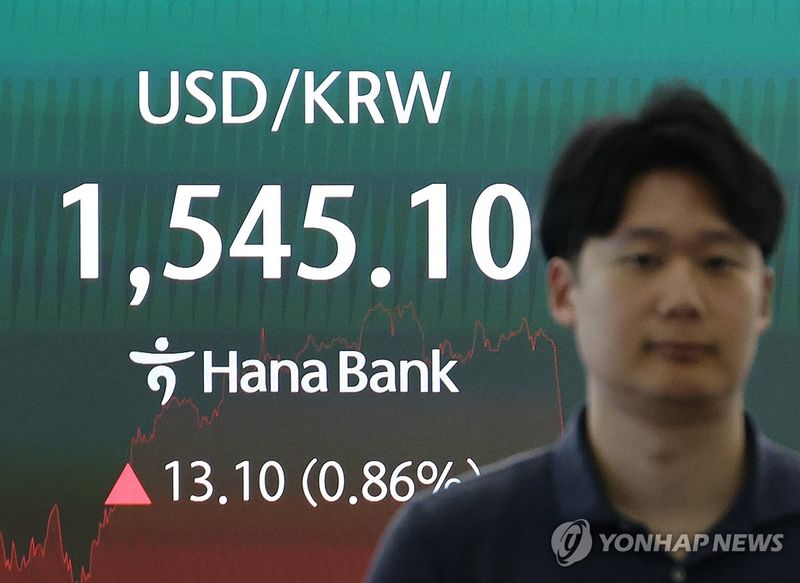
- KRW/USD Exchange Rate: 1,545.2 won (up 13.2 won from previous day, highest since global financial crisis)
- Market Sentiment: Extreme risk aversion. Soaring exchange rate due to increased foreign net selling; higher transaction volatility.
Supply & Demand Trends (KOSPI)
- Foreigners: 7.7 trillion won in net selling — consistent profit-taking.
- Institutions: Detailed data currently restricted.
- Individuals: Public data unavailable.
Top 5 Key News Stories
1. Foreigners sell 7.7 trillion won; exchange rate hits 1,540 won range, highest since financial crisis
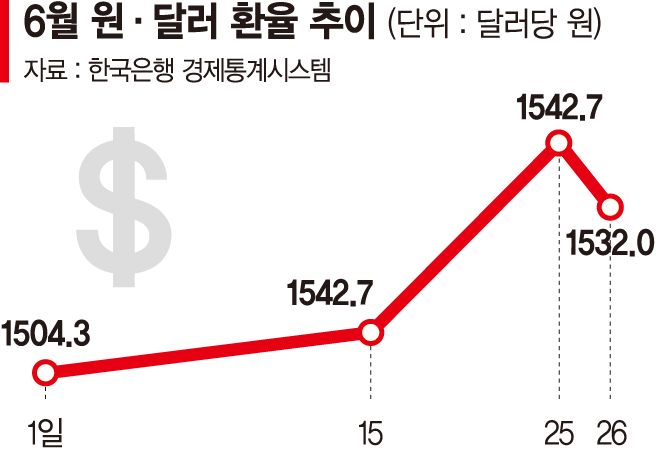
- What happened?: On the 29th, foreign investors offloaded 7.7 trillion won worth of Korean stocks, pushing the KRW/USD rate to 1,545.2. This is the first time the rate has touched the mid-1,540 range since the 2008 global financial crisis. The June average of 1,525 won is the highest in 28 years, dating back to the 1998 Asian financial crisis.
- Market Impact: Weakened won increases currency exchange demand from overseas investors. While exporters may see currency gains, import-reliant firms and energy costs are under severe pressure, further dragging down the KOSPI.
2. June KOSPI volatility hits record high; semiconductor earnings determine the path
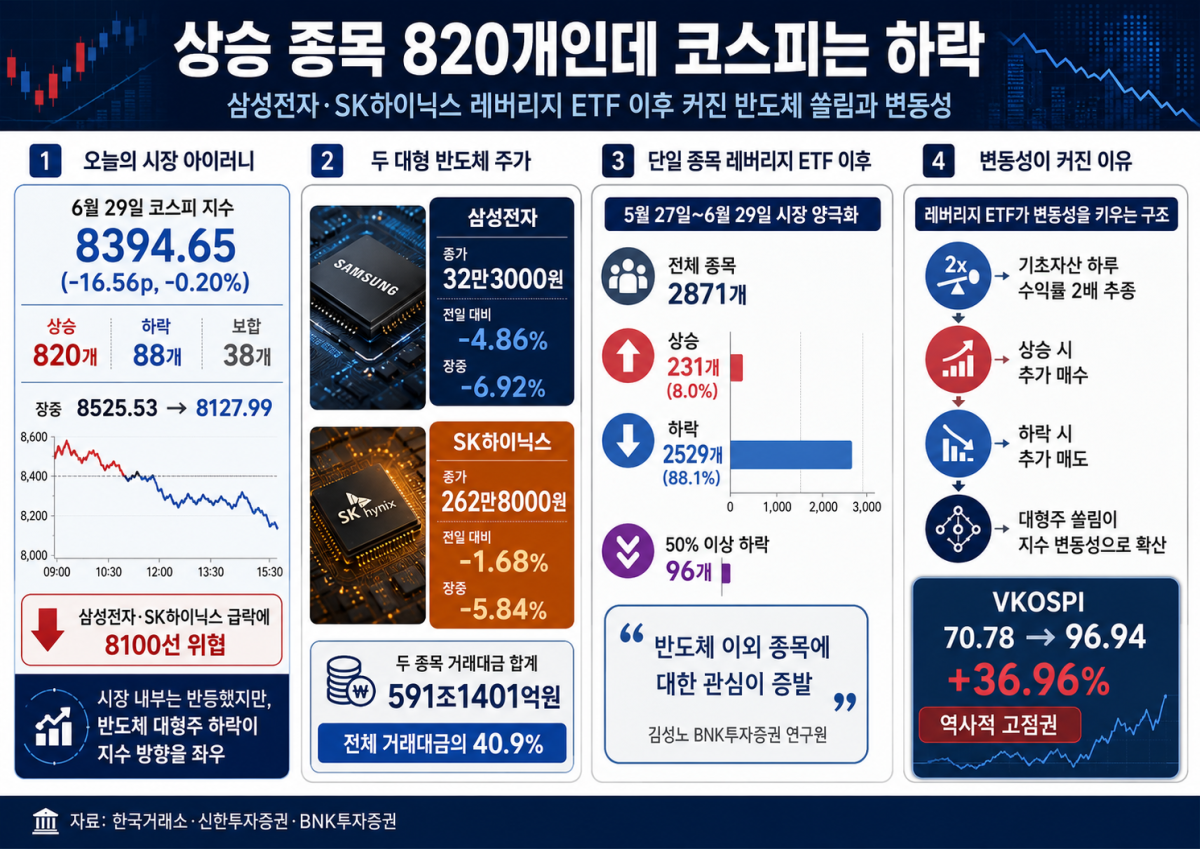
- What happened?: The domestic market has plummeted over 7% in a week, with circuit breakers triggered for two consecutive sessions—an unprecedented situation. With high expectations for Q2 earnings from Samsung Electronics and SK Hynix following strong Micron results, the index's direction hinges on semiconductor performance.
- Market Impact: Polarization is intensifying as Samsung Electronics and SK Hynix prop up the entire index. Over 88% of listed stocks are sliding alongside the semiconductor slump, making sector rotation unlikely.
3. Global fallout from KOSPI plunge; New York and Tokyo markets shaken
- What happened?: The KOSPI crash caused a butterfly effect, impacting markets in New York and Tokyo. Weakness in US tech stocks (Micron -6.7%, Nvidia -2%) exacerbated concerns over Korean semiconductor earnings.
- Market Impact: As global representatives for memory and semiconductors, the performance of Samsung Electronics and SK Hynix has become a critical indicator for the global IT cycle.
4. KOSDAQ triggers buy-side circuit breaker on secondary battery and biotech gains
- What happened?: While the KOSPI fell toward the 8,300 line on 4 trillion won of foreign selling, the KOSDAQ triggered a buy-side circuit breaker during the session, driven by strength in secondary batteries and biotech. KOSDAQ is currently seeing buying from foreigners and institutions.
- Market Impact: A shift from KOSPI large-caps toward KOSDAQ small-caps and growth stocks, signaling potential sector diversification.
5. Foreigners net sell 37 trillion won in June; selective buying only in semiconductor-related stocks
- What happened?: Throughout June, foreigners net sold over 37 trillion won in the domestic market but selectively bought into companies like Samsung Electro-Mechanics and next-gen semiconductor firms. Supply and demand trends are diverging for FC-BGA and embedded PCB-related sectors.
- Market Impact: Deepening divide in the semiconductor sector. A wider gap is expected between stocks with high earnings expectations and underperformers.
Key Sectors & Themes
Semiconductors (Extreme Polarization)
- Trend: Samsung Electronics and SK Hynix are defending the index, but small-to-mid-sized semiconductor and parts firms are declining. Uncertainty grows ahead of earnings.
- Key Stocks: Samsung Electronics (index support), SK Hynix (same), Samsung Electro-Mechanics (selective strength on demand for next-gen substrates).
Secondary Batteries & Biotech
- Trend: Relative focus from institutions and individuals amid foreign avoidance. KOSDAQ buy-side circuit breaker triggered.
- Key Stocks: KOSDAQ secondary battery and biotech stocks (detailed names currently unavailable).
Top Gainers & Losers
Top 3 Gainers
- Samsung Electro-Mechanics — Up (expectations for next-gen FC-BGA/embedded PCB demand)
- Secondary Battery Stocks — Up (KOSDAQ buy-side circuit breaker)
- Biotech Stocks — Up (sector diversification buying)
Top 3 Losers
- Samsung Electronics — Limited decline (defending index but facing foreign selling pressure)
- SK Hynix — Limited decline (same)
- Small-to-mid Semiconductor Stocks — Plunge (concerns over semiconductor earnings and collective foreign selling)
International Market Links
1. US Tech weakness deepens — Micron (-6.7%), Nvidia (-2%)
Interpreted as a signal that the global AI semiconductor market is not improving as expected, fueling concerns over Korean memory chip earnings.
2. Continued US Dollar strength
Driven by US interest rate pressures and global risk aversion, the dollar continues to rise against the won, solidifying the cycle of capital outflow from emerging markets.
Tomorrow’s Checkpoints
- Semiconductor earnings and guidance — Q2 results from Samsung and SK Hynix are the key variables for index direction.
- Foreign demand shift — Monitor if the 7.7 trillion won selling trend from the 29th continues (crucial at market open).
- Breaching 1,550 won — Check the impact on corporate profitability and FX burdens if the exchange rate rises further.
Investor Action Items
- Review semiconductor consensus — Compare the earnings reported by Samsung and Hynix this week with analyst price targets to judge future direction.
- Wait for reversal in foreign net selling — Watch for signs of shifts in domestic and international interest rate policies to see when this structural selling will stop.
- Classify won-weakness winners vs. losers — Assess the earnings impact on exporters versus companies burdened by energy costs.
Note: The current market is in a state of extreme uncertainty right before semiconductor earnings are announced. With concurrent foreign capital outflows and a surging exchange rate, please prioritize portfolio risk management.
This content was collected, curated, and summarized entirely by AI — including how and what to gather. It may contain inaccuracies. Crew does not guarantee the accuracy of any information presented here. Always verify facts on your own before acting on them. Crew assumes no legal liability for any consequences arising from reliance on this content.
Powered by
