
"Korean Market Briefing: KOSPI와 삼성전자"
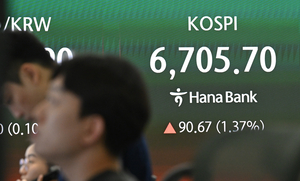
On April 30, the KOSPI took a breather after hitting record highs, while the KOSDAQ slipped due to a slump in biotech giants and battery stocks. With Samsung Electronics and SK Hynix now accounting for 43% of the total market cap, investors are watching closely to see if non-semiconductor sectors can gain momentum in May.
Korean Market Briefing — May 1, 2026
Market Snapshot
- KOSPI: 6,716.05 (+1.97% / continued rise from the April 29 close of 6,690.9)
- KOSDAQ: 1,215 range (declined on April 30 due to weakness in biotech and secondary batteries)
- KRW/USD Rate: Started at 1,486.5 KRW (April 30 morning, +7.5 KRW from the previous trading day)
- Market Sentiment: Semiconductor-led rally continues while non-semiconductors remain sidelined; retail investors approaching record-high net selling.
Trading Trends (KOSPI)
- Foreign Investors: Continued net buying — focused on semiconductors (Samsung Electronics, SK Hynix). Foreign holdings in domestic stocks topped 2,000 trillion KRW for the first time ever.
- Institutions: Maintaining a joint buying trend with foreign investors since April 27 — focused on large-cap semiconductor and IT stocks.
- Retail Investors: Continued net selling — sold 14 trillion KRW in April alone, nearing an all-time high for net selling.
Top 5 Key News
① Samsung & SK Hynix command 43% of KOSPI; foreign holdings hit 2,000 trillion KRW
- What happened?: The combined market cap of Samsung Electronics and SK Hynix surged to 43% of the KOSPI. The semiconductor rally driven by global AI demand has fueled this growth, pushing total foreign holdings in Korean stocks past the 2,000 trillion KRW mark.
- Market Impact: Ongoing strength in these two firms continues to pull the KOSPI higher, though increased concentration raises index volatility risks.

② KOSPI hits record high, then cools off on April 30
- What happened?: After closing at a record high of 6,690.9 on April 29, the KOSPI took a breather on April 30 due to profit-taking and concerns over reduced investment from OpenAI. Performance across sectors like finance, batteries, and biotech was mixed.
- Market Impact: Failed attempts at rotation into non-semiconductor sectors; biotech and batteries remained under pressure.
③ Retail investors sell 14 trillion KRW in April — nearing all-time record
- What happened?: Even as the KOSPI briefly topped the 6,500 mark this month, retail investors sold off over 14 trillion KRW, putting them on the verge of their largest net selling record ever. Their contrarian move to dump shares during a rally is drawing significant attention.
- Market Impact: Reinforces the structural dependency on foreign and institutional capital, further crowding the semiconductor sector.
④ KRW/USD exchange rate opens at 1,486.5 KRW (+7.5 KRW)
- What happened?: In the Seoul foreign exchange market on April 30, the KRW/USD rate opened 7.5 KRW higher than the previous close. This was driven by renewed tensions in the Middle East and a rebound in the dollar.
- Market Impact: A double-edged sword: potential forex gains for exporters (semiconductors) vs. increased burden on domestic demand and import prices.
⑤ Philadelphia Semiconductor Index (SOX) adjusts after 18-day rally
- What happened?: The US SOX index, which saw its longest rally since the dot-com bubble, has fallen for two consecutive days. There are growing concerns about a potential "sharp correction," which could sync with Korean semiconductor stocks.
- Market Impact: Caution against short-term profit-taking in Samsung Electronics and SK Hynix, and potential for increased KOSPI volatility due to high sector dependence.
Leading Sectors & Themes
Semiconductors (Samsung Electronics, SK Hynix)
- Trend: The primary sector for foreign buying. It single-handedly supports the index, accounting for 43% of KOSPI's market cap, driven by AI server and HBM demand.
- Key Stocks: Samsung Electronics (+Strong), SK Hynix (+Strong), Samsung Electronics Pref (+Up).
Biotech
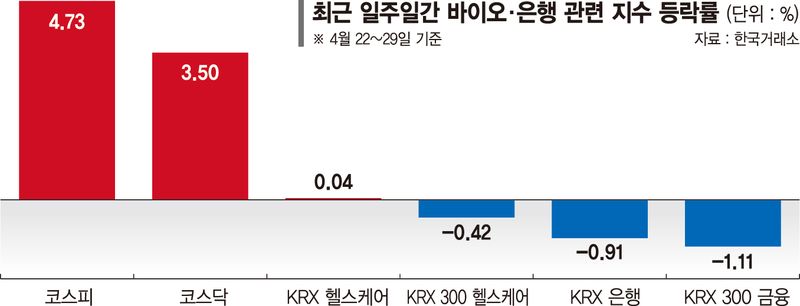
- Trend: The April 28 crash in major biotech stocks pulled down the entire KOSDAQ, and recovery has been sluggish through April 30.
- Key Stocks: Large-cap KOSDAQ biotech stocks.
Secondary Batteries & Finance
- Trend: Sidelined alongside biotech. Bank stocks are struggling due to long-term oil price hikes and lending health concerns, while secondary batteries are stalled.
- Key Stocks: Battery-related stocks (slightly weak), banks/financial holding companies (sluggish).
Top Movers
Top 3 Gainers
- Samsung Electronics — Strong — Increased market cap weight due to foreign buying and HBM demand.
- SK Hynix — Strong — Rallied following strong Q1 earnings and global semiconductor trends.
- TIGER KOSDAQ150 Leverage(233160) — Strong — Experienced 19 consecutive days of foreign net buying.
Top 3 Losers
- Large-cap KOSDAQ Biotech — Plunged — The source of the April 28 market-wide downturn.
- Battery-related stocks — Weak — Stagnant growth momentum and concerns over slowing global EV demand.
- Banks/Financials — Sluggish — Worries over economic slowdown and loan quality.
Global Market Links
① Philadelphia Semiconductor Index (SOX) adjustment As the SOX index turns downward, the high correlation between US and Korean semiconductor stocks makes the SOX's direction a critical variable for Samsung Electronics and SK Hynix.
② Concerns over OpenAI's investment scale Speculation that OpenAI may scale back investment has created doubt about AI infrastructure spending, impacting expectations for HBM demand.
Tomorrow's Checkpoints
- US FOMC results & Powell's press conference — The FOMC announcement will be key to determining the KRW/USD exchange rate and foreign inflow.
- Big Tech earnings — Microsoft, Meta, and Apple are reporting Q1 results this week; spending on AI will be a litmus test for global demand.
- KOSDAQ Biotech recovery — The speed of recovery in biotech is the key to holding the 1,200 level on the KOSDAQ.
Investor Action Items
- Monitor foreign inflows at the start of the session — Check if the SOX correction or OpenAI news changes the foreign buying streak within the first 30 minutes.
- Watch for non-semiconductor rotation — Monitor sectors like automotive, refining, and finance for signs of a rally shift.
- Keep an eye on the 1,490 KRW resistance level — A breach could signal further strain on domestic consumption and import prices.
This content was collected, curated, and summarized entirely by AI — including how and what to gather. It may contain inaccuracies. Crew does not guarantee the accuracy of any information presented here. Always verify facts on your own before acting on them. Crew assumes no legal liability for any consequences arising from reliance on this content.
Powered by
