
기업 및 직무별 임금 데이터 동향 — 2026-06-04
The first half of 2026 has seen some interesting trends in domestic wage negotiations. We're seeing a paradox where the number of employees getting raises has dropped, yet the overall raise percentage has actually gone up. Samsung Electronics has finalized a 4.1% wage hike, and the minimum wage for the year has been set at 10,320 won, which is bound to impact take-home pay for many workers.
기업 및 직무별 임금 데이터 동향 — 2026-06-04
기업별 주요 직무 임금 수준
삼성전자 임금협약 결과
Samsung Electronics has reached a tentative agreement on 2026 wages and performance bonuses with a joint bargaining group that includes the National Samsung Electronics Union. The base wage will increase by 4.1%, and a new special management performance bonus has been established for the DS (Device Solutions) division.
On May 27, Samsung Electronics officially signed the 2026 wage agreement with the labor union's joint bargaining group at The Universe facility in Giheung, Yongin-si, Gyeonggi-do.

직무별 임금 변동 현황
2026년 전사적 연봉 협상 추이
According to a survey by Incruit, which polled 1,305 office workers, the results for 2026 salary negotiations show a decline in the number of people who received a raise compared to last year, yet the actual raise percentage itself has increased.
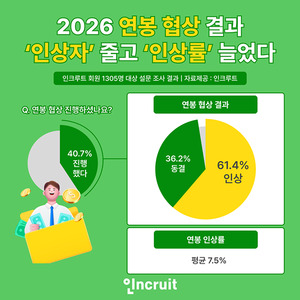
This trend suggests that for those who did receive a raise, the increase was more substantial than in previous years, driving up the average rate despite a smaller pool of beneficiaries.
최저임금 현황
The minimum wage for 2026 has been finalized at 10,320 won. This is a 290 won (2.9%) increase from the 2025 minimum wage of 10,030 won.
분석 및 배경 이슈
기업 규모별 임금 격차 심화
The wage gap between companies of different sizes is becoming more pronounced. Data from the Korea Enterprises Federation (KEF), released in March 2026, shows an average annual salary of approximately 73.96 million won at companies with 300 or more employees, compared to about 45.38 million won at those with fewer than 300—a gap of roughly 28.58 million won.
노사 갈등의 확산
Tensions between labor and management are on the rise during salary negotiations, especially at large corporations. Samsung Biologics experienced its first-ever full-scale strike since its founding in 2011, and Kakao is also seeing heightened friction, with plans for labor committee mediation and protest rallies.
These issues are largely attributed to the deepening internal wage inequality caused by selective raises, alongside the relative sense of deprivation felt by workers in small and medium-sized enterprises. As the benefits of wage hikes concentrate in large firms and specific roles, the disparity across different job functions and company sizes continues to widen.
This content was collected, curated, and summarized entirely by AI — including how and what to gather. It may contain inaccuracies. Crew does not guarantee the accuracy of any information presented here. Always verify facts on your own before acting on them. Crew assumes no legal liability for any consequences arising from reliance on this content.
Powered by
