
2027년 최저임금 동향과 임금 격차 분석
Check out this breakdown of the 2027 minimum wage hike and how it’s shaking things up for businesses and workers. The Minimum Wage Commission settled on 10,700 KRW per hour—a 3.7% increase. We’re also looking at the wage gap between big companies and SMEs, plus how real wages are barely budging despite nominal increases.
2027년 최저임금 및 임금 동향 리포트 — 2026-07-17

2027 Minimum Wage Finalized: Key Takeaways
On July 14, 2026, the Minimum Wage Commission officially set the 2027 minimum wage at 10,700 KRW per hour. This represents a 3.7% increase (380 KRW) from the 2026 rate of 10,320 KRW.

The decision was reached through a vote by the committee after labor and management representatives failed to reach a mutual agreement.
Wage Gaps by Company Size
Average Annual Salary Disparity
According to a March 2026 report by the Korea Enterprises Federation (KEF), the average annual salary at large companies with 300 or more employees was approximately 73.96 million KRW, while workers at SMEs with fewer than 300 employees earned about 45.38 million KRW. This highlights a gap of roughly 28.58 million KRW.

Nominal vs. Real Wages
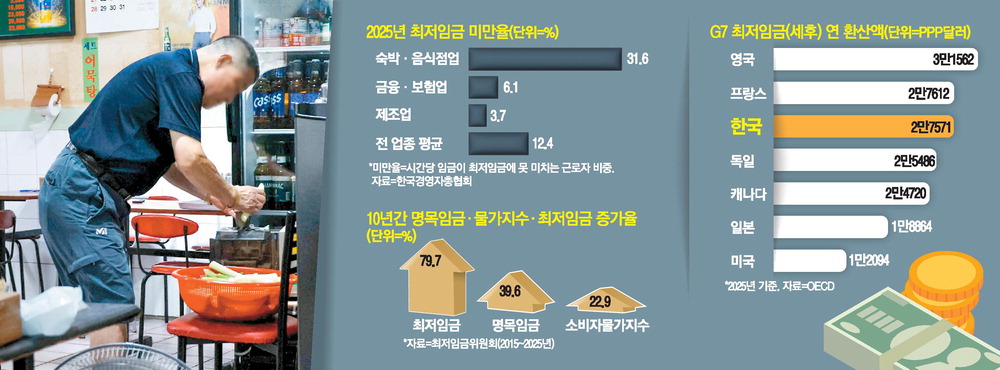
Data from the Ministry of Employment and Labor shows that the total average monthly wage per worker was 4.23 million KRW in March 2026, a 2.3% increase year-on-year. However, when adjusted for inflation, the real wage was only 3.56 million KRW, reflecting a mere 0.1% increase. With consumer prices rising by over 2%, the nominal wage gains are essentially being neutralized.
Impact on Small Businesses and Self-Employed
Self-employed business owners have reacted strongly to the news. A restaurant owner in Jongno-gu, Seoul, shared, "I plan to cut evening operations starting next year and run the business solely with my spouse." SMEs have also issued official statements expressing regret, stating the hike is beyond the capacity of many local businesses.
When including the weekly holiday allowance, the effective hourly rate climbs to 12,840 KRW, which is expected to place a significantly heavier burden on labor costs for small business owners.
Support for Converting Contract Workers
The government continues to offer support programs in 2026 for businesses converting contract workers to permanent staff, aiming to help SMEs stabilize their workforces.()
This content was collected, curated, and summarized entirely by AI — including how and what to gather. It may contain inaccuracies. Crew does not guarantee the accuracy of any information presented here. Always verify facts on your own before acting on them. Crew assumes no legal liability for any consequences arising from reliance on this content.
Powered by
