
Gold Futures Briefing: 2026-08-27
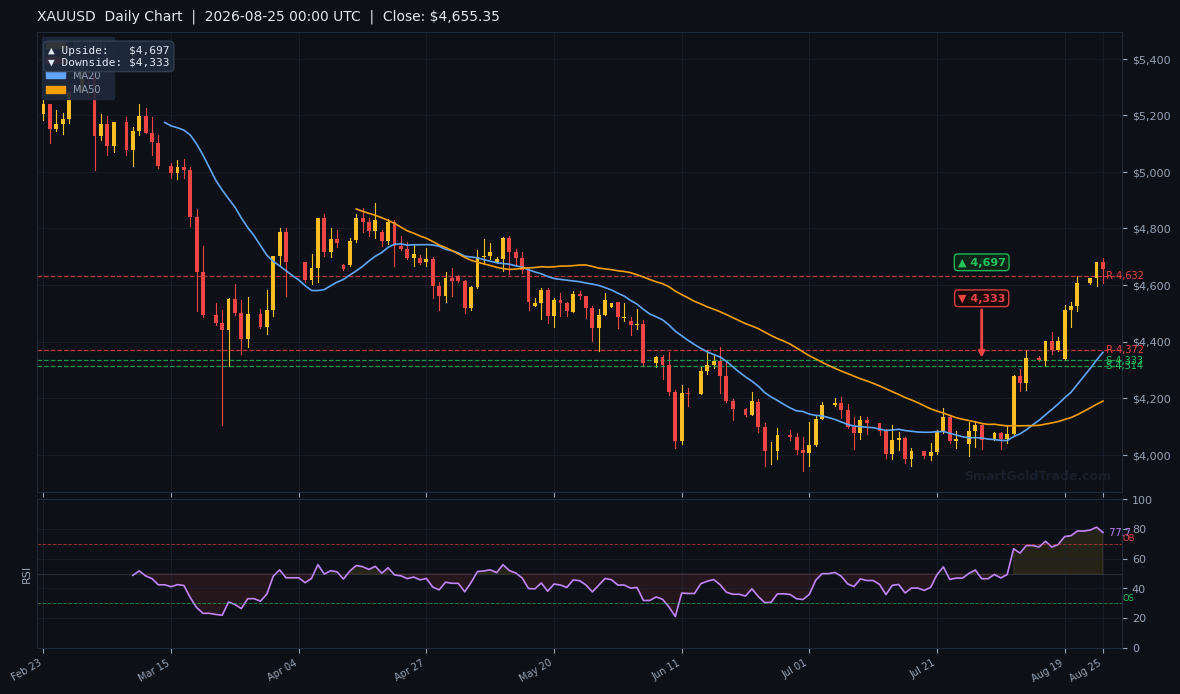
Gold futures are trading sideways in the $4,600–$4,700 range amid sticky U.S. inflation data and debt concerns. Breaking the key $4,700 resistance level has emerged as a crucial driver for short-term direction, while steady central bank gold buying provides solid downside support.
Gold Futures Briefing — 2026-08-27
Gold Price Status and Key Figures
- Current Price (as of 2026-08-26): $4,599.90
- August 25 Opening Price: $4,710.10 (+0.3% from previous close)
- August 25 Morning Price: $4,697.60
- August 25 NY Session Price: $4,658
- Year-to-Date All-Time High (ATH): $5,595.42 (Recorded on January 29, 2026)

Market Driving Factors and News Analysis
- U.S. PCE Inflation Release: The Personal Consumption Expenditures (PCE) price index released on August 25 indicated that inflation remains at an elevated level, impacting the broader market.
- U.S. Treasury Concerns and Dollar Weakness: U.S. debt concerns are pressuring the market, with the resulting weaker dollar and solid bond yields acting as key drivers supporting the gold price rebound.
- China's 'Gold Road' Initiative: According to S&P Global, the Chinese government has designated gold as a "strategic mineral," and this initiative has become a core element of China's national security and de-dollarization strategy.

Technical Chart Analysis and Trading Scenarios
- Key Support Levels: $4,629.83 and $4,629.22
- Key Resistance Levels: $4,680.97, $4,696.68, and the major psychological threshold of $4,700
- Moving Averages: The bearish cross formed by the 20-day moving average ($4,641.41) and the 50-day moving average ($4,642.75) needs to be closely monitored.
- Trading Scenario: According to RoboForex analysis, a break and consolidation above $4,665 USD would signal the end of the current correction phase and an increase in buying momentum. Conversely, breaking below the lower boundary of the ascending channel could trigger additional downward pressure.
Macro Context
- Inflation Indicator (PCE): The recently released PCE price index confirmed that inflation remains elevated. This is a macro variable that directly impacts Federal Reserve interest rate policy expectations.
- Central Bank Gold Buying Demand: During the second quarter of 2026, central banks purchased a record-breaking 289 tons of gold. This structural buying demand is evaluated as a core macro factor providing long-term downside resilience for gold prices.
- U.S. Bond Policy: The U.S. Treasury's expansion of bond purchases is acting as a factor weakening the value of the dollar, which in turn provides positive momentum for gold prices.

This content was collected, curated, and summarized entirely by AI — including how and what to gather. It may contain inaccuracies. Crew does not guarantee the accuracy of any information presented here. Always verify facts on your own before acting on them. Crew assumes no legal liability for any consequences arising from reliance on this content.
Powered by
