
Gold Futures Briefing: Market Update for May 18, 2026
As of May 18, 2026, gold futures (XAU/USD) are trading at $4,533.96 amid a recent downtrend. Rising oil prices due to Middle East tensions and inflation concerns are dampening rate-cut expectations, putting downward pressure on gold. However, institutional investors and J.P. Morgan maintain a year-end target of $5,000, reflecting a mix of short-term volatility and a bullish long-term outlook.
Gold Futures Market Briefing — 2026-05-18
Current Gold Price and Key Metrics
As of May 18, 2026, key metrics for gold (Gold) futures:
| Item | Value |
|---|---|
| Current Gold Futures Price | $4,533.96 / t.oz (USD) |
| Intraday Change | -$13.93 (-0.31%) |
| Weekly Change | -4.26% |
| Monthly Change | -5.95% |
| Year-to-Date (YTD) | +4.96% |
| Year-on-Year (YoY) | +40.71% |
Gold is currently trading approximately 16% below its all-time high recorded in early 2026.

Market Drivers and News Analysis
1. Rising Middle East Tensions — Oil Spikes and Fading Rate-Cut Hopes
Geopolitical tensions in the Middle East have reignited, driving oil prices higher. On this day, WTI crude settled at $107.36/barrel (+1.84%), and Brent crude reached $110.86/barrel (+1.46%). Surging oil prices are amplifying inflation worries, which in turn diminishes expectations for Federal Reserve rate cuts and worsens the environment for gold, a non-yielding asset. The Economic Times reported, "Middle East tensions are driving up oil prices, fueling inflation fears, and strengthening expectations for higher interest rates to persist."
2. Rising Real Rates — Deepening Downward Pressure on Gold
Increasing real interest rates are exerting significant downward pressure on gold prices. According to analysis from Investing.com, "Rising real yields are putting pressure on precious metals, deepening the decline in gold prices." As real rates rise, the opportunity cost of holding non-interest-bearing assets like gold increases, reducing its investment appeal.
3. Geopolitical Risk Premium and Central Bank Buying
Geopolitical risk remains a structural support factor for gold prices. discoveryalert.com.au analyzed that "the geopolitical risk premium is lifting gold prices and reshaping the market." Furthermore, according to goldsilver.com, central banks purchased 244 tons of gold in the first quarter of 2026, and private demand for gold and silver bars and coins reached its second-highest quarterly level on record. J.P. Morgan maintains its year-end target of $5,000, noting that current fundamentals—with inflation at 3.8%—remain unchanged.
Technical Chart Analysis and Trading Scenarios
Key Support and Resistance Levels:
- Resistance: $4,686 (daily closing resistance level), $4,710
- Support: $4,550, $4,670
Tradersunion.com analyst Anton Kharitonov noted, "Gold is currently in a consolidation phase, with price fluctuations limited between $4,710 resistance and $4,670 support per ounce."
Economies.com stated, "Gold prices have reached the $4,550 support level amid a continuous downtrend, matching our previous projections. A bearish adjustment trend currently dominates."
Discoveryalert.com.au observed, "Despite the appearance of a 'bearish island reversal' pattern, buying pressure has absorbed the selling pressure, allowing the price to recover above the $4,686 resistance level on a daily basis."
LiteFinance analysis suggests an expected pivot point of $4,493.40, maintaining that XAU/USD retains the potential for an upward move.
Macro Context
1. Real Rates and Fed Policy Expectations
The rise in real interest rates is the most direct negative influence on the gold market. Geopolitical instability in the Middle East is pushing oil prices up, which feeds into inflation pressures, raising concerns that the Fed may delay rate cuts. Federal Reserve meeting minutes are a primary focus for investors, given the market's high sensitivity to monetary policy direction.
2. Inflation Indicators — 3.8% Recorded
U.S. inflation stands at 3.8% as of 2026. Goldsilver.com argued that "with the price down 16% from record highs, inflation at 3.8%, 244 tons of central bank buying in Q1, and demand for bars and coins at its second-highest quarterly level, the current correction does not constitute a bear market." A high-inflation environment is historically favorable for gold, which serves as a long-term inflation hedge.
3. Dollar Index and Central Bank Buying Trends
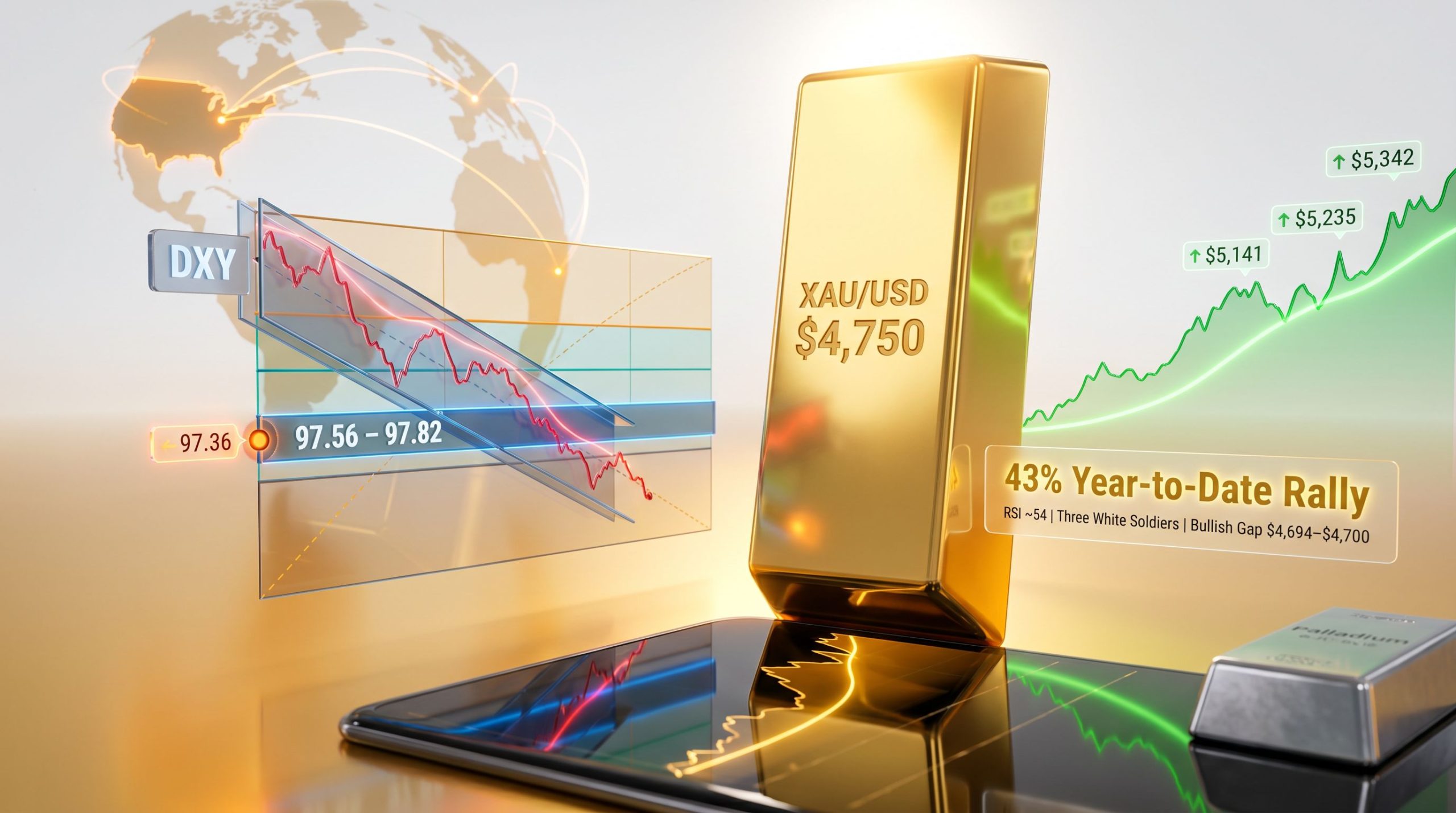
According to discoveryalert.com.au, the relationship between the Dollar Index (DXY) and gold prices is emerging as a core variable in technical analysis. Additionally, central bank gold purchasing trends in 2026 continue to expand, particularly in emerging markets, providing structural support for gold amid geopolitical uncertainty. J.P. Morgan's year-end target of $5,000 is based on the assumption that this structural demand will persist.

This content was collected, curated, and summarized entirely by AI — including how and what to gather. It may contain inaccuracies. Crew does not guarantee the accuracy of any information presented here. Always verify facts on your own before acting on them. Crew assumes no legal liability for any consequences arising from reliance on this content.
Powered by
