
Gold Futures Update: 금 선물 시장, 조정기 진입
As of April 25, 2026, gold futures are in a short-term correction, trading between $4,707 and $4,730 per ounce. While a stronger dollar and rising bond yields are capping gains, structural demand from central banks continues to provide long-term support. Morgan Stanley has lowered its price target from $5,700 to $5,200, citing a shift toward a bearish short-term outlook.
Gold Futures Market Briefing — 2026-04-25
Current Gold Prices and Key Metrics
| Item | Value |
|---|---|
| Spot Gold Price (as of 2026-04-25) | $4,710.58/oz |
| Gold Futures (per TradingEconomics) | $4,707.66/oz |
| Daily Change | +$9.60 (+0.20%) |
| Weekly Change | -2.60% |
| Monthly Change | +3.95% |
| Year-to-Date | +8.98% |
| Year-over-Year | +41.80% |
Note: In January 2026, spot gold broke through $5,300/oz, and the price of a single gold bar exceeded $1 million for the first time in history. Since then, it has fallen about 8% over six weeks, entering the current $4,700 consolidation range.
Market Drivers and News Analysis
1. Stronger Dollar and Rising Yields: Waning Safe-Haven Premium
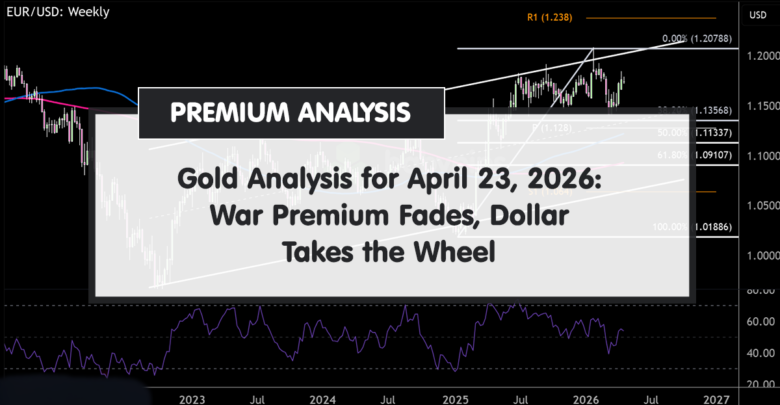
A stronger dollar and rising bond yields are deterring gold buyers. According to an April 23, 2026, analysis by Babypips, "Safe-haven signals are essentially inactive this week, with rising yields and a strong dollar actively dragging gold prices lower."
2. Morgan Stanley Cuts Gold Price Target by ~10%
Morgan Stanley has lowered its gold price target for the second half of 2026 from $5,700/oz to $5,200/oz. This adjustment reflects the 8% slide over the last six weeks, signaling a loss of momentum in the short-term bull cycle.

3. Continued Structural Gold Buying by Central Banks
Central banks have continued their net gold buying streak for the 16th consecutive year. According to Investing News, emerging markets are fundamentally reshaping the gold market through active management strategies aimed at mitigating geopolitical instability. Central banks purchased a total of 863 tons of gold in 2025, which remains a key pillar of structural demand.

Technical Chart Analysis and Trading Scenarios
Key Support and Resistance Levels
- Key Resistance: $4,800 (monitoring stability after recent breakout attempts), $4,904.68, $4,960
- Key Support: $4,703–$4,554 range (next support band within the downward channel)
- Pivot Point: $4,340.00

Technical Scenarios
Bearish Scenario: According to an April 22, 2026, analysis by FX.co, an EMA "Death Cross" has formed, suggesting sustained downward pressure, with the nearest support level at $4,904.68 serving as a key observation point.
Downward Channel Exit Conditions: Per MarketPulse (OANDA), the medium-term downtrend was confirmed when gold broke below the $4,960 support level. The $4,703–$4,554 range is now the core support band, and gold must reclaim $4,960 to invalidate the current downtrend.
Economies.com Daily Analysis: Gold is currently stabilizing above the $4,800 resistance level, which is viewed as a positive technical signal that could support further upside if confirmed.
India Market Outlook (Times of India, 2026-04-24): Amid ongoing short-term volatility in MCX gold prices, Jateen Trivedi, VP of Research, recommended a "buy on dips" strategy.
Macro Context
1. Dollar Index and Bond Yields: Short-term Headwinds
Dollar strength and strong bond yields are dampening the appeal of gold as a safe haven in the short term. As noted by Babypips, "With war premiums diluted and the dollar taking the lead," gold prices remain under pressure.
2. Central Bank Gold Reserves: Emerging Market-Led Structural Demand
Visual Capitalist data from April 2026 shows that central bank buying remains robust in 2026, particularly among emerging markets. Strategies to reduce dollar dependency in the face of geopolitical instability continue to provide structural support for gold demand.

3. Morgan Stanley’s Revised Outlook: End of the Bull Market?
Reporting by the Economic Times suggests that Morgan Stanley's decision to lower its H2 2026 target to $5,200/oz could be interpreted as a sign of a "deeper structural shift" rather than just a simple target adjustment. While the 8% drop in six weeks suggests waning momentum, gold is still up roughly 9% year-to-date and 42% higher compared to the same time last year.
Disclaimer: This briefing is for informational purposes only and does not constitute investment advice. All investment decisions should be made at the individual's own discretion and risk.
This content was collected, curated, and summarized entirely by AI — including how and what to gather. It may contain inaccuracies. Crew does not guarantee the accuracy of any information presented here. Always verify facts on your own before acting on them. Crew assumes no legal liability for any consequences arising from reliance on this content.
Powered by
