
Gold Futures Market Briefing — 2026-07-11 요약
Gold futures fluctuated between July 9-10 as safe-haven demand from Middle East geopolitical tensions clashed with the U.S. Federal Reserve’s hawkish stance. While central bank gold demand remains strong, the price is technically hovering around the $4,100 resistance level.
Gold Futures Market Briefing — 2026-07-11
Current Gold Price and Key Figures
As of July 9, 2026, gold futures were recorded at $4,106.51/oz.
Gold saw a slight rise after breaking through the $4,100 resistance level amid volatile intraday trading, though it is still technically viewed as a rebound within a bearish trend.

Market Drivers and News Analysis
1. U.S. Federal Reserve’s Hawkish Rate Policy
On July 9, HSBC downgraded its 2026-2027 gold price forecast, citing a shift toward a more hawkish U.S. interest rate policy and a strengthening dollar.
2. Historic Central Bank Gold Demand
According to a survey by the World Gold Council (WGC), 45% of central banks worldwide plan to increase their gold holdings, reaching a record high. While Invesco’s Q3 2026 gold outlook notes that the second quarter was the worst in 12 years, central bank demand is expected to push gold prices upward toward the end of the year.
3. Middle East Geopolitical Tensions and Safe-Haven Appeal
Deepening geopolitical tensions in the Middle East are acting as a key variable, with gold attempting a technical rebound as a traditional safe-haven asset.

Technical Chart Analysis and Trading Scenarios
Key Resistance and Support Levels:
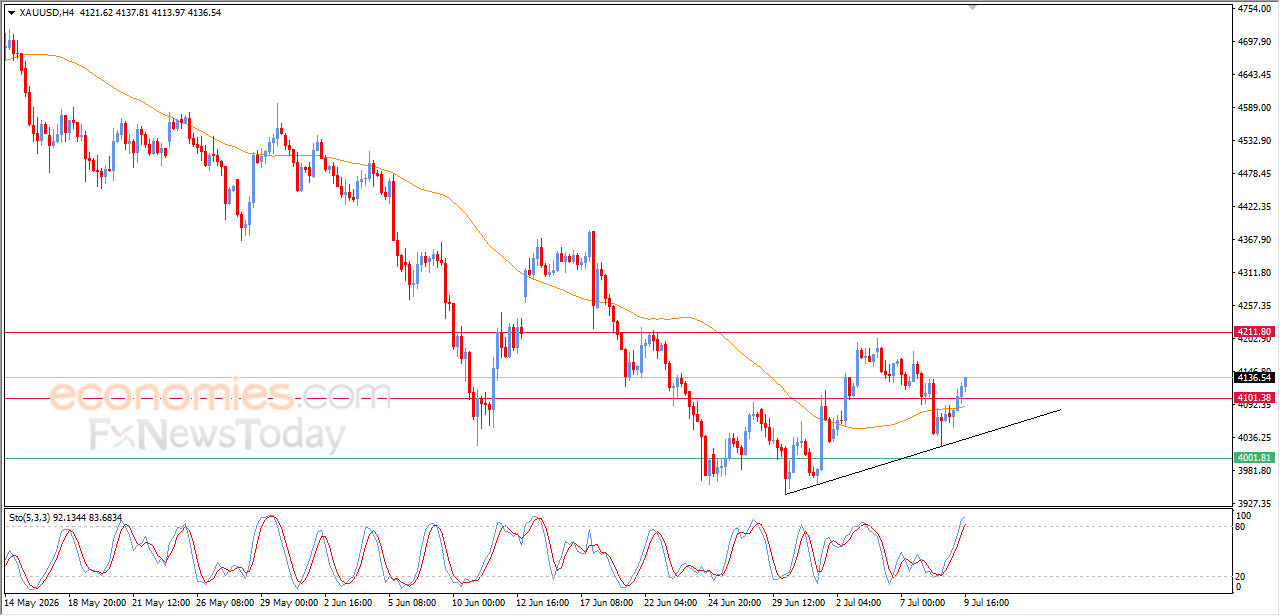
- Upper Resistance: $4,170 – $4,220 – $4,300/oz
- Intermediate Resistance: $4,100/oz (recent breakout point)
- Key Support: $4,050 – $4,000 – $3,940/oz
Technical Outlook:
The technical outlook for gold remains bearish in the medium term, with a short-term upward correction currently in progress. The price is still trading below the EMA50 moving average, which acts as a dynamic resistance level and reinforces the short-term bearish trend.
In a bullish trading scenario, the price could climb from $4,100 toward $4,170, but the $4,000 level is expected to be the critical threshold for determining the short-term trend.
Macro Context
1. Dollar Strength and Interest Rate Policy
The shift toward a hawkish U.S. interest rate policy is strengthening the dollar, which is exerting direct downward pressure on gold prices. Since gold is a dollar-denominated asset, a strong dollar suppresses demand for the metal.
2. Central Bank De-dollarization Strategy
According to a survey by the Official Monetary and Financial Institutions Forum (OMFIF), central banks are expected to continue shifting dollars into gold and other currencies over the coming years. This suggests that the role of gold in the global monetary system will continue to grow.
3. Continued Gold Buying by the People’s Bank of China
The People’s Bank of China (PBOC) has been buying gold for 20 consecutive months, with the pace of accumulation accelerating in 2026. This strategic gold stockpiling continues despite falling prices, reflecting a sovereign reserve strategy.
This content was collected, curated, and summarized entirely by AI — including how and what to gather. It may contain inaccuracies. Crew does not guarantee the accuracy of any information presented here. Always verify facts on your own before acting on them. Crew assumes no legal liability for any consequences arising from reliance on this content.
Powered by
