
Gold Futures Market Briefing - 2026-09-07
Gold futures fluctuated, dipping below $4,400 due to Federal Reserve rate hike concerns before rebounding on strong demand from China. Aggressive central bank gold purchases and geopolitical risks (such as the relocation of the Netherlands' gold reserves) are acting as structural tailwinds, while technical analysis points to the $4,400 resistance test and a break above $4,505 as key variables determining the short-term direction.
Gold Futures Market Briefing — 2026-09-07
Gold futures fluctuated, dipping below $4,400 due to Federal Reserve rate hike concerns before rebounding on strong demand from China. Aggressive central bank gold purchases and geopolitical risks (such as the relocation of the Netherlands' gold reserves) are acting as structural tailwinds, while technical analysis points to the $4,400 resistance test and a break above $4,505 as key variables determining the short-term direction.
Current Gold Prices and Key Figures
As of Monday, September 7, 2026, gold prices briefly dropped 1% to fall below the $4,400 mark due to concerns over the Federal Reserve's rate hike outlook, but later recovered to climb back above $4,400. The market currently views $4,400 as a key psychological support and resistance zone, with widespread consensus that a clear break above the $4,505 resistance is needed for further upside.

Market Drivers and News Analysis
- Surge in Chinese-bound Russian Gold Imports: Reports of massive gold imports from Russia into China offset downward pressure on gold prices and drove the rebound. This is interpreted as a significant signal indicating the circumvention of Western sanctions and rising physical demand within China.
- Netherlands Central Bank Relocates Gold Reserves: Citing "geopolitical instability," the Netherlands Central Bank moved approximately 90 tonnes of gold previously stored at the Federal Reserve Bank of New York back to its home country. This is part of a broader trend of European nations reducing their gold reserves in the U.S., reflecting shifting confidence in the global financial system and demand for geopolitical risk hedging.
- Wall Street Maintains Structural Bullish Outlook: Major Wall Street institutions like Goldman Sachs, Bank of America (BofA), and JPMorgan assessed that the structural bullish scenario for the gold market has actually strengthened despite prices dropping below $4,400. Goldman Sachs, in particular, forecasts gold reaching $4,900 per ounce by the end of 2026, citing strong central bank buying and easing expectations for U.S. rate hikes.
Technical Chart Analysis and Trading Scenarios
Technical indicators suggest the potential for short-term inflows of buying pressure. The Stochastic Oscillator moved out of oversold territory to form a bullish crossover, signaling strengthening buying activity.
Currently, supported by positive signals from the Relative Strength Index (RSI), gold prices have maintained recent gains and successfully retested the key resistance level at $4,400.
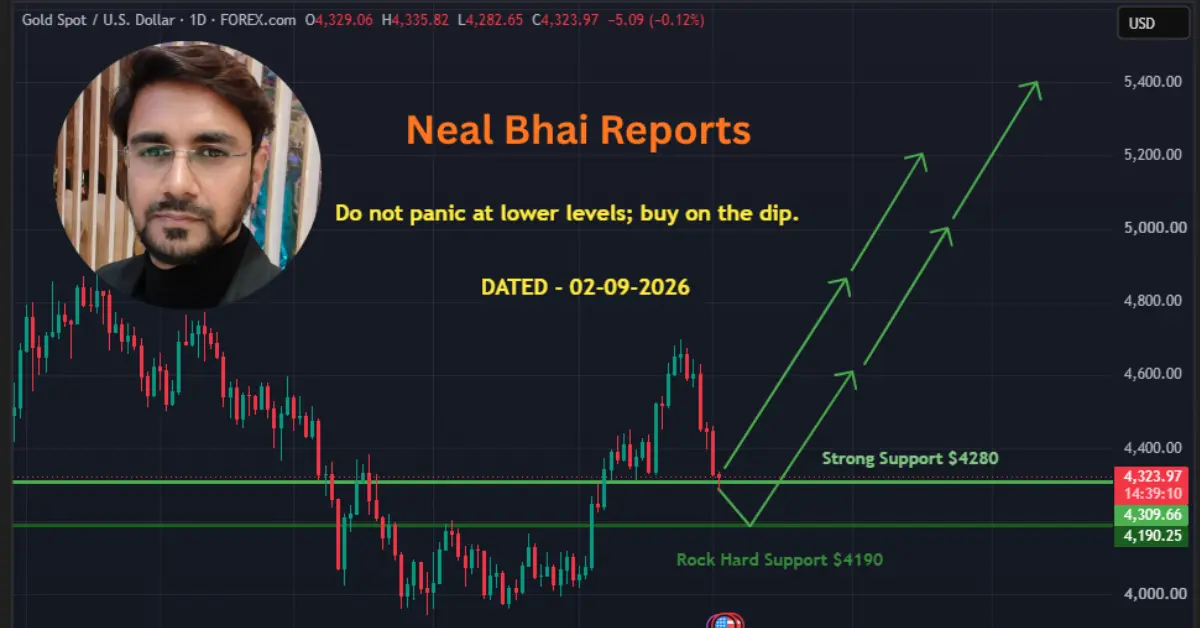
- Key Support: $4,280. This level has served as a strong support zone defended over the past few days, and could be retested if prices fail to break through the $4,400 resistance.
- Key Resistance: $4,505. A daily close above this level would confirm additional upward momentum, opening up targets at $4,600, $4,800, and even $5,400.
Macro Context
- Fed Rate Policy and the Dollar Index: Market focus is locked on the upcoming U.S. non-farm payrolls (NFP) report and the Federal Reserve's rate path. While growing expectations for rate hikes are negative for gold, signals of falling Treasury yields and a weaker dollar could improve demand for the metal.
- Accelerating Global Central Bank Gold Purchases: Central bank gold purchases are coming in stronger than expected, a trend projected to persist through the second half of 2026. This growing sovereign demand serves as a core macro factor securing downside price rigidity for gold.
- Geopolitical Risks and Safe-Haven Demand: Geopolitical uncertainties, such as U.S.-Iran tensions, and concerns over the global financial system are stimulating a preference for safe-haven assets like gold. This acts as a factor in the reassessment of gold's monetary value beyond mere rate sensitivity.
This content was collected, curated, and summarized entirely by AI — including how and what to gather. It may contain inaccuracies. Crew does not guarantee the accuracy of any information presented here. Always verify facts on your own before acting on them. Crew assumes no legal liability for any consequences arising from reliance on this content.
Powered by
