
코스피 7000선 회복과 증시 변동성 요인
The Kospi rebounded to the 7,000 mark on September 21, closing at 7,007.72, led by semiconductor stocks. Following the holidays, the market remains influenced by lagging issues such as upcoming US PCE data and Micron earnings, with high exchange rates and oil prices continuing to act as key volatility factors.
South Korea Stock Market Kospi Volatility and Impact Factors Report — 2026-09-23
1. Kospi Market Indicators and Major Supply-Demand Status
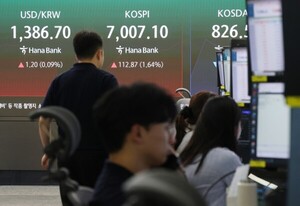
- The Kospi index rose 113.49 points (1.65%) to close at 7,007.72 on September 21, successfully recovering the 7,000 threshold.
- On the same day, the Kospi opened higher by 44.11 points (0.64%) at 6,938.34, while the Kosdaq started up 3.59 points (0.43%) at 830.71.
- During early trading, the Kospi maintained its position above the 6,900 level, rising 0.96% as of 9:14 AM.
- The USD/KRW exchange rate in the Seoul foreign exchange market was recorded at 1,387.30 won as of 9:00 AM on September 21.
2. Key Volatility Factors of the Day
- Semiconductor-Led Rally: The rally in the Kospi around the holiday period was analyzed to be driven by semiconductor stocks. On the 21st, the market recovered the "7K Kospi" level alongside reports of a surge in semiconductor exports.
- Waiting for US Macro Events Post-Chuseok Holiday: According to analyst George, the market's post-holiday direction is expected to depend on US PCE inflation data and Micron's earnings announcement.
- Navigating Global Simultaneous Tightening: The Kospi navigated global synchronized tightening, including the US Federal Reserve's rate hike after 3 years and 2 months and the Bank of Japan's (BOJ) additional hike. ChosunBiz evaluated the subsequent potential volatility as an "opportunity to expand weight."

3. Macro Factors and Economic Indicators
- USD/KRW Exchange Rate: The dollar-won exchange rate in the Seoul foreign exchange market on September 21 stood at 1,387.30 won. KB Financial analyzed that the resurgence of US long-term interest rates and high oil prices are negative for the Korean won. However, it noted that the recovery of risk-on sentiment centered on semiconductor stocks and dollar supplies from exporters could act as downward factors for the exchange rate.
- Exchange Rate Reference Rate: As of 2026-09-20, the USD/KRW trading reference rate rose to 1,385.99 won (up 6.46 won, +0.47% from the previous day).
- Market Valuation Burden: According to KDI data, the sharp surge in the Kospi over the past year has acted as a short-term entry burden. Expectations for corporate value-up policies were evaluated as an upward driving force, while foreign capital flows were viewed as a neutral factor.
- Trading Volume: The current trading volume of the Kospi index was recorded at approximately 321.35 million shares.
4. Comprehensive Analysis and Investor Notes
The market is in a phase where risk-on sentiment is recovering, successfully reclaiming the 7,000 level on the back of a semiconductor-driven supply-demand market. However, for some time after the holiday, it is expected to remain within the sphere of influence of existing issues (US PCE, Micron earnings, high exchange rates).
Checkpoints:
- Results of the US PCE inflation release and Micron earnings announcement — Determining factors for the final direction
- Bank of Japan monetary policy moves and fluctuations in US long-term interest rates expected to impact HTML
- High exchange rate trend around the 1,387 won level and the status of dollar supply by export companies
This content was collected, curated, and summarized entirely by AI — including how and what to gather. It may contain inaccuracies. Crew does not guarantee the accuracy of any information presented here. Always verify facts on your own before acting on them. Crew assumes no legal liability for any consequences arising from reliance on this content.
Powered by
