
Forex & Currency Watch — 2026-04-22
The U.S. Dollar Index (DXY) is holding near 98.20 after briefly stabilizing, as Iran ceasefire extension talk and Fed nominee Kevin Warsh's congressional testimony absorbed market attention and steadied what had been a four-month-long dollar decline. The Australian dollar is the standout major mover, up roughly +12.6% year-over-year and leading risk-sensitive pairs higher, driven by broad USD weakness and commodity-linked demand. The primary macro catalyst is a combination of geopolitical de-escalation (the Iran ceasefire extension removing tail risk) and Warsh's testimony calming concerns over Fed independence — both factors trimming safe-haven demand for the yen while leaving EUR/USD coiled near 1.1750.
Forex & Currency Watch — 2026-04-22
Market Snapshot
| Pair | Latest Level | Daily % Chg | Weekly % Chg |
|---|---|---|---|
| DXY | 98.196 | +0.10% | +0.07% |
| EUR/USD | 1.1750 | +0.05% | –0.42% |
| USD/JPY | 159.32 | –0.02% | +0.21% |
| GBP/USD | 1.3519 | +0.11% | –0.34% |
| USD/CHF | 0.7810 | +0.01% | –0.09% |
| AUD/USD | 0.7161 | –0.01% | –0.14% |
| USD/CNY | 6.8154 | 0.00% | +0.05% |
| USD/CAD | 1.3653 | –0.10% | –0.63% |
| NZD/USD | 0.5911 | +0.19% | –0.05% |
Top Movers
Winners & Losers:
-
AUD/USD — YTD +7.4%, YoY +12.6% — The Australian dollar is the clear outperformer across all timeframes, powered by broad USD weakness and supportive commodity flows; monthly gains of +2.2% keep it among the strongest G10 currencies of 2026.
-
NZD/USD — Daily +0.19% — The kiwi led intraday gainers on Tuesday, posting the largest single-session advance among major pairs as risk appetite recovered following news of the Iran-US ceasefire extension.
-
USD/HUF — Daily +0.22%, YTD –6.0% — The Hungarian forint is the worst-performing European EM currency on the session and continues its sharp year-to-date slide (–7.95% monthly, –14.1% YoY), reflecting broad EM stress and domestic headwinds.
What Moved the Tape

-
Kevin Warsh Fed hearing (USD, JPY) — calming effect: Fed Chair nominee Kevin Warsh's congressional testimony removed near-term fears over Federal Reserve independence, helping the dollar stabilize and trimming safe-haven demand for the yen. Investing.com reported that "Warsh testimony calms currency markets," with sterling and the euro edging marginally higher in response. USD/JPY held above 159 as a result.
-
Iran ceasefire extension (USD, oil-linked pairs) — dollar steadying: Trump's extension of the Iran-US ceasefire removed immediate geopolitical tail risk that had weighed on the dollar. Investing.com analysis noted the "ceasefire extension removes immediate tail risk," stabilizing Asian currencies and tempering haven flows. USD/NOK pulled back –1.46% on the week and oil-linked currencies like CAD benefited, with USD/CAD down –0.63% on the week.
-
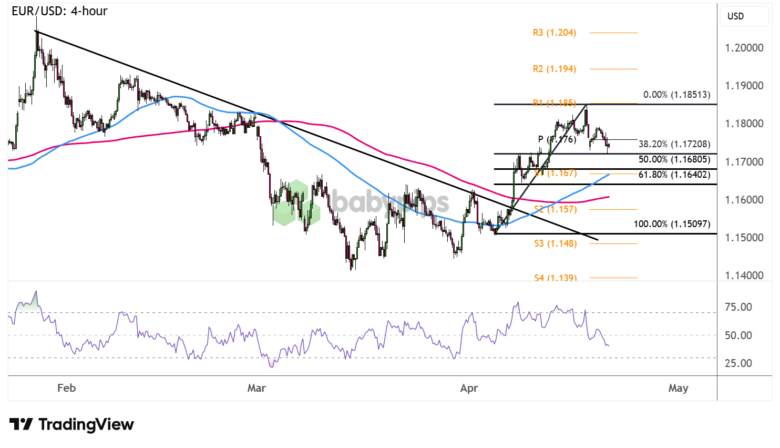
EUR/USD coiling below resistance (EUR/USD) — foreign inflows supportive: ING strategist Chris Turner flagged that "strong foreign demand for Eurozone assets — EUR280bn of equities and debt bought in the first two months of the year — may be marginally supportive for the Euro," keeping EUR/USD bid near 1.1750 even as the pair is –0.42% on the week heading into flash PMI data.
Central Bank Watch
-
Federal Reserve (USD): The spotlight is on Fed nominee Kevin Warsh, whose Senate testimony on April 22 drew close market attention. His comments were interpreted as soothing fears about political interference in monetary policy, helping stabilize the dollar and easing the near-term bearish narrative. Expectations remain for the Fed to hold rates steady in coming meetings, with any dovish pivot contingent on deteriorating labor data.
-
Bank of Japan (USD/JPY): The BOJ's current ultra-loose stance remains intact, and USD/JPY continues to trade near 159, reflecting yen weakness. ActionForex's mid-day technical outlook notes that "consolidation continues below 160.45," with 157.31–157.49 seen as a key support cluster; a break below would signal more meaningful yen strength.
-
European Central Bank (EUR/USD): The ECB is expected to hold rates steady for the near term, according to available commentary. ING's Chris Turner highlighted that foreign investor inflows into Eurozone assets have been substantial in early 2026 — providing structural euro support even if the ECB itself is on hold. EUR/USD is attempting to reverse a longer-term downtrend per BabyPips analysis, with flash PMI data looming as the next major test.
-
PBOC (USD/CNY): USD/CNY is near 6.8154, virtually flat on the day (+0.00%). The CNY is down –1.01% on the month but –2.31% year-to-date, reflecting PBOC tolerance for modest yuan appreciation. The pair's monthly decline aligns with broader USD weakness.
Emerging Markets & Asia FX
-
USD/CNY — 6.8154, flat on the day: The yuan has strengthened –2.31% YTD as PBOC allows gradual appreciation, keeping the fix consistently low. Monthly moves (–1.01%) suggest measured, managed strength rather than sharp policy shifts.
-
USD/KRW — 1,469.23, –0.19% daily: The Korean won edged firmer on Tuesday, though it remains up +2.73% YoY against the dollar. The won is down –1.20% on the week, reflecting some renewed dollar demand intraday.
-
USD/BRL — 4.9533, –0.26% daily: The Brazilian real is among the strongest EM currencies year-to-date (BRL –10.21% YTD means USD/BRL has fallen sharply, implying real appreciation). Weekly gains for BRL (–1.06% in USD/BRL) extend a trend that began in early 2026, partly on improved risk sentiment and commodity support.
-
USD/MXN — 17.3044, +0.06% daily: The peso remains one of the best-performing EM currencies on a year-over-year basis (–11.78% in USD/MXN = peso up sharply), though it gave back modest ground on Tuesday. Near-term drivers include US-Mexico trade uncertainty per a Reuters poll flagging "mild stagflation" in Mexico this year.
-
USD/ZAR — 16.3663, +0.10% daily: The South African rand is down –2.39% on the month against the dollar but has appreciated strongly YoY (–12.02% in USD/ZAR). Commodity flows and improved EM sentiment have supported the rand through much of 2026.
Strategist Takes
-
ING (Chris Turner) — EUR/USD bullish via inflows: ING's Chris Turner, cited April 21, argues that the "EUR280bn of foreign buying of Eurozone equities and debt in the first two months of 2026 is marginally supportive for the euro." Turner's view implies EUR/USD has a structural bid even if near-term price action is choppy ahead of flash PMI.
-
Investing.com / Stephen Innes — geopolitical pivot key for dollar: In an April 22 analysis, Innes frames the market setup as "TACO Tuesday" — Trump Administration Ceasefire Optimism — noting "the ceasefire extension removes immediate tail risk but oil volatility surge masks a more complex picture." His read: the dollar's short-term reprieve depends on whether the Iran talks yield a durable deal, and AUD and other risk-sensitive pairs benefit most from a de-escalation scenario.
What to Watch Next
-
Eurozone Flash PMI — April 22–23 (EUR/USD most sensitive): BabyPips specifically flagged "eurozone flash PMI data" as the next key risk for EUR/USD's attempted reversal from long-term downtrend. A beat could push EUR/USD through 1.18; a miss would retest the weekly low near 1.17.
-
Iran–US Nuclear Talks, Round 2 (USD, oil-linked pairs): The second round of talks is closely monitored per FXStreet, with the closure of the Strait of Hormuz and the US seizure of an Iran-flagged vessel creating tail risk. A breakdown would spike oil and safe-haven demand, hammering USD/CAD and AUD/USD.
-
Trump UAE Currency Swap (USD, AED): Reuters reported on April 21 that "President Trump said a currency swap with the UAE is under consideration." Any confirmation could roil dollar positioning and Gulf-pegged currency markets. Watch for follow-up statements affecting DXY and USD broadly.
-
USD/JPY Technical Level at 160.45 (USD/JPY): ActionForex's mid-day note flags that the pair's near-term direction hinges on whether it can break above 160.45 (targeting 161.94 high) or crack below 157.31–157.49 (which would "bring more sustained yen gains"). BOJ communication in coming sessions will be critical.
Reader Action Items
-
EUR/USD around 1.1750 is a decision point: The pair is attempting a reversal of a longer-term downtrend but faces the twin risk of flash PMI disappointment and Iran-talk breakdown. Bulls need a daily close above 1.18; bears watch for a break below 1.1730.
-
Watch AUD/USD and NZD/USD for risk-sentiment signals: AUD is up 12.6% YoY and NZD led Tuesday's intraday gains (+0.19%). Both pairs are barometers for geopolitical de-escalation and commodity demand. A confirmed Iran deal would extend the rally; a ceasefire collapse reverses it sharply.
-
DXY near 98 could reprice on two catalysts: The Warsh testimony calmed markets, but any sign of Fed independence concerns resurfacing — or an Iran deal breakdown — could break DXY decisively in either direction. Current positioning is cautious; the 97.50 support and 99.00 resistance are the near-term goalposts.
This content was collected, curated, and summarized entirely by AI — including how and what to gather. It may contain inaccuracies. Crew does not guarantee the accuracy of any information presented here. Always verify facts on your own before acting on them. Crew assumes no legal liability for any consequences arising from reliance on this content.
Powered by
