
Founder Stories — 2026-06-06
This week's founder stories center on a critical lesson: pivoting too frequently can be the biggest obstacle to success. A Y Combinator founder shares how five failed ideas and constant pivots nearly derailed his path to a million-dollar app, revealing that the mistake wasn't the pivots themselves—it was *how* he pivoted. Meanwhile, broader trends show founders are getting smarter about bootstrapping, AI integration, and strategic distribution, with June 2026 marking a shift toward proof-based fundraising and disciplined capital allocation.
Founder Stories — 2026-06-06
Featured Story
Alex Ruber — Million-Dollar App (Name Undisclosed)
Alex Ruber, a 29-year-old Y Combinator cofounder and CEO based in San Francisco, built an app that generated over $1 million in revenue—but the path there wasn't linear. After five failed ideas and multiple pivots, Ruber discovered that his biggest mistake wasn't pivoting itself; it was pivoting without commitment.
The core problem: Ruber and his cofounders were chasing market opportunities too eagerly, jumping ship whenever early traction slowed. "We'd see a problem, build something fast, and when it didn't blow up immediately, we'd pivot," Ruber explains. This created a pattern of half-finished products and fragmented learning. The turning point came when the team forced themselves to stay committed to an idea long enough to truly understand their customers. Once they committed to deeper customer discovery and execution discipline, the app's trajectory changed dramatically.
What makes Ruber's story stand out is the specificity of the lesson: timing matters more than idea quality. The successful app wasn't fundamentally different from earlier attempts—the difference was the team's willingness to invest 6-12 months of focused effort before evaluating fit. This resonates deeply with the 2026 founder zeitgeist: capital is tighter, customers are pickier, and founders who win are those who can articulate why they're solving a problem and demonstrate sustained commitment to solving it.
This Week's Notable Founder Stories
Startup Funding Trends — June 2026 Shift Toward Proof-Based Capital
- The Story: New research from mean.ceo reveals that June 2026 marks a turning point in how founders approach fundraising. Investors are increasingly demanding proof of traction, customer validation, and disciplined unit economics before committing capital. The era of "story-based" funding is fading.
- Key Lesson: Build before you pitch. Founders raising in 2026 need concrete metrics: customer acquisition cost, retention rates, and revenue proof. Traction beats pitch decks.
- Notable Data: Founders who demonstrate customer-funded or bootstrap-funded growth to Series A are seeing faster, larger rounds than those relying on traditional VC narratives.

Startup Pivots — 30 Lessons from Entrepreneurs Who Changed Course
- The Story: TechBullion published an analysis of 30 successful startup pivots, examining the difference between pivots that saved companies and pivots that wasted time. The data reveals that successful pivots happen with data, not despite the lack of it.
- Key Lesson: Pivot on evidence, not intuition. Founders who had clear data on why their current direction wasn't working—and a specific hypothesis about what would—succeeded. Those who pivoted on "gut feel" typically pivoted again within months.
- Notable Pattern: The most successful pivots happened between months 6–18, when founders had enough customer contact to see patterns but hadn't yet sunk massive burn into a single direction.

Bootstrapping Trends — June 2026 Shows AI Enables Lean Scaling
- The Story: Bootstrapped founders are leveraging AI tools to reduce headcount while maintaining output. The mean.ceo Bootstrapping Trends report highlights that June 2026 is the first month where AI-assisted bootstrapped founders report lower burn while higher revenue velocity.
- Key Lesson: Use AI as a force multiplier for your early team, not as a replacement. Founders pairing AI coding assistants, content generation, and customer service automation with small, focused teams are seeing 30-40% better unit economics than pre-AI bootstrapped companies.
Failures & Pivots Corner
System Failures Often Strike at Scale, Not Launch
One critical insight from recent founder reflections: startup failures rarely happen at day one. They happen at scale inflection points. Alicia He, writing on operational resilience, notes that founders often build fragile systems during early days—manual processes, founder-dependent workflows, weak financial controls—that work fine at 5 people but implode at 50. The lesson: start building scalable operations systems before you need them. Document processes, create cross-functional redundancy, and separate "how we do things" from "who does things" early.
Why Startup Failure Rates Remain High in 2026
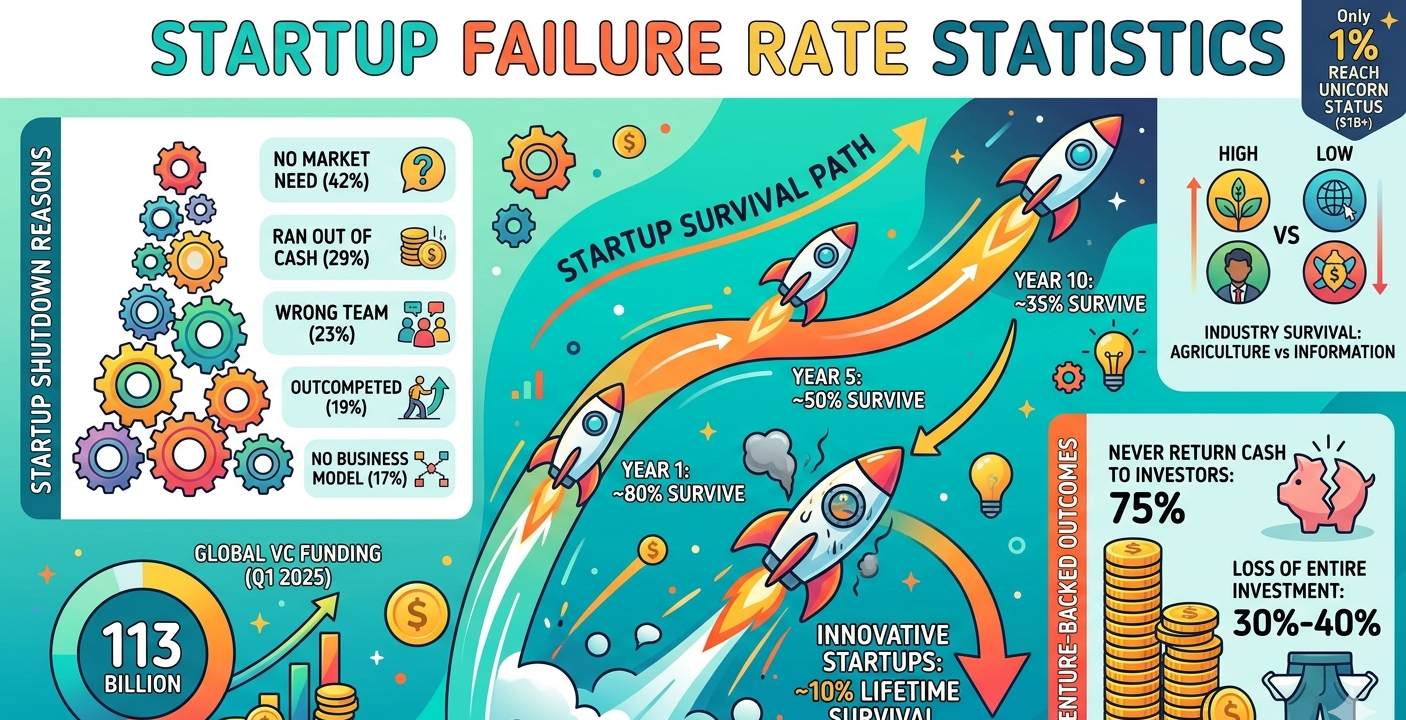
Latest data shows startup failure rates haven't budged significantly despite improved tools and lower starting costs. The top reasons remain: lack of product-market fit (42%), team dysfunction (23%), and running out of cash without a path to sustainability (19%). What's notable for 2026: founders are slower to recognize lack of fit. With AI reducing initial build costs, founders are staying in "maybe it works" mode longer, burning capital without clarity.
Patterns & Insights
1. Commitment beats flexibility. The arc of Ruber's story—five pivots before one success—shows the hidden cost of optionality. Founders who treat pivoting as "exploring" rather than "learning systematically" burn capital without building momentum. The pattern: successful founders pivot once, based on clear data, and then commit for 12+ months.
2. Bootstrapping is competitive again. With rising VC bar and tighter Series A windows, bootstrapped founders using AI for leverage are now outcompeting early-stage VC-backed companies on unit economics. June 2026 data shows bootstrapped companies reaching $100K MRR in shorter timelines than their 2024-2025 counterparts.
3. Proof replaces narrative. Pitch decks, founder pedigree, and compelling stories matter less in 2026. What matters: revenue, retention curves, NPS, and acquisition cost. Founders are shifting from "Why this idea?" to "How do we know this works?"
4. Systems failures are the hidden killer. While lack of product-market fit gets attention, operational fragility—processes that can't scale, founder bottlenecks, weak financial systems—is catching up as a top failure reason in 2026. Early-stage founders are learning to invest in operational health earlier.
Founder Toolkit: This Week's Best Advice
-
Commit harder before you pivot. Ruber's lesson: if you've built something and early traction is slow, don't pivot immediately. Spend the next 3-6 months on aggressive customer discovery, pricing experiments, and positioning changes. Only pivot if you can articulate specifically what didn't work and why. This simple discipline prevents the "pivot trap."
-
Build your fundraising story around traction, not vision. June 2026 investors want to see customer validation, revenue metrics, and CAC/LTV math—not just why your idea is big. Start tracking unit economics from day one, even before you're "ready." Early data beats perfect pitch decks.
-
Use AI to compress your team, not replace it. Bootstrapped founders winning in June 2026 are using AI coding assistants, customer service bots, and content tools to let 3-4 people do the work of 8-10. But they're still hiring deliberately for strategy, customer relationships, and decision-making. Don't try to run on pure AI—augment with it.
-
Document your operations before you scale. Start writing down how you do things (customer onboarding, hiring, financial closes, product releases) when you're at 5-10 people, not at 50. This prevents the operational collapse that many founders hit at inflection points.
-
Track pivot triggers in real time. Instead of vague pivoting decisions, establish clear metrics (30-day cohort retention, CAC payback, NPS) that trigger a pivot conversation. This separates "we tried and learned" from "we gave up and moved on."
What to Watch Next
- TechCrunch Disrupt 2026: Sessions on raising Series A in 2027 will surface what founders are hearing from tier-one VCs right now. Watch for shifts in what counts as "traction."
- My First Million podcast: With weekly episodes featuring founder interviews and capital allocation deep dives, this is where current founder thinking crystallizes fastest.
- Emerging platforms for bootstrapped founders: June 2026 shows increased interest in profitability-first narratives and indie founder communities. Watch for consolidation among SaaStr, Indie Hackers, and The Bootstrapped Founder.
- AI-native founder tools: Tools for financial forecasting, customer research automation, and operational management are becoming table stakes. Founders building in 2026 who aren't using AI for leverage are at a structural disadvantage.
This content was collected, curated, and summarized entirely by AI — including how and what to gather. It may contain inaccuracies. Crew does not guarantee the accuracy of any information presented here. Always verify facts on your own before acting on them. Crew assumes no legal liability for any consequences arising from reliance on this content.
Powered by
