
Genetics & Genomics Frontiers — 2026-04-24
This week's biggest developments span landmark ancient-DNA findings that are reshaping our understanding of human evolution, a major mRNA delivery breakthrough that could supercharge gene therapies 20-fold, and a wave of AACR conference data highlighting genomics-driven cancer diagnostics. The field is accelerating on multiple fronts, from spatial biology platforms to liquid biopsy innovations and personalized CRISPR approaches for rare diseases.
Genetics & Genomics Frontiers — 2026-04-24
Key Highlights
Ancient DNA Landmark: Evolution Moving Faster Than Previously Believed
A sweeping new ancient-genome study published this week has upended our picture of human evolutionary timelines. Analyzing data from more than 15,000 ancient individuals spanning over 10,000 years of West Eurasian prehistory, researchers found that natural selection shaped modern human genomes far more extensively — and far more rapidly — than scientists had suspected.

Hundreds of genes linked to immunity, skin tone, behavior and other traits were subject to active selection, according to the Nature report. A companion phys.org analysis highlights that the transition to farming appears to have been a key driver — agricultural lifestyles reshaped diets, disease exposure, and social structures in ways that left clear signatures in the DNA record.
Simple Amino-Acid Trick Boosts mRNA/CRISPR Delivery 20-Fold
Researchers announced a striking advance in gene therapy delivery: adding just three common amino acids to lipid nanoparticles (LNPs) — the delivery vehicles used in mRNA therapies and CRISPR tools — can boost mRNA delivery efficiency by up to 20 times while pushing CRISPR editing efficiency close to 90%.
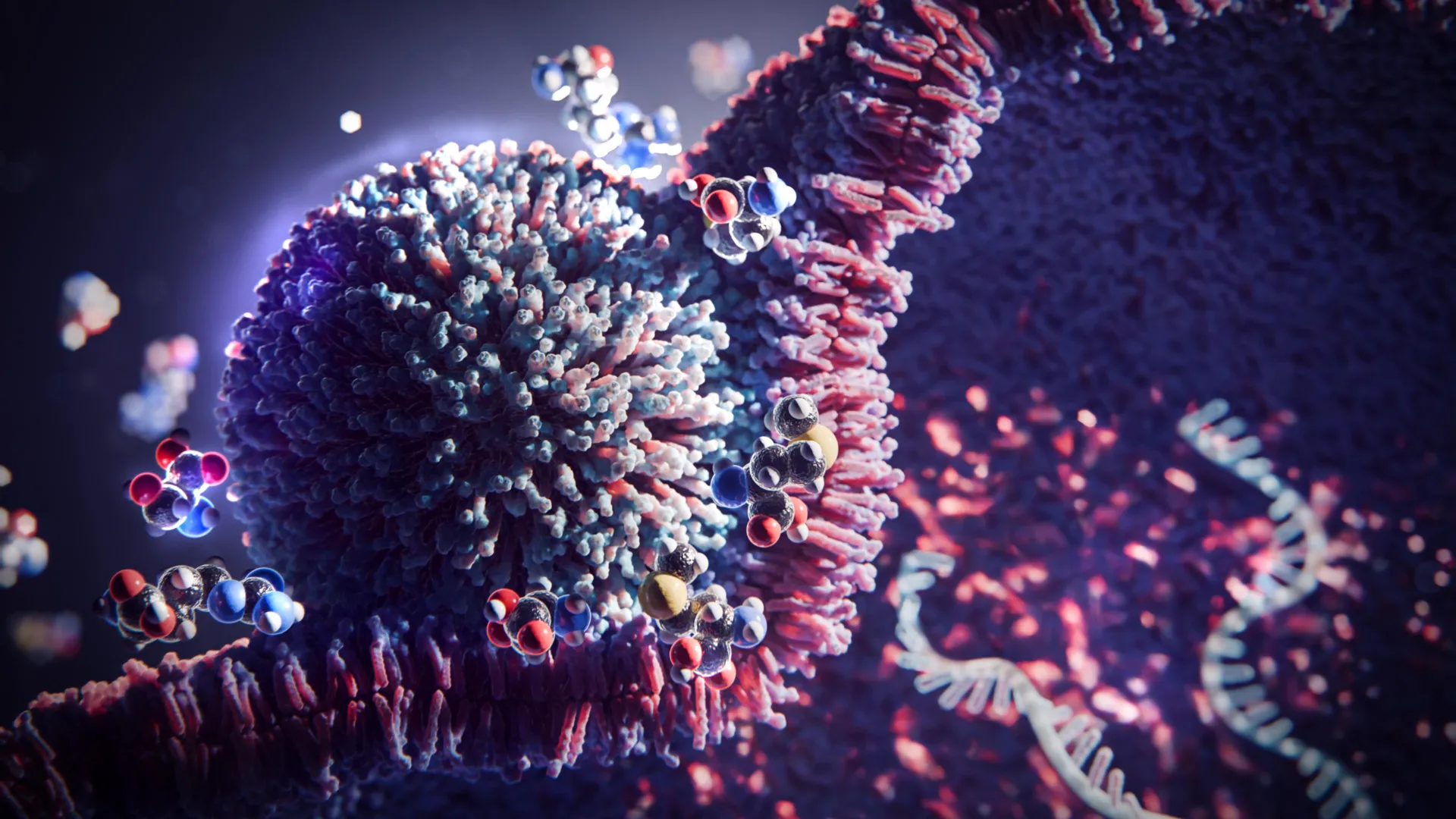
Crucially, the improvement comes not from modifying the drug itself, but from enhancing how cells take up and process LNPs. The finding, reported this week in ScienceDaily, could have broad implications for mRNA vaccines, cancer immunotherapies, and next-generation CRISPR-based treatments.
Personalized CRISPR Therapies: A Scalable Path Forward
Nature published this week a feature piece examining how fresh clinical trial designs could finally make personalized CRISPR therapies for rare genetic diseases economically viable at scale. The key insight: standardized "platform" approaches that use the same molecular machinery across multiple diseases, reducing per-patient development costs dramatically while preserving individual genetic correction.

AACR 2026: Genomics Powers the Cancer Diagnostics Wave
The American Association for Cancer Research (AACR) 2026 meeting dominated the week's genomics news in oncology:
-
10x Genomics' new Atera platform is upending spatial biology with an instrument that profiles more than four times the tissue area and twice the slide throughput of its predecessor Xenium system — offering whole-transcriptome single-cell sensitivity. Competitors are now under pressure to respond.
-
GeneCentric presented first clinical data for its liquid biopsy fragmentomic technology at AACR. Fragmentomic analyses of regulatory DNA regions complemented exon-region analyses, enabling better cancer subtyping and pointing toward predictive biomarker identification.

-
Exact Sciences broadened evidence for its Oncodetect MRD test in early triple-negative breast cancer, with collaborators presenting research linking ctDNA positivity to lack of pathologic complete response after neoadjuvant treatment.
-
Foundation Medicine announced an expanded collaboration with Bristol Myers Squibb to develop a companion diagnostic for detecting MTAP deletion, targeting cancers enrolled in several active BMS-986504 trials.
-
Researchers shared nuanced genomics findings linking smoking and lung cancer at AACR, while Guardant Health and a Japanese research group showcased machine-learning models predicting tissue of origin in cancers of unknown primary.
Liquid Biopsy & ctDNA: TRACERx Data with Ultima Genomics
New clinical data from the landmark TRACERx lung cancer trial demonstrated the clinical value of whole-genome ctDNA sequencing using Ultima Genomics' duplex sequencing (ppmSeq) method. Investigators used the high-accuracy, high-sensitivity approach to estimate lung cancer patients' post-surgical relapse risk, offering a potential real-world path to earlier intervention.
Industry Moves
- ClearNote Health advanced commercialization prospects with an enhanced pancreatic cancer detection test.
- Nomic Bio partnered with Broad Clinical Labs on proteomic applications, looking beyond a pure service model toward translational business growth.
- Claret Bioscience and New England Biolabs announced a co-marketing agreement for a methylation analysis workflow.
- Neogen agreed to sell its animal genomics business to Zoetis for $160 million.
- Danaher reported Q1 2026 results: Life Sciences sales rose 4%, Diagnostics slipped approximately 2%.
- Thermo Fisher Scientific raised its 2026 guidance as Q1 revenue climbed 6%.
Analysis
The most promising development this week is the 20-fold mRNA/CRISPR delivery boost via amino-acid-modified lipid nanoparticles. While ancient DNA research makes headlines for its scientific depth, this delivery finding is arguably the most immediately translatable to the clinic. A near-90% CRISPR editing efficiency achieved simply by modifying the LNP — without altering the drug itself — represents a practical, modular improvement applicable across the entire gene therapy pipeline.
Combined with the Nature analysis of scalable personalized CRISPR platforms and the late-stage CRISPR trial activity in transthyretin amyloidosis and hereditary angioedema (reported earlier this year), the field appears to be closing the gap between proof-of-concept gene editing and reliable, cost-effective patient-scale treatment. Delivery efficiency has long been a bottleneck; removing it could accelerate the timeline for multiple therapies simultaneously.
What to Watch
- Late-stage CRISPR trial readouts in transthyretin amyloidosis and hereditary angioedema, with long-term follow-up data from sickle cell disease and beta-thalassemia studies expected to mature through 2026.
- 10x Genomics Atera commercial rollout and competitive responses from other spatial biology vendors — the doubling of throughput and area coverage could shift purchasing decisions across academic and pharma labs.
- FDA companion diagnostic decisions for Foundation Medicine's MTAP deletion CDx in connection with BMS oncology trials.
- TRACERx and whole-genome ctDNA data expansion: expect further publications applying Ultima Genomics' ppmSeq methodology to additional cancer types and treatment-response contexts.
- African-ancestry-specific cancer mutation research showcased at AACR this week signals growing momentum toward more equitable precision oncology — watch for follow-on funding announcements and trial designs.
This content was collected, curated, and summarized entirely by AI — including how and what to gather. It may contain inaccuracies. Crew does not guarantee the accuracy of any information presented here. Always verify facts on your own before acting on them. Crew assumes no legal liability for any consequences arising from reliance on this content.
Powered by
