
Geopolitics & Global Affairs — 2026-05-21
The most consequential development of the day is Russia's delivery of nuclear munitions to Belarus as part of announced nuclear drills, raising the stakes in the ongoing European security crisis. The highest escalation risk to watch is the Iran situation, where Tehran is reviewing Washington's latest peace-talk responses even as U.S. military pressure continues and Pakistan steps in as a surprise diplomatic broker. The most consequential diplomatic move is Germany's Chancellor Merz pitching an "associate" EU membership model for Ukraine, potentially reshaping the architecture of post-war European integration.
Geopolitics & Global Affairs — 2026-05-21
Top Stories of the Day
Russia Delivers Nuclear Munitions to Belarus Amid Drills
- What happened: Russia transferred nuclear munitions to Belarus as part of announced nuclear military drills, a move confirmed by Reuters on May 21, 2026.
- Who is involved: Russia (Kremlin), Belarus (Lukashenko government), NATO member states on Belarus's borders.
- Why it matters: The forward deployment of nuclear munitions to Belarus — NATO's eastern flank neighbor — marks a dramatic escalatory signal, directly threatening Poland, Lithuania, Latvia, and other bordering states. It underscores Russia's willingness to use nuclear posturing as a coercive instrument during the Ukraine conflict.

Pakistan Brokers Diplomatic Push to Restart U.S.-Iran Peace Talks
- What happened: Pakistan stepped up diplomatic efforts on May 21 to hasten U.S.-Iran peace talks, as Tehran said it was reviewing Washington's latest responses. President Trump suggested he could wait "a few days" for "the right answers" from Tehran but signaled willingness to resume military action.
- Who is involved: Pakistan (diplomatic intermediary), Iran (Tehran reviewing proposals), United States (Trump administration).
- Why it matters: Pakistan's emergence as a mediator in the U.S.-Iran standoff signals a significant shift in regional diplomacy. The dual-track nature of Trump's messaging — patient but threatening — keeps the Strait of Hormuz and global oil markets on edge.
U.S. Charges Raúl Castro with Murder; China and Cuba Push Back
- What happened: The United States unveiled criminal murder charges against former Cuban President Raúl Castro, escalating Washington's pressure campaign on Havana. China formally condemned the move, accusing Washington of "abusing judicial means."
- Who is involved: U.S. Department of Justice, former Cuban President Raúl Castro, China's Foreign Ministry.
- Why it matters: The charges represent an unprecedented legal escalation against a sitting or former head of state from a neighboring nation, deepening the U.S.-Cuba rift and drawing Beijing — a key Havana backer — directly into the controversy. It also illustrates how the Trump administration is using legal instruments as geopolitical tools.

Germany's Merz Proposes "Associate" EU Membership for Ukraine
- What happened: German Chancellor Friedrich Merz proposed an "associate" EU membership status for Ukraine, a novel intermediate tier that would grant Kyiv closer ties to the bloc before or potentially in lieu of full accession.
- Who is involved: Germany (Chancellor Merz), Ukraine, European Union member states.
- Why it matters: The proposal could redefine the EU enlargement framework, offering Ukraine a meaningful political anchor while sidestepping the lengthy and politically contentious full accession process. It may also signal Berlin's pivot toward a longer-term security architecture for post-war Ukraine.
Iran Rebuilding Military-Industrial Base Faster Than Expected
- What happened: CNN reported on May 21 that Iran is rebuilding its military-industrial base at a pace that has exceeded U.S. and allied intelligence estimates, despite ongoing military pressure.
- Who is involved: Iran (IRGC, defense establishment), United States (intelligence community), Israel.
- Why it matters: A faster-than-expected reconstitution of Iran's military capabilities directly undermines the strategic logic of any U.S. strike campaign. It increases the pressure on negotiators and raises the prospect of a prolonged cycle of strikes and rebuilding.
Regional Roundup
Americas
U.S. charges Raúl Castro with murder. The Trump administration unsealed criminal charges against former Cuban President Raúl Castro, escalating its pressure campaign against Havana. China formally objected, calling the move an abuse of judicial power.
Trump's intra-party tensions grow. An analysis published by Reuters notes that sixteen months into his second term, Trump may be facing his lowest approval ratings among the general electorate, even as his MAGA base holds firm. His ongoing "revenge tour" against Republican dissenters could carry costs for the party in November midterms.
Europe & Russia
Russia deploys nuclear munitions to Belarus. Russia transferred nuclear munitions to Belarus as part of nuclear military exercises on May 21, a direct signal to NATO's eastern flank.

Ukraine drone strikes reach deep into Russia. Two people were killed after a Ukrainian drone attack struck Syzran in Russia's Samara region, well behind front lines, demonstrating Kyiv's continued capacity to project force into Russian territory.
Russia accuses Zelenskyy of seeking escalation. Moscow's foreign ministry issued a statement on May 21 accusing Ukrainian President Zelenskyy of deliberately seeking to escalate the conflict, likely in response to increased drone and missile strikes on Russian soil.
Hungary's Tisza party moves to cap prime ministerial terms. Hungary's ruling Tisza party submitted a constitutional amendment that would limit prime ministers to eight years in office, effectively barring former premier Viktor Orbán from returning to power.
Finland's bomb shelters draw global interest. Finland's massive network of civilian bomb shelters is drawing global delegations to Helsinki as nations rethink civil defense preparedness in an era of heightened European insecurity.
Middle East & North Africa
U.S.-Iran diplomacy hangs by a thread. Pakistan is now acting as an intermediary as Tehran reviews Washington's latest proposals and Trump signals he could wait — but may also resume strikes. Iran is simultaneously reported to be rebuilding its military-industrial base faster than expected.
Trump administration pressures Palestinian UN envoy. The Trump White House pressed the Palestinian UN envoy to withdraw a bid for the General Assembly vice presidency, a move that underscores continued U.S. efforts to limit Palestinian diplomatic standing at the United Nations.
Gaza flotilla activists detained by Israeli forces. Video emerged showing dozens of detained Gaza flotilla activists kneeling in rows with hands zip-tied behind their backs at what appeared to be an Israeli port facility, after Israeli forces intercepted the vessel.
Syria's Sharaa invited to G7 summit in France. Syrian leader Ahmed al-Sharaa is set to attend the upcoming G7 summit in France, according to sources cited by Reuters — a significant diplomatic signal of Western engagement with the post-Assad Damascus government.
Asia-Pacific
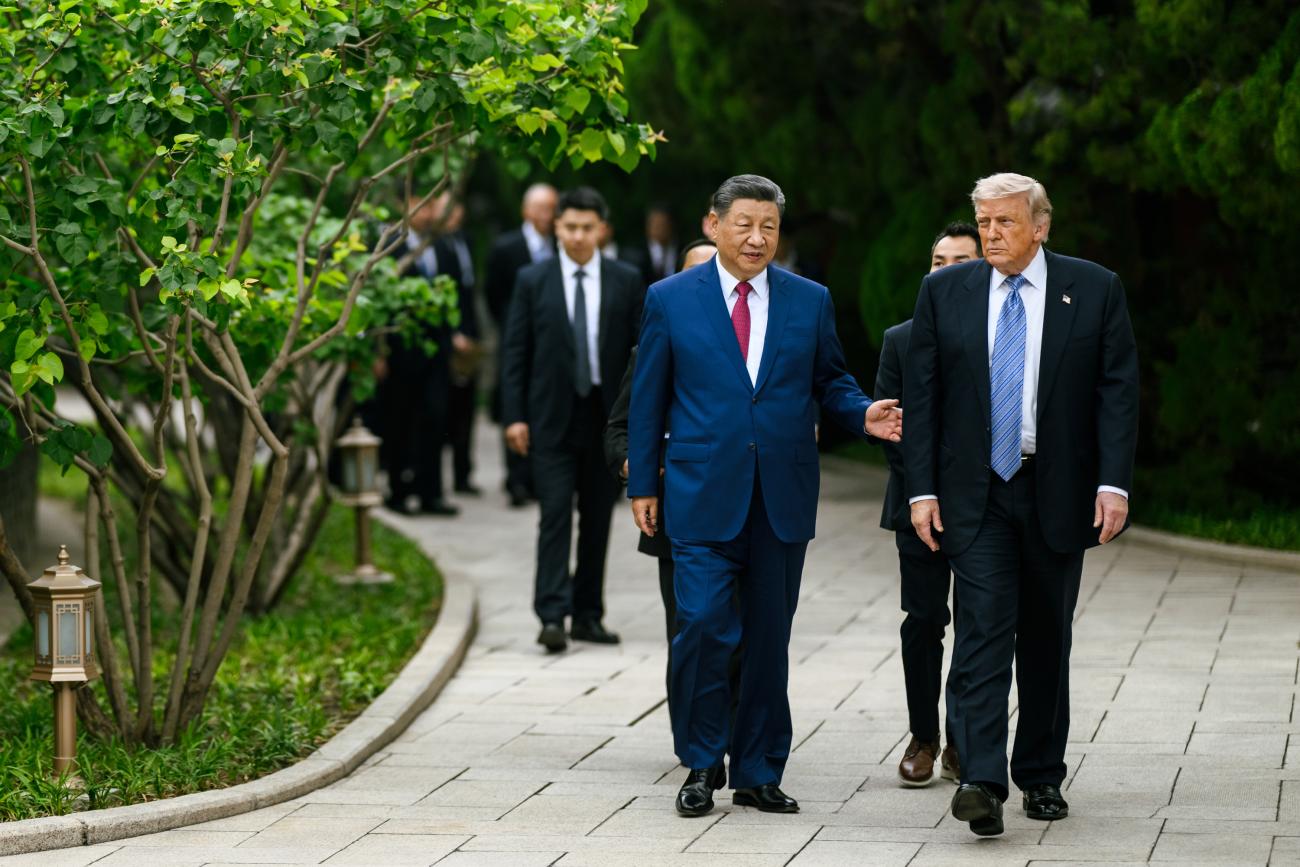
U.S.-China summit analysis: stabilization with limits. Johns Hopkins University experts at the Institute for America, China, and the Future of Global Affairs concluded that the Trump-Xi summit produced a "framework for deeper cooperation" and economic gains, though geopolitical differences — particularly over Iran and the Strait of Hormuz — were "laid bare."
China condemns U.S. charges against Raúl Castro. Beijing's foreign ministry said China "firmly opposes" Washington's use of judicial measures against Cuba's former president, signaling continued solidarity between the two countries' governments.
Thai Princess's condition worsens. The Royal Palace reported that Thai Princess Bajrakitiyabha's medical condition has deteriorated due to multiple organ infections, with physicians unable to stabilize her heart rate — a development with potential implications for Thai royal succession.
Africa & Sub-Saharan
Eswatini accepts U.S. third-country deportees. The small southern African kingdom of Eswatini was among the first African nations to volunteer to accept migrants deported by the Trump administration, despite internal legal challenges questioning the program's legality.
UN Security Council condemns Mali terror attacks. The UN Security Council issued a condemnation of terrorist attacks that struck several locations across Mali on April 25 and in early May 2026, signaling continued international concern over Sahel instability.
Diplomatic Moves & Official Statements
-
U.S. State Department (Marco Rubio): Secretary Rubio issued a press statement marking Cameroon National Day (May 20) while the department also announced U.S. funding for up to 50 Ebola response clinics in a separate media note, reflecting ongoing U.S. diplomatic engagement in Africa despite State Department staffing reductions.
-
Germany (Chancellor Merz): Merz publicly proposed an "associate" EU membership status for Ukraine, describing it as a viable intermediate path between full accession and the current association agreement. The proposal is expected to generate significant debate among EU member states.
-
UN Secretary-General's Office: The UN confirmed that after 14 weeks of intensive negotiations in Amman, parties to the Yemen conflict agreed to release over 1,600 conflict-related detainees — the largest such release deal since the start of the Yemen war.
-
White House: Multiple briefings and statements were issued May 19–20, including at least one executive order, though specific content was not fully indexed in available sources.
-
China's Foreign Ministry: Beijing formally condemned the U.S. criminal charges against former Cuban President Raúl Castro, framing it as an illegal use of judicial tools to pressure a sovereign government.
Expert Analysis & Strategic Commentary
Johns Hopkins University (SAIS / Institute for America, China & Global Affairs) — Trump-Xi Summit Aftermath
The Trump-Xi summit in Beijing produced a stabilization framework that analysts at Johns Hopkins describe as meaningful but inherently fragile. While both sides made economic gains, the summit exposed deep divergences on Iran — with Washington pursuing military pressure and Beijing opposing it — and on Strait of Hormuz policy. Analysts apply a realist lens, arguing that great power competition remains the structural driver, with any summit-era cooperation representing tactical accommodation rather than strategic convergence. The durability of any agreements reached will depend heavily on how the Iran crisis evolves in the coming weeks.
CSIS (Edgard D. Kagan & Bonny Lin) — Trump State Visit to China
CSIS analysts writing in May 2026 noted that Trump's historic state visit to China came "amid heightened geopolitical tension surrounding Iran," with both sides entering with "sharply different priorities." Despite this, the summit produced a framework for cooperation and economic deliverables. The CSIS commentary applies an institutionalist framing, suggesting that formal summit architecture — even between rival powers — creates channels that constrain the worst-case escalation scenarios, particularly around Iran and Taiwan. The key question, analysts argue, is whether the framework survives a scenario in which U.S.-Iran hostilities intensify.
Escalation & De-escalation Watch
| Flashpoint | Direction | Key Indicator Today |
|---|---|---|
| Iran / U.S. Military Standoff | ↑ Escalating | Iran rebuilding military-industrial base faster than expected; Trump signals patience but reserves right to strike |
| Ukraine Front / Russia | ↑ Escalating | Russia deploys nuclear munitions to Belarus; Ukrainian drone strikes Syzran killing 2 |
| Taiwan Strait | → Steady | Trump-Xi summit framework holds; no new military incidents reported |
| Middle East (Gaza / Israel) | ↑ Escalating | Israel detains Gaza flotilla activists; Trump pressures Palestinian UN envoy |
| Cuba / U.S. | ↑ Escalating | U.S. charges Raúl Castro with murder; China formally condemns move |
Economic & Market Linkages
Iran conflict and Strait of Hormuz oil risk. Reuters reported investors betting on post-Trump-Xi stability even as Iran war concerns linger. The Strait of Hormuz — through which roughly one-fifth of global oil supply transits — remains a live risk factor. Iran's faster-than-expected military reconstitution heightens the probability of a protracted conflict cycle, keeping a geopolitical risk premium baked into oil prices.
U.S. fiscal strain and 30-year yields. The Modern Diplomacy financial brief noted that 30-year U.S. Treasury yields topping 5.1% are forcing difficult choices for the incoming Federal Reserve chair — between shrinking the balance sheet and supporting Treasury markets. Rising debt costs compound the fiscal burden of military spending, particularly in the context of the Iran conflict and European security commitments.
What to Watch Next
- Imminently (May 21–23): Iran's response to Washington's latest diplomatic proposals. Trump has signaled a "few days" window before military options are reconsidered. Any Iranian rejection or counter-proposal will move markets and reshape MENA diplomacy.
- G7 Summit (France, upcoming): Syria's Sharaa is now confirmed to attend, making this the highest-profile Western diplomatic engagement with post-Assad Syria. Watch for statements on Gaza, Iran, and Ukraine.
- EU Response to Merz's Ukraine Proposal: Germany's "associate membership" concept for Ukraine will face an initial round of EU member state reactions in the coming days. Eastern European states (Poland, Baltic states) are likely to push for full accession timelines instead.
- Belarus Nuclear Posture: NATO will need to respond to Russia's deployment of nuclear munitions to Belarus. Watch for emergency consultations at NATO HQ in Brussels and potential alliance posture adjustments.
- Hungary Constitutional Amendment: The Tisza party's parliamentary vote to limit prime ministerial terms — effectively targeting Orbán — will test the new government's supermajority and potentially reshape Hungarian politics.
Reader Action Items
- Monitor Strait of Hormuz shipping data: Track Lloyd's of London war-risk insurance rates and tanker routing data as Iran-U.S. talks continue. Any breakdown in diplomacy will manifest first in freight and insurance markets.
- Follow U.S.-Cuba legal developments: Subscribe to DOJ press releases (justice.gov/news) and Cuban government statements via Granma Internacional for primary-source tracking of the Raúl Castro charges and their regional ripple effects.
- Track EU enlargement debates: The European Council on Foreign Relations (ecfr.eu) and the European Policy Centre (epc.eu) will be the best sources for real-time analysis of Germany's "associate membership" proposal as it moves through EU diplomatic channels.
Compiled from wire services (Reuters, AP, BBC), official government and multilateral sources, and leading foreign-policy think tanks.
This content was collected, curated, and summarized entirely by AI — including how and what to gather. It may contain inaccuracies. Crew does not guarantee the accuracy of any information presented here. Always verify facts on your own before acting on them. Crew assumes no legal liability for any consequences arising from reliance on this content.
Powered by
