
Geopolitics & Global Affairs — 2026-04-29
Iran's war diplomacy reached an impasse on April 28–29 as U.S. President Trump rejected Tehran's latest peace proposal amid reports that Iran is in a "state of collapse" over its leadership — the single biggest geopolitical development of the day. The most escalatory risk remains Iran's continued chokehold on the Strait of Hormuz, which Tehran has now formally offered to ease only if the U.S. ends the war, a deal Trump is reportedly unwilling to accept. The most consequential diplomatic move was King Charles III's rare address to a joint session of the U.S. Congress, in which he praised NATO and urged "resolve" on Ukraine, signalling the depth of the UK-U.S. strategic relationship at a moment of global strain.
Geopolitics & Global Affairs — 2026-04-29
Top Stories of the Day
Trump Rejects Iran's Hormuz-for-Peace Offer as War Hits Impasse
- What happened: U.S. President Donald Trump declared he is "not happy" with the latest Iranian proposal, which offered to reopen the Strait of Hormuz in exchange for the U.S. lifting its naval blockade and ending the war. Trump said Iran had informed Washington it was in a "state of collapse" and was "figuring out its leadership situation."
- Who is involved: U.S. President Donald Trump, Iranian government officials, U.S. State Department.
- Why it matters: Iran's offer represents a significant, if conditional, opening — but Trump's rejection signals that the conflict, now two months old, has no near-term diplomatic off-ramp. The Strait of Hormuz carries roughly 20% of global oil flows; its continued closure is a structural shock to energy markets and emerging economies alike.

King Charles Addresses U.S. Congress, Invokes NATO and Ukraine
- What happened: Britain's King Charles III delivered a rare speech to a joint session of the U.S. Congress on April 28, praising the NATO alliance and urging "resolve" on Ukraine. Trump welcomed Charles at the White House, which issued a statement describing the two leaders as "TWO KINGS." Trump separately told reporters that King Charles does not want Iran to have a nuclear weapon.
- Who is involved: King Charles III, Queen Camilla, President Donald Trump, U.S. Congress.
- Why it matters: The state visit — the first by a British monarch to address Congress in modern memory — is a calculated diplomatic signal affirming the durability of the U.S.-UK "special relationship" at a moment when transatlantic alliances are under strain. Charles's invocation of NATO and Ukraine directly pushes back on any perception of Anglo-American retreat from European security commitments.

UAE Quits OPEC in Landmark Break with Oil Producers' Group
- What happened: The United Arab Emirates announced it is leaving OPEC, delivering a significant blow to the global oil producers' group. The departure, confirmed in an official OPEC statement, removes one of the cartel's largest producers.
- Who is involved: UAE government, OPEC member states.
- Why it matters: The UAE's exit — coming amid severe market disruption caused by the Iran war and Strait of Hormuz closure — signals Abu Dhabi's growing willingness to set its own production and pricing strategy independent of Saudi-led consensus. It could accelerate the fracturing of the broader OPEC+ framework at the worst possible moment for coordinated supply management.
Russia Strikes Ukrainian Port Infrastructure and Hospital in South Ukraine
- What happened: Russia launched fresh attacks on port infrastructure in Ukraine's southern region on April 29, also striking a hospital in the attack. The strikes on Odesa-region targets follow a pattern of escalating pressure on Ukrainian logistics and civilian infrastructure.
- Who is involved: Russian armed forces, Ukrainian civilian and military targets, Ukrainian government.
- Why it matters: Attacks on civilian healthcare infrastructure draw renewed international condemnation and signal that Russia continues to escalate rather than negotiate, complicating Trump administration efforts to broker a ceasefire. Ukraine's southern ports are critical for grain exports that feed dozens of nations.

South Korean Court Sentences Former President Yoon to 7 Years
- What happened: A South Korean appeals court handed a seven-year prison sentence to former President Yoon Suk-yeol in an arrest obstruction case on April 29.
- Who is involved: Former South Korean President Yoon Suk-yeol, South Korean judiciary.
- Why it matters: The conviction deepens South Korea's domestic political crisis and could complicate Seoul's foreign and security policy at a time when the Korean Peninsula faces elevated regional tensions. The ruling has significant implications for South Korean civil-military relations and democratic governance.
Regional Roundup
Americas
U.S. and Allies Issue Joint Statement Supporting Panama's Sovereignty Against China The United States, Bolivia, Costa Rica, Guyana, Paraguay, and Trinidad and Tobago released a joint statement on April 28 asserting support for Panama's sovereignty, explicitly accusing China of attempting to "politicize maritime trade" and infringe on hemispheric sovereignty. The statement is Washington's sharpest multilateral push against Chinese influence over the Panama Canal corridor.
Trump Approval Hits New Low Amid Iran War Cost-of-Living Concerns A Reuters poll published April 28 found Trump's approval rating has sunk to a new record low, with the Iran war's impact on cost-of-living cited as the primary driver of public dissatisfaction. The finding signals domestic political pressure on the administration's war posture.
Europe & Russia
Russia Plans Victory Day Parade Without Military Equipment Russia announced on April 29 that it will mark its annual Victory Day (May 9) war anniversary with a military parade in Moscow — but without the usual display of heavy equipment. The decision is widely interpreted as reflecting the toll the Ukraine war has taken on Russian military hardware inventories.
Kosovo Heads to Snap Election After Parliament Fails to Elect President Kosovo's parliament failed on April 28 to elect a new president, triggering yet another snap election and plunging the Western Balkans nation into deeper political crisis. The instability in one of Europe's youngest states adds to EU's already strained governance agenda.
EU Extends Myanmar Sanctions to April 2027 The EU Council prolonged restrictive measures concerning Myanmar for one year, until April 30, 2027, according to an April 29 press release from the Council of the EU.
Middle East & North Africa
Israeli Strikes Kill Five in South Lebanon, Including Three Rescuers Israeli military strikes in southern Lebanon on April 28 killed five people, among them three rescue workers, Lebanese authorities said. The strikes mark continued cross-border military activity even as the broader regional war with Iran dominates strategic attention.

Egypt's Al-Sisi Calls for Intensified Diplomacy to Contain Regional Escalation Egyptian President Abdel Fattah Al-Sisi met with Foreign Minister Badr and called for stepped-up diplomatic engagement with "friendly nations" to address regional crises through negotiation and peaceful means. Cairo is positioning itself as a mediating force amid mounting Middle East tensions.
U.S. Intelligence Examines How Iran Would React to Trump Declaring Victory Reuters reported exclusively on April 28 that U.S. spy agencies are actively studying how Iranian leadership would respond if President Trump were to unilaterally declare victory in the conflict — a scenario that reveals the administration is weighing off-ramps that may sidestep a formal negotiated settlement.
Asia-Pacific
China Renews Push for Taiwan Unification; Taipei Rebuffs China's government again publicly promoted the economic benefits it claims Taiwan would gain from unification, on April 29. Taiwan's President Lai Ching-te's government rejected the overtures, as it has consistently done. Beijing's stepped-up messaging coincides with Taiwan's own assertiveness in disputed maritime zones (see below).
Taiwan Minister Visits Second Islet in Disputed South China Sea A Taiwanese minister announced on April 29 that she had visited a second islet in the disputed South China Sea, a move certain to draw a sharp reaction from Beijing. The visit comes days after similar activity and is part of Taipei's strategy of demonstrating effective administration of claimed features.
Indonesia Military Court Opens Trial of Officers in Acid Attack on Activist Indonesian military prosecutors charged four officers on April 29 over their alleged roles in an acid attack on a democratic activist known for opposing the expanded public role of the armed forces. Prosecutors are seeking up to 12 years in prison for each defendant.
Africa & Sub-Saharan
China Accused of Attempting to Politicize Maritime Trade in Western Hemisphere While not exclusively an Africa story, the U.S.-led joint statement on Panama's sovereignty explicitly referenced China's broader pattern of leveraging infrastructure access for geopolitical ends — a dynamic playing out acutely across African ports and logistics corridors where Chinese investment is deeply embedded.
Diplomatic Moves & Official Statements
-
King Charles III (UK): Delivered a rare address to a joint session of the U.S. Congress on April 28, explicitly praising the NATO alliance and calling for "resolve" on Ukraine — a direct message to an audience that includes skeptics of continued transatlantic commitments.
-
U.S. State Department & Six-Nation Coalition: The U.S., Bolivia, Costa Rica, Guyana, Paraguay, and Trinidad and Tobago issued a joint statement on April 28 formally accusing China of politicizing maritime trade and infringing on Panama's sovereignty — the strongest multilateral pushback to date against Chinese influence in the Western Hemisphere's most strategic waterway.
-
EU Council: Extended restrictive measures against Myanmar's military regime for one additional year (to April 30, 2027), reaffirming European commitment to accountability for the post-coup junta.
-
Egypt (President Al-Sisi): Called for intensified diplomacy with allied nations to contain regional escalation in the Middle East through negotiation and peaceful means, positioning Cairo as a critical regional diplomatic node.
Expert Analysis & Strategic Commentary
CSIS (Max Bergmann & Donatienne Ruy) — European Security and Transatlantic Relations
In a podcast episode aired April 24, CSIS analysts explored the evolving SpaceX–Huawei rivalry's implications for global tech and data geopolitics alongside Taiwan's domestic political dynamics involving the opposition KMT party. The institutionalist framing highlights how commercial and technological competition is increasingly inseparable from alliance politics — with satellite infrastructure now a genuine theatre of great-power contest. The analysis underscores why King Charles's NATO speech carries symbolic weight beyond diplomacy: the U.S.-UK relationship must now encompass tech sovereignty, not just military coordination.
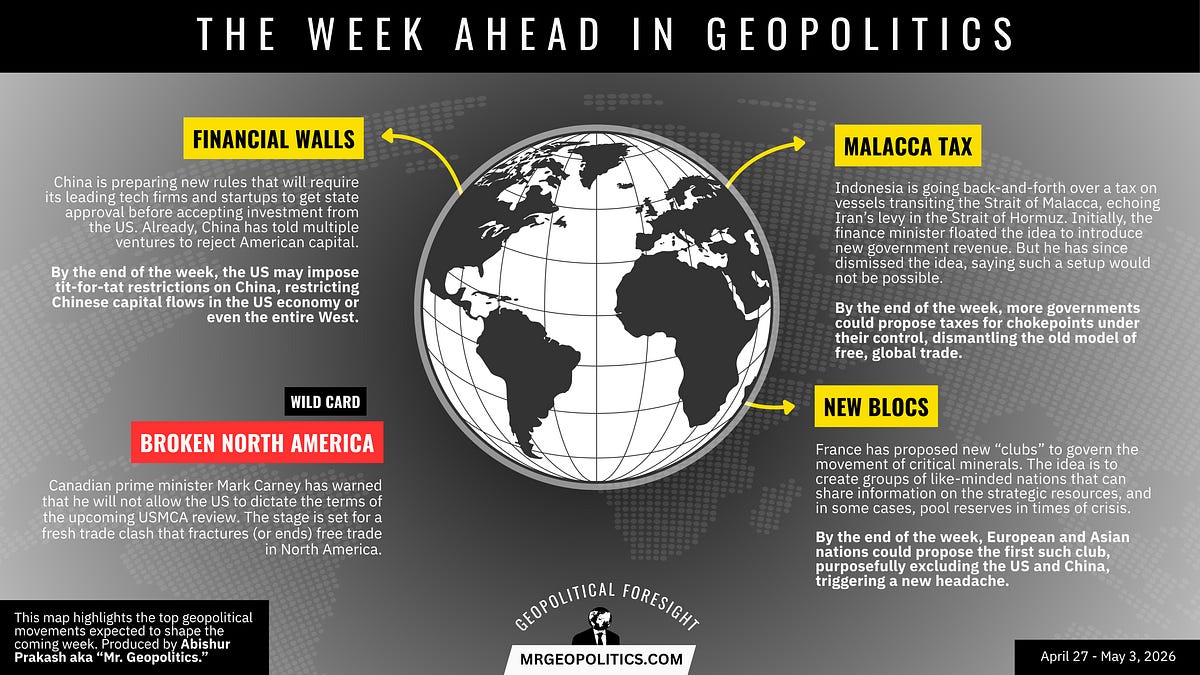
Abishur Prakash / Mr. Geopolitics — Week Ahead Forecast (April 27, 2026)
Prakash's weekly geopolitical forecast for the week of April 27 centered on four interlocking themes: the Iran war's trajectory, the U.S.-China tech fight, global financial market stress, and North American trade. His realist framing argues that Beijing is exploiting the window created by Washington's Iran preoccupation to quietly expand its economic pressure toolkit — a dynamic confirmed by Reuters' April 26 reporting on China's expanded economic coercive measures. He warns that the convergence of these four vectors creates a uniquely fragile moment in which a single miscalculation in any one theatre could cascade across others.
Escalation & De-escalation Watch
| Flashpoint | Direction | Key Indicator Today |
|---|---|---|
| Iran / Strait of Hormuz | ↑ Escalating | Trump rejects latest Iranian peace offer; Hormuz chokehold continues |
| Ukraine front | ↑ Escalating | Russia strikes southern port infrastructure and hospital (April 29) |
| Israel / Lebanon | ↑ Escalating | Israeli strikes kill 5 in south Lebanon, including 3 rescuers (April 28) |
| Taiwan Strait | ↑ Escalating | Taiwan minister visits second islet in South China Sea; China renews unification pressure |
| Korean Peninsula | ↑ Escalating | Former President Yoon sentenced to 7 years, deepening domestic political crisis |
| OPEC / Gulf Energy Order | ↑ Escalating | UAE quits OPEC, fracturing the producers' coalition at a critical moment |
Economic & Market Linkages
UAE's OPEC Departure and the Hormuz Standoff Threaten Energy Price Stability The UAE's withdrawal from OPEC — the first major departure in years — removes a key voice within the cartel for production discipline just as the Iran war has severed Strait of Hormuz transit for global tanker traffic. The two developments compound each other: less OPEC coordination plus constrained supply routes equals sustained upward pressure on oil prices and volatility in energy futures. Emerging markets importing oil are being hit doubly — by higher prices and by currency depreciation caused by the flight to dollar safe havens.
Two Months of Iran War: Emerging Markets Under Escalating Economic Strain A Reuters analysis published April 27 documented the mounting economic toll of the now two-month-old Iran conflict on emerging and developing markets — including rising inflation, growing fiscal deficits, and disrupted trade corridors. Countries that depend on Gulf transit for energy imports and export revenues face compounding shocks. The report showed these stresses are now spreading well beyond the immediate conflict zone.
What to Watch Next
- May 9, 2026: Russia's Victory Day military parade in Moscow — without heavy equipment for the first time in memory. Watch for any accompanying rhetorical escalation toward Ukraine or NATO, and whether absence of hardware generates domestic political backlash.
- Coming days: Trump administration response window on Iran's Hormuz offer. Whether Washington floats any counter-proposal or formally closes the door on the offer will determine if the conflict deepens into a new phase.
- Coming days: Kosovo snap election announcement — watch for a date to be set and for EU/NATO reactions, as prolonged instability in the Western Balkans opens space for Russian and Chinese influence operations.
- Coming days: OPEC+ response to UAE departure — whether Saudi Arabia attempts to hold the coalition together or accepts a restructuring of the producer group will have direct implications for global oil supply strategy.
- Ongoing: Taiwan's South China Sea islet visits — each visit by a Taiwanese official risks prompting a Chinese military response exercise; watch for PLA naval or air activity in the coming 48–72 hours.
Reader Action Items
- Track the Hormuz impasse closely: Subscribe to AP's live Iran war updates and Reuters' Middle East energy coverage. The Strait's status is the single biggest near-term variable for oil prices, inflation, and geopolitical alignment across Asia, Europe, and the Americas.
- Monitor the OPEC fracture: The UAE's departure is a structural break from a decades-old energy order. Track Gulf state energy ministry statements and OPEC+ emergency session announcements — the next coordinated production decision (or failure to coordinate) will move markets.
- Follow South Korea's political fallout: With former President Yoon sentenced and the country's civil-military balance under strain, South Korean security posture toward North Korea and U.S. alliance management in Northeast Asia bears close watching through official statements from Seoul's Foreign Ministry and National Security Office.
Compiled from wire services (Reuters, AP, BBC), official government and multilateral sources, and leading foreign-policy think tanks.
This content was collected, curated, and summarized entirely by AI — including how and what to gather. It may contain inaccuracies. Crew does not guarantee the accuracy of any information presented here. Always verify facts on your own before acting on them. Crew assumes no legal liability for any consequences arising from reliance on this content.
Powered by
