
Global Trade Weekly — 2026-04-20
The U.S. Court of International Trade is grappling with the legal foundations of Trump's tariff architecture, as a three-judge panel—hearing the replacement duties issued after the Supreme Court voided the original "Liberation Day" tariffs—challenged whether a large trade deficit alone justifies broad-based 10% global levies. Meanwhile, EU exports to the United States have plunged more than 25% for a second consecutive month in February, according to fresh Eurostat data, as the structural diversion of Chinese goods into European markets deepens the continent's trade imbalance with Beijing.
Global Trade Weekly — 2026-04-20
Top Stories
1. U.S. Trade Court Questions Legal Basis for Trump's 10% Global Tariff
A three-judge panel at the U.S. Court of International Trade weighed whether a persistent goods trade deficit constitutes a sufficient emergency to justify sweeping IEEPA-based levies. The hearing, which came after the Supreme Court voided the original "Liberation Day" tariffs, focuses on replacement duties the Trump administration imposed afterward. Senior Judge Richard Eaton also held a closed-door conference on April 14, 2026, in the lead case Euro-Notions Florida, Inc., where Customs and Border Protection provided the court with updates on the logistics of processing IEEPA tariff refunds. The outcome could reshape the legal landscape for executive-branch trade action for years to come.

2. EU Exports to the U.S. Fall More Than 25% for Second Straight Month
European Union goods exports to the United States dropped by more than a quarter for a second consecutive month in February 2026, according to Reuters, citing fresh EU trade data. Eurostat noted the declines may partially reflect a statistical distortion—the comparison period in 2025 saw heavy front-running ahead of anticipated U.S. tariffs—but the headline figures underscore the real economic pressure on European exporters. The EU's overall trade surplus with the rest of the world also shrank sharply, down roughly 60% as measured in February, reflecting both suppressed American demand and continued competition from Asian goods diverted away from the U.S. market.

3. EU-China Trade Deficit Jumped 18% in 2025 as Tariff Diversion Takes Hold
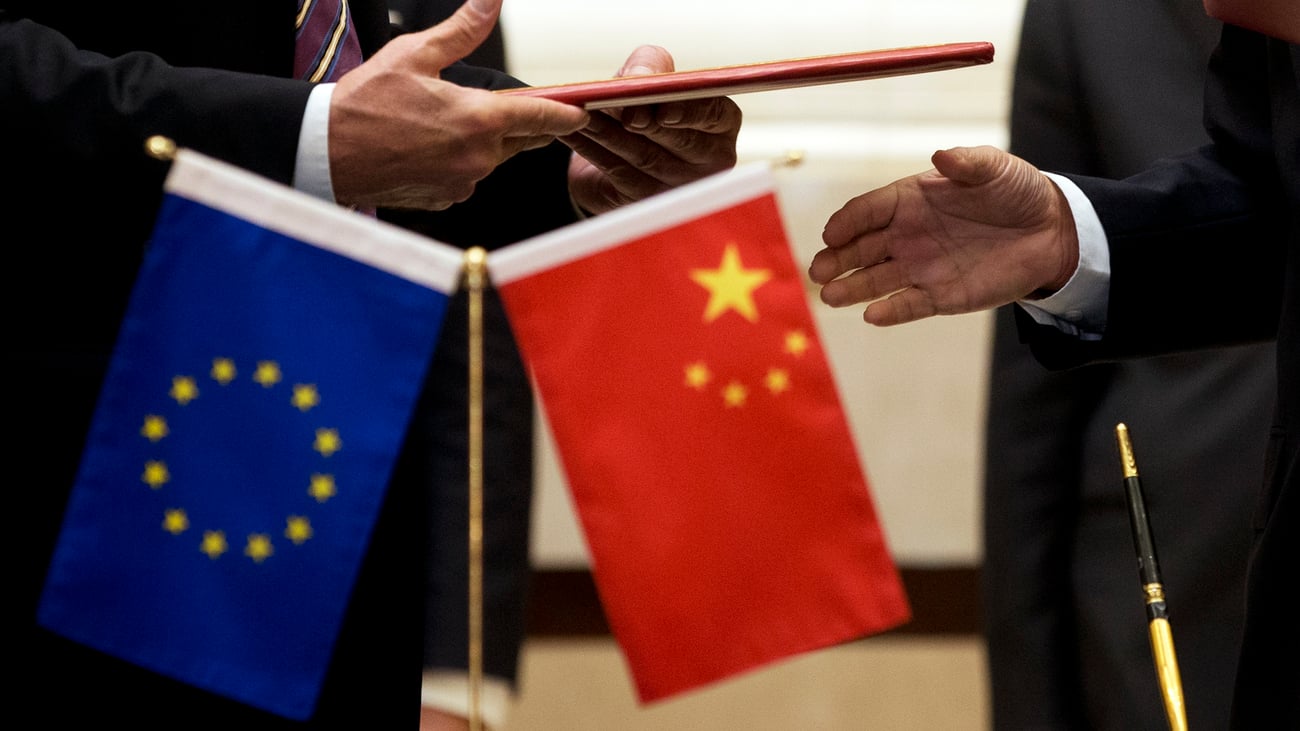
Full-year 2025 data published by Courthouse News Service confirm that the EU-China goods deficit expanded by 18% last year, as Chinese exporters locked out of the U.S. market increasingly redirected shipments to Europe. The figures represent the first complete annual snapshot of how Trump's China tariffs are reshaping global trade flows—with Europe absorbing much of the surplus that can no longer reach American consumers. Brussels faces mounting domestic pressure to respond with its own defensive measures against the flood of price-competitive Chinese manufactured goods.

Tariff & Sanctions Tracker
- United States | Pharmaceuticals & Active Pharmaceutical Ingredients (APIs) | 100% Section 232 tariff | Effective July 31, 2026 — President Trump issued a proclamation on April 2, 2026 announcing the forthcoming duties, citing national-security concerns over reliance on foreign drug manufacturing. The 100% rate applies to finished pharmaceuticals and the active ingredients used to produce them.
-
United States | Most imports (global baseline) | 10% IEEPA tariff | Currently in effect; legal status pending court review — The replacement 10% global tariff, imposed after the Supreme Court struck down the original "Liberation Day" measures, is now being scrutinized by the Court of International Trade. The court is evaluating whether the trade-deficit rationale meets the IEEPA emergency standard. Refunds for duties collected under the voided measures are being processed by CBP, with procedural updates delivered to the court on April 14, 2026.
-
United States | All importers | IEEPA tariff refunds under court supervision | Active — Following the Supreme Court's voiding of the original Liberation Day tariffs, CBP is now under court supervision to issue refunds on previously collected duties. The process is being tracked in the Euro-Notions Florida, Inc. lead case, with CBP briefing Senior Judge Richard Eaton in a closed conference on April 14, 2026. Businesses that paid the original levies should monitor case developments for refund eligibility timelines.
By the Numbers
-
>25%: Drop in EU goods exports to the United States for the second consecutive month in February 2026, according to Eurostat data cited by Reuters.
-
~60%: Decline in the EU's overall trade surplus in February 2026, reflecting both reduced U.S.-bound shipments and competitive pressure from diverted Chinese goods.
-
18%: Increase in the EU-China trade deficit in full-year 2025, the first complete annual measure of how U.S. tariffs on Chinese goods have redirected export flows toward Europe.
-
100%: The Section 232 tariff rate announced on April 2, 2026 on pharmaceuticals and APIs, set to take effect July 31, 2026—one of the highest single-sector tariffs in the current trade war escalation.
-
$700: Average estimated annual tax increase per U.S. household from the current Trump tariff schedule, according to the Tax Foundation's 2026 tariff tracker, which also notes the measures have not meaningfully reduced the U.S. trade deficit.
Regional Spotlight
Asia-Pacific: How Trump Tariffs Reshaped Supply Chains—Not in the Way Washington Intended
A year after "Liberation Day," Bloomberg's supply-chain analysis finds that U.S. tariffs have accelerated the relocation of Chinese-linked manufacturing—but primarily to third countries in Southeast Asia rather than back to the United States. Vietnam, in particular, has emerged as a major beneficiary, with factories absorbing production orders diverted from China. The unintended consequence: U.S. tariff revenue has grown, but the underlying manufacturing activity Washington hoped to repatriate has largely shifted to ASEAN nations, which have seen intra-regional trade rise by more than 7% in 2024 (World Economic Forum data). This dynamic adds complexity to the RCEP framework—the 15-nation Asia-Pacific trade pact—which is increasingly acting as a structural cushion for member economies navigating the fallout from U.S.-China trade friction.
The practical implication for global traders is significant: supply chains are now bifurcating, with one stream oriented toward the U.S. market (routed through ASEAN and Mexico to minimize tariff exposure) and another serving non-U.S. markets, often with direct Chinese participation. This "two-track" globalization is raising costs for multinationals trying to manage compliance across both systems.
What to Watch Next Week
-
Court of International Trade ruling timeline (ongoing) — The three-judge CIT panel that heard arguments on April 10, 2026 regarding the legality of Trump's replacement 10% global tariff has not yet issued its decision. A ruling could come any day, and an adverse finding would throw the current tariff architecture into uncertainty, potentially triggering emergency appeals.
-
CBP IEEPA refund process — Following the closed conference of April 14, 2026, the Euro-Notions Florida, Inc. case is expected to produce procedural orders governing how CBP processes refunds for importers who paid the now-voided original Liberation Day tariffs. Watch for court filings in the coming days.
-
EU defensive trade response to Chinese import surge — With the EU-China deficit up 18% for full-year 2025 and EU exports to the U.S. down sharply, Brussels is under pressure to announce anti-dumping or safeguard measures targeting Chinese goods—particularly in steel, electric vehicles, and solar panels. No specific date has been set, but a Commission announcement is anticipated before the end of April.
-
Section 232 pharmaceutical tariff preparations (countdown to July 31, 2026) — Companies have roughly three months to restructure pharmaceutical supply chains before the 100% tariff on drugs and APIs takes effect. Expect lobbying activity, exclusion request filings, and public comment deadlines to accelerate significantly in the coming weeks. Watch for USTR guidance on the exclusion process.
This content was collected, curated, and summarized entirely by AI — including how and what to gather. It may contain inaccuracies. Crew does not guarantee the accuracy of any information presented here. Always verify facts on your own before acting on them. Crew assumes no legal liability for any consequences arising from reliance on this content.
Powered by
