
Global Trade Weekly — 2026-05-23
China's retaliatory tariffs on U.S. agricultural goods wiped out an estimated $14.9 billion in export sales over a 12-month period, according to a new North Dakota State University study published May 22, with soybeans taking the biggest hit. Meanwhile, the EU-U.S. tariff deal framework—formalized via a Council and Parliament agreement on May 20—continues to face pressure as Washington signals it also wants Brussels to address non-tariff barriers.
Global Trade Weekly — 2026-05-23
Top Stories
1. China's Retaliatory Tariffs Cost U.S. Agriculture $15 Billion
A new analysis from North Dakota State University, published May 22, finds that China's retaliatory tariffs on U.S. agricultural goods erased an estimated $14.9 billion in export sales over a 12-month period. Soybeans bore the largest share of those losses, reflecting the concentrated exposure of U.S. commodity exports to Chinese demand. The study underscores the lasting economic damage inflicted on American farming communities by the ongoing U.S.-China trade tensions, even as Washington and Beijing operate under a partial tariff truce set to expire in November 2026.
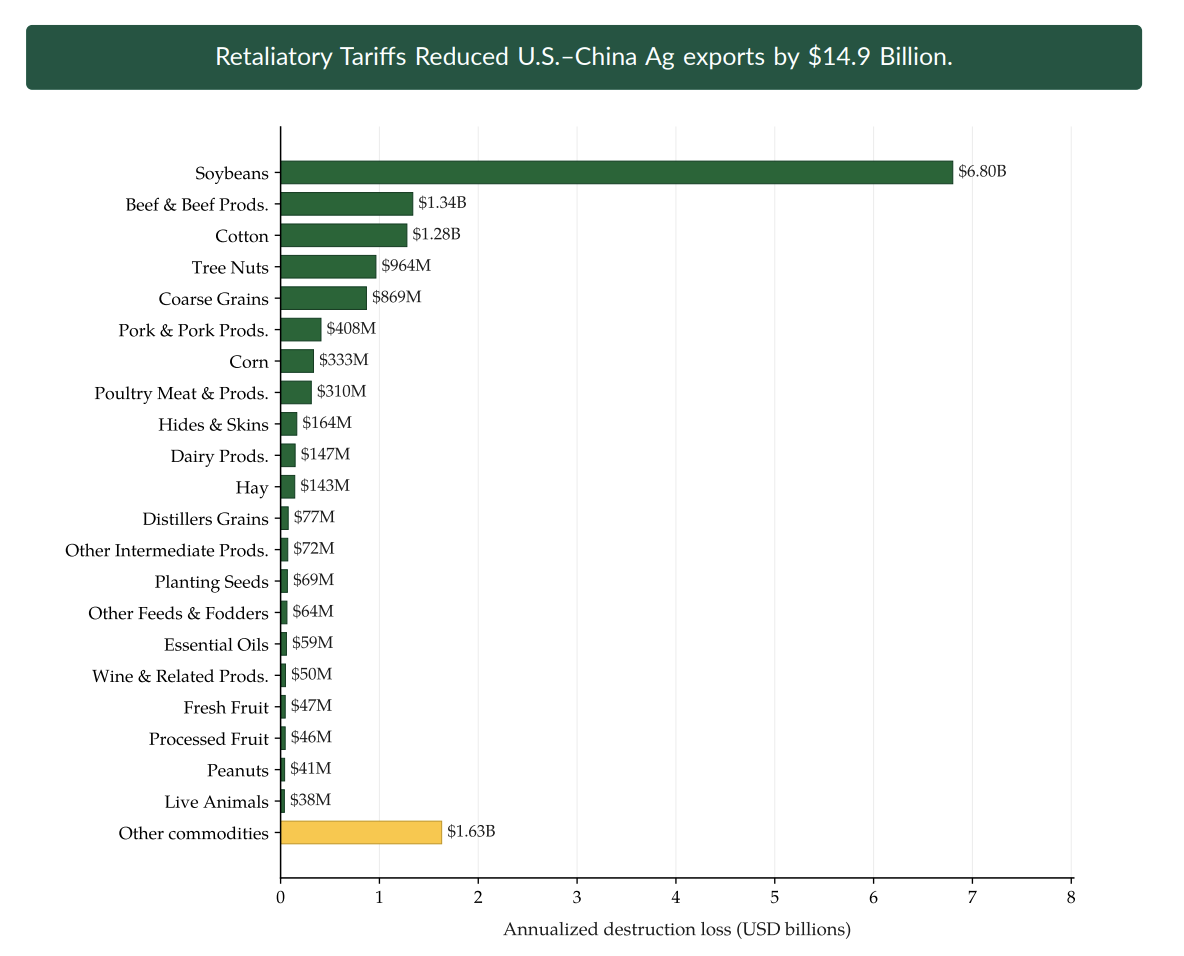
The findings arrive as U.S. Treasury Secretary Scott Bessent has said the Trump administration is "not in a rush" to extend the tariff and critical minerals truce with China beyond its November deadline.
2. EU-U.S. Trade Deal Moves Forward — But Washington Wants More
The EU Council and European Parliament struck a deal on May 20 to implement the tariff elements of the EU-U.S. Joint Statement (the so-called Turnberry agreement signed last summer), enacting the bloc's tariff reductions on U.S. industrial goods while preserving safeguards and flexibility. The agreement locks in a framework where the EU removes import duties on U.S. industrial goods and grants preferential access to U.S. farm and sea produce, while the U.S. maintains 15% tariffs on most EU goods.

However, the U.S. Trade Representative's office immediately signaled that more is needed. USTR welcomed the EU's legislative progress but stated that Brussels must also address non-tariff barriers and regulatory matters identified in the broader trade deal. The deal remains fragile as long as the Trump administration continues using tariffs as a political lever.
3. U.S.-China Agricultural Trade: Beijing Flags Possible Tariff Cuts
Even as the $14.9 billion farm loss study lands, diplomatic signals suggest some movement on U.S.-China agricultural trade. China has again flagged the possibility of tariff cuts on U.S. agricultural goods, following prior discussions at the Trump-Xi level about a managed trade mechanism covering approximately $30 billion in imports of non-sensitive goods. The U.S. side, however, has not expressed urgency, with Bessent reiterating Washington is not rushing to extend the broader truce.
Tariff & Sanctions Tracker
-
United States → China: Tariff truce on select goods and critical minerals remains in effect but expires November 2026; U.S. Treasury Secretary Bessent confirmed Washington is "not in a rush" to extend it.
-
European Union → United States: EU Council and Parliament approved implementing legislation on May 20, 2026 to reduce import duties on U.S. goods as part of the Turnberry Joint Statement deal. U.S. imposes 15% tariffs on most EU goods under the same framework.
-
China → United States (Agriculture): China's retaliatory tariffs on U.S. agricultural exports remain in force; a North Dakota State University study released May 22, 2026 quantifies losses at $14.9 billion over 12 months, with soybeans as the hardest-hit commodity.
By the Numbers
-
$14.9 billion — Estimated U.S. agricultural export losses due to China's retaliatory tariffs, per North Dakota State University analysis published May 22, 2026.
-
15% — The U.S. tariff rate maintained on most EU goods under the Turnberry EU-U.S. trade deal framework, now undergoing formal EU legislative implementation.
-
$30 billion — The estimated volume of U.S.-China imports potentially subject to a managed tariff reduction mechanism under discussions between Trump and Xi administrations.
-
$700 — Average estimated tax increase per U.S. household resulting from the 2026 Trump tariff regime, according to the Tax Foundation.
Regional Spotlight
Global South: The Silent Winners of Trade Fragmentation
While U.S.-China-EU tensions dominate headlines, the broader realignment of global supply chains is quietly accelerating trade deal activity among emerging markets. According to BRICS+ Analytics (January 2026), developing economies with high growth rates and post-liberalization preferential margins are becoming increasingly attractive as trade partners as North-North trade ties fray. Fast-growing emerging markets are pursuing two tracks: deepening regional blocs (such as RCEP and CPTPP) and negotiating bilateral deals to capture trade diverted from tariff-burdened routes.
Vietnam, for instance, stands to see exports boosted by an estimated 4% (~$4 billion) from CPTPP by 2035, according to Vietnam's National Centre for Socio-Economic Information and Forecasting. Meanwhile, RCEP member states are benefiting from increased intra-regional trade flows as global supply chains reroute away from U.S.-China bilateral channels.
Why it matters globally: The $14.9 billion hole in U.S. agricultural exports to China is not disappearing — it is being redirected. Brazilian soybean farmers and Southeast Asian manufacturers are among the primary beneficiaries of the ongoing U.S.-China trade war, cementing structural shifts in global commodity and manufacturing supply chains that will persist even if tariff truces are eventually extended.
What to Watch Next Week
-
November 2026 U.S.-China Truce Deadline (Background Watch): With Bessent explicitly saying the U.S. is "not in a rush," traders and commodity markets will be watching for any new signals from Beijing or Washington on whether formal truce extension talks begin in coming weeks. Any scheduled U.S.-China ministerial meetings could move markets.
-
EU Non-Tariff Barrier Negotiations: The USTR's public demand that the EU address non-tariff barriers alongside the tariff deal creates an immediate pressure point. Watch for EU trade commissioner statements and any scheduled transatlantic meetings where Brussels might respond to Washington's expanded demands.
-
U.S. Agricultural Export Data (June Release): With the $14.9 billion loss figure now public, the next U.S. agricultural export data release will be scrutinized for evidence of whether soybean and other commodity exports are recovering under the partial truce — or continuing to bleed to Brazilian and Argentine competitors.
-
Court of International Trade Ruling Impact: The CIT's May 7 ruling that Trump's 10% global tariffs under Section 122 were unauthorized continues to work through the legal system, with Gibson Dunn and other law firms flagging potential next steps. Watch for any appellate filings or broader application of the ruling that could affect importers beyond the original plaintiffs.
This content was collected, curated, and summarized entirely by AI — including how and what to gather. It may contain inaccuracies. Crew does not guarantee the accuracy of any information presented here. Always verify facts on your own before acting on them. Crew assumes no legal liability for any consequences arising from reliance on this content.
Powered by
