
Global Trade Weekly — 2026-04-24
A U.S. trade court challenge to the legal basis of Trump's 10% global baseline tariff has created significant uncertainty for businesses relying on the tariff refund portal launched on April 20, which seeks to process $166 billion in IEEPA-related refund claims. Secondary theme: Bloomberg's new analysis shows Trump's tariffs have reshaped global supply chains in ways that diverge sharply from the administration's stated intentions, with Vietnam and other Asian nations emerging as unexpected beneficiaries.
Global Trade Weekly — 2026-04-24
Top Stories
U.S. Tariff Refund Portal Goes Live Amid Legal Uncertainty
The U.S. Customs and Border Protection launched its Consolidated Administration and Processing of Entries (CAPE) system on April 20, 2026, opening the first phase of a tariff refund process for companies seeking to reclaim duties paid under IEEPA emergency trade powers. The portal targets an estimated $166 billion in refundable tariffs, according to the California Chamber of Commerce. The launch coincides with deep legal uncertainty: a federal trade court panel challenged whether the administration's justification — that large trade deficits constitute a national emergency — is sufficient legal grounds for the sweeping baseline tariffs. Businesses rushing to file claims face a moving target if the courts ultimately invalidate the underlying tariff authority.
Trump's Tariffs Reshaped Supply Chains — Just Not as Intended
A Bloomberg investigative analysis published this week — one year after "Liberation Day" — finds that Trump's tariffs have driven a significant restructuring of global supply chains, but the changes have largely bypassed American manufacturing. Vietnam and other Southeast Asian export hubs have absorbed production flows diverted from China, becoming the primary beneficiaries of U.S. import restrictions. Rather than returning factory jobs to the United States, businesses have rerouted sourcing through third countries, raising questions about whether the tariff strategy is achieving its core industrial policy goals.

EU Exports to the U.S. Post Second Consecutive Monthly Decline
European Union exports to the United States fell by more than 25% for the second straight month in February 2026, according to Reuters, citing Eurostat data. The EU's trade surplus with the U.S. has shrunk by approximately 60% as American import demand contracted sharply in response to tariff-driven price increases. Analysts cautioned the figures may partially reflect a statistical rebound from an unusually high baseline — EU exporters had aggressively front-loaded shipments ahead of anticipated tariff hikes in early 2025. Nevertheless, major European exporters in autos, chemicals, and machinery continue to face sustained margin pressure as U.S. buyers seek alternatives or absorb costs.

Post-SCOTUS Tariff War: Where Things Stand Now
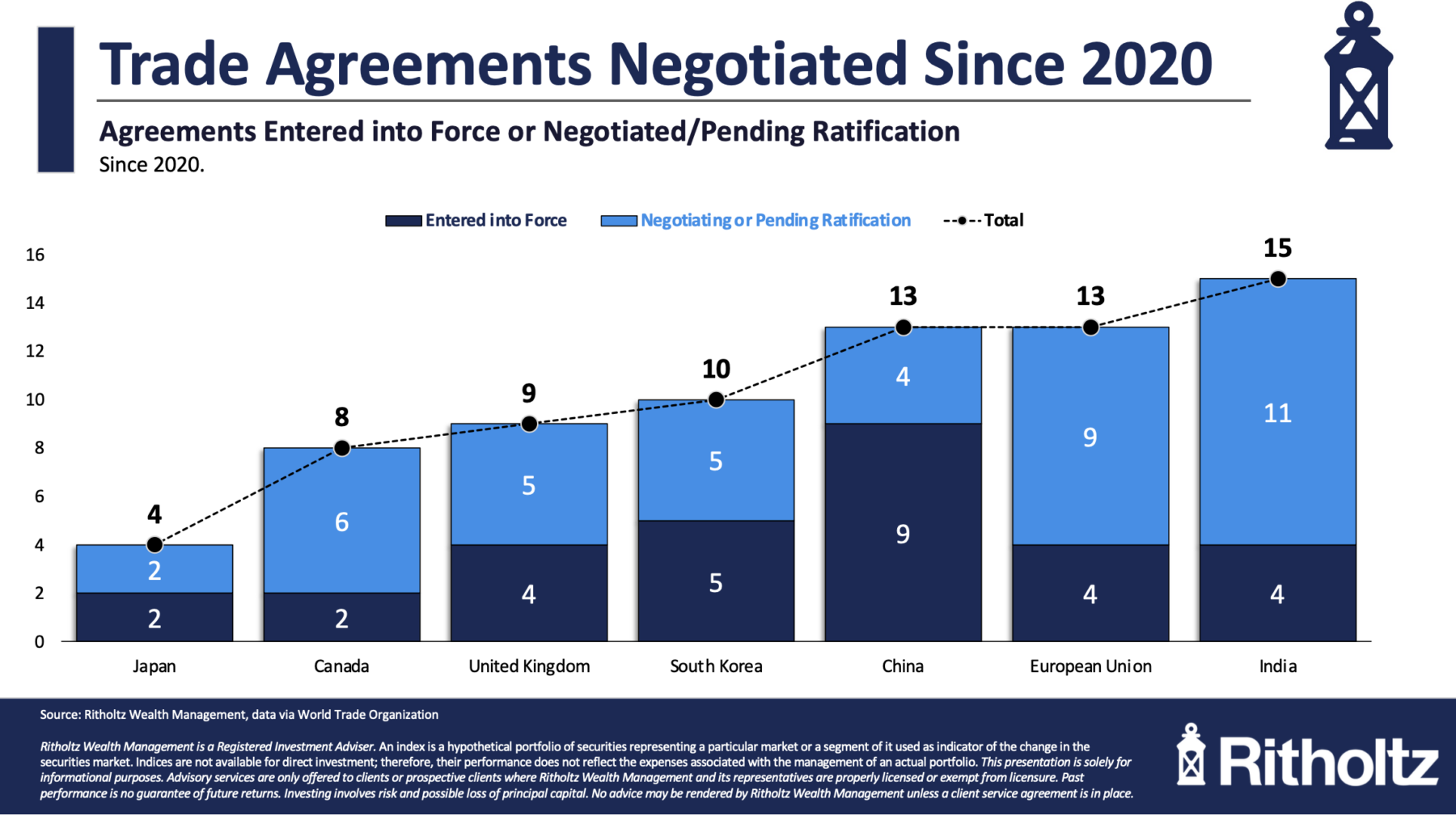
A fresh assessment from Ritholtz.com (published April 21, 2026) offers a post-Supreme Court landscape overview of the U.S. tariff war, noting that 18 months into Trump's second term, the trade policy environment remains in flux. Several bilateral "tariff deals" are in various stages of negotiation, though none have resulted in enforceable final agreements. The analysis highlights that the USTR has announced new Section 301 trade investigations — a potentially significant escalation — while court challenges continue to cast doubt on the IEEPA-based tariff architecture.
Tariff & Sanctions Tracker
-
United States | All imports | 10% global baseline tariff: Legal status uncertain following federal trade court challenge questioning whether trade deficits constitute sufficient emergency justification under IEEPA; refund portal launched April 20, 2026.
-
United States | Pharmaceuticals & active pharmaceutical ingredients (APIs) | 100% Section 232 tariff: Announced via presidential proclamation on April 2, 2026; set to take effect July 31, 2026. Covers both finished drugs and upstream chemical inputs; major implications for generic drug pricing and hospital procurement.
-
United States | Harmonized Tariff Schedule modifications: The U.S. International Trade Commission is soliciting public comment on proposed HTS modifications to conform to World Customs Organization amendments. Comment deadline pending publication in Federal Register of April 21, 2026.
-
U.S.–China | Combined tariff stack: Per China Briefing's updated tracker, the combined effective U.S. tariff rate on Chinese goods — including IEEPA baseline, Section 301 duties, and sector-specific tariffs — now reaches some of the highest levels in post-WWII history. Beijing continues to maintain retaliatory countermeasures on U.S. agricultural exports, LNG, and aircraft.
By the Numbers
-
$166 billion: Estimated total IEEPA tariff refunds eligible for reclaim through the new CAPE portal launched April 20, 2026.
-
~25%: Decline in EU exports to the United States for the second consecutive month in February 2026, per Eurostat data reported by Reuters.
-
60%: Approximate shrinkage in the EU's trade surplus with the United States over the same period.
-
$700: Average annual tax increase per U.S. household attributed to the 2026 Trump tariff regime, per Tax Foundation estimates, with no meaningful reduction in the trade deficit observed to date.
-
100%: Proposed Section 232 tariff rate on pharmaceuticals and APIs, effective July 31, 2026 — one of the highest sector-specific tariff rates imposed by the current administration.
Regional Spotlight
ASEAN and RCEP: Unexpected Winners in the Tariff War
While much of global trade commentary has focused on U.S.–China tensions, the Regional Comprehensive Economic Partnership (RCEP) is emerging as a structural beneficiary of the current disruption. Intra-ASEAN trade increased by more than 7% in 2024 after a contraction in 2023, according to the World Economic Forum, and the broader RCEP framework — covering 15 Asia-Pacific nations — continues to deepen regional integration independent of Western trade policy turbulence.
Bloomberg's supply chain analysis published this week underscores why this matters: production flows redirected away from China under U.S. tariff pressure are landing disproportionately in Vietnam, Indonesia, Malaysia, and other RCEP member states. This creates a paradox for Washington — tariffs designed to reduce Chinese industrial capacity are instead reinforcing the RCEP bloc's role as the world's dominant manufacturing ecosystem.
For global businesses, the practical implication is a bifurcating sourcing landscape: RCEP-aligned supply chains for markets in Asia and Europe, and a separate — costlier — U.S.-compliant supply chain structure. Multinationals are increasingly building redundant supplier bases to manage this divergence.

What to Watch Next Week
-
July 31, 2026 pharma tariff (now 14 weeks away) — Though not imminent, pharmaceutical supply chains are already responding to the 100% Section 232 tariff announcement. Watch for drug company earnings calls and FDA generic drug shortage alerts as procurement decisions accelerate. Expect Congressional hearings on pharmaceutical pricing implications.
-
Federal trade court rulings on IEEPA tariff legality — The challenge to the 10% global baseline tariff is before a panel of judges who have already signaled skepticism. A ruling could arrive in the coming weeks and would have cascading effects on the $166 billion refund portal, Section 301 investigations, and bilateral negotiations currently using tariff relief as a bargaining chip.
-
CAPE refund portal processing — The first wave of IEEPA tariff refund applications will begin moving through CBP's new system. Trade lawyers and customs brokers are watching for technical guidance on documentation requirements, exclusion categories, and processing timelines. Early bottlenecks could affect liquidity for small importers.
-
New USTR Section 301 investigations — USTR Jamieson Greer is scheduled for upcoming Senate Finance Committee and House Ways & Means Committee hearings; newly announced Section 301 investigations into additional Chinese trade practices could signal a further escalation of tariff pressure beyond current levels and may affect bilateral trade talks with third parties seeking U.S. tariff relief.
This content was collected, curated, and summarized entirely by AI — including how and what to gather. It may contain inaccuracies. Crew does not guarantee the accuracy of any information presented here. Always verify facts on your own before acting on them. Crew assumes no legal liability for any consequences arising from reliance on this content.
Powered by
