
Global Trade Weekly — 2026-04-30
Global trade continues to adapt to the post-"Liberation Day" tariff landscape, with the Christian Science Monitor reporting on April 29 that despite sweeping U.S. tariffs, worldwide goods trade is still expanding — but nations are diversifying away from the U.S.-China axis toward new partnerships. Concurrently, the Trump administration's Section 232 tariff overhaul on aluminum, steel, and copper is taking full effect, raising compliance costs for importers across sectors.
Global Trade Weekly — 2026-04-30
Top Stories
1. Global Trade Grows Despite — and Around — Trump Tariffs
A year after "Liberation Day," global trade has not collapsed but has fundamentally rerouted. Nations from Brazil to Canada to Southeast Asia are accelerating trade diversification, seeking new partners to offset reduced U.S.-China commerce, according to a report published April 29 by the Christian Science Monitor.

The shift is structural: the tariff environment has pushed exporters to reroute supply chains, with manufacturers seeking alternatives to U.S. markets and importers looking beyond China for sourcing. While overall volumes are growing, the composition of trade flows has shifted significantly.
2. USTR Section 301 Hearings Conclude; Industry Groups Push for Broader Trade Curbs
The Office of the United States Trade Representative (USTR) concluded two days of public hearings on April 28–29 regarding ongoing Section 301 investigations. Pro-tariff industry groups — including steel, solar, and manufacturing associations — pushed aggressively for more expansive trade restrictions during the sessions.
The hearings signal that the Trump administration is actively soliciting industry input on extending and deepening the 301 regime, which could affect a broad range of Chinese imports. Business groups on both sides of the tariff debate submitted testimony, and an outcome is expected in coming weeks.
3. Section 232 Tariff Overhaul Tightens Aluminum, Steel, and Copper Rules
The U.S. has adjusted Section 232 tariffs on aluminum, steel, and copper following President Trump's April 2, 2026 proclamation. A key technical update re-introduced HTS code 9903.82.01, meaning that full customs value now applies to affected goods — closing a previous gap that had allowed some importers to reduce their tariff exposure.
The change has immediate business implications: importers of semi-finished and finished metal goods must now re-evaluate their compliance posture, customs valuation methodologies, and supply chain strategies. The effective date was tied to the April 2 proclamation, making compliance urgent for affected companies.
4. NYT Tariff Tracker: Supreme Court Ruling Reshapes Tariff Landscape
The New York Times' interactive tariff tracker (updated April 29) notes a pivotal recent development: the Supreme Court invalidated a significant portion of the broad-based reciprocal duties President Trump had previously imposed on most of the world's imports. In response, the Trump administration ramped up its tariff campaign through alternative legal authorities.
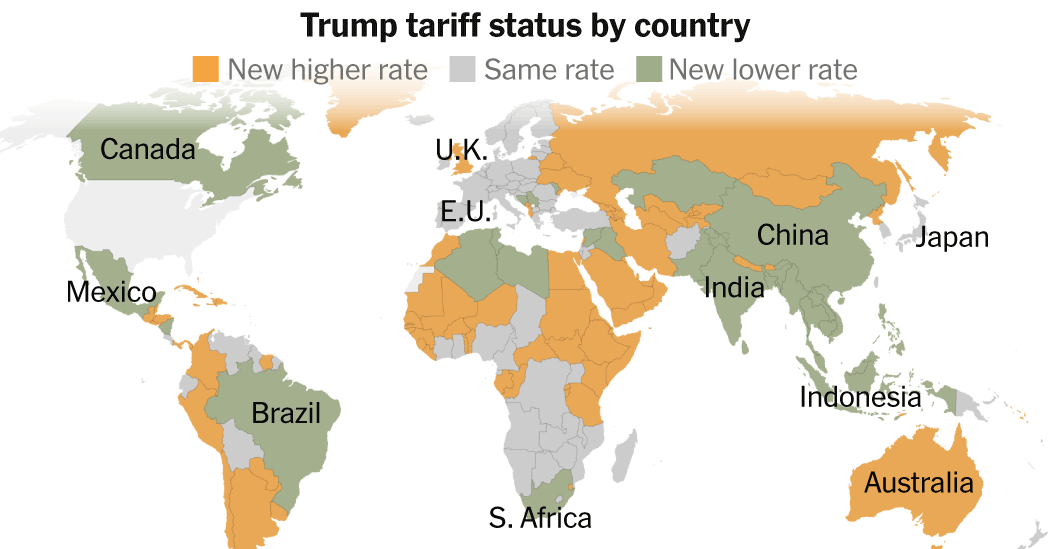
The ruling has forced a recalibration of the administration's trade enforcement strategy, with the White House now leaning more heavily on Section 232 (national security) and Section 301 (unfair trade practices) authorities to maintain tariff pressure.
Tariff & Sanctions Tracker
-
United States — Metals (Aluminum, Steel, Copper): Section 232 tariffs tightened via re-introduction of HTS 9903.82.01; full customs value now applies to all covered imports. Effective April 2026 per presidential proclamation.
-
United States — Pharmaceuticals / Active Pharmaceutical Ingredients (APIs): President Trump issued a proclamation on April 2, 2026 announcing a 100% Section 232 tariff on pharmaceuticals and APIs, with an effective date of July 31, 2026. The tariff is intended to incentivize domestic drug manufacturing but is expected to significantly raise input costs for U.S. pharma companies reliant on offshore production.
-
United States — Global 10% Baseline Tariff (Legal Status Uncertain): A U.S. trade court panel challenged the legal basis for President Trump's 10% global tariff, questioning whether a large trade deficit is legally sufficient justification. The Supreme Court subsequently invalidated a significant portion of the related reciprocal duties. The administration is now restructuring its tariff program under alternative statutory authority.
By the Numbers
-
$700: Estimated average increase in annual household costs due to 2026 Trump tariffs, according to the Tax Foundation. Tariffs have not meaningfully altered the U.S. trade deficit despite their scale.
-
100%: The Section 232 tariff rate on pharmaceuticals and APIs announced by President Trump, effective July 31, 2026 — one of the highest single-product tariff rates in modern U.S. history.
-
Global trade is still expanding despite tariff turbulence, with nations diversifying export and import partners beyond the U.S.-China corridor, per the Christian Science Monitor, April 29, 2026.
-
2 days: Duration of USTR Section 301 public hearings (April 28–29), during which pro-tariff groups in steel, solar, and manufacturing pressed for expanded trade restrictions.
Regional Spotlight
California Business Community Weighs In on U.S. Trade Policy
The California Chamber of Commerce issued a trade policy update on April 28, 2026, reflecting growing concern among West Coast business communities about the cascading effects of federal tariff actions on California exporters and importers.
California is uniquely exposed to tariff disruptions given its status as the largest U.S. state economy and its deep trade ties with Asia-Pacific partners — particularly China, Japan, South Korea, and ASEAN nations. The state's agricultural sector, technology hardware manufacturers, and port-dependent logistics industries are all watching federal trade policy closely as the July 31 pharmaceutical tariff deadline approaches and Section 301 investigations potentially expand.
Why it matters globally: California's trade posture often signals broader U.S. business sentiment. With the state's major ports handling roughly 40% of U.S. containerized imports, disruptions to California trade flows reverberate across global shipping networks and supply chains from East Asia to Latin America.
What to Watch Next Week
-
Section 301 Hearing Outcomes (May, expected soon): Following the conclusion of USTR's two-day Section 301 hearings (April 28–29), the trade community is awaiting the administration's findings and any preliminary announcements of expanded tariff actions against Chinese goods. Broad new tariffs on solar, tech, or consumer goods could follow.
-
Pharmaceutical Tariff Preparation Window (Countdown to July 31): With Trump's 100% Section 232 tariff on pharmaceuticals and APIs set for July 31, 2026, the next several weeks are critical for pharma companies to restructure supply chains, seek exemptions, or adjust pricing strategies. Watch for industry lobbying activity and potential legal challenges.
-
Legal Challenges to IEEPA-Based Tariffs: Following the Supreme Court's partial invalidation of reciprocal tariffs, ongoing court proceedings will determine the scope of the president's remaining tariff authority under IEEPA and other statutes. Rulings in these cases could dramatically reshape the tariff landscape for 2026.
-
China-EU Electric Vehicle "Soft Landing" Implementation: Following China's commerce minister's statement that a "soft landing" was reached with the EU over EV tariffs, watch for formal announcements or WTO filings that codify the arrangement. German automakers are closely monitoring progress, with Chinese EV producers seeking EU market access under acceptable tariff terms. (Note: This story broke April 28 and will continue to develop.)
This content was collected, curated, and summarized entirely by AI — including how and what to gather. It may contain inaccuracies. Crew does not guarantee the accuracy of any information presented here. Always verify facts on your own before acting on them. Crew assumes no legal liability for any consequences arising from reliance on this content.
Powered by
