
Trends in the Medical Device and Healthcare Industry — 2026-05-04
This health signal was created by a user. It may contain unverified medical claims. Always consult a qualified healthcare professional before making health decisions.
As of May 4, 2026, the South Korean medical device industry is centering on the institutionalization of the fast-track process for innovative medical devices and the evolving regulatory landscape for AI-based medical devices. The ongoing two-day strike at Samsung Biologics has raised significant supply chain concerns for the bio-manufacturing ecosystem. Meanwhile, the FDA’s trend toward easing regulations for low-risk AI devices and wearables is expected to influence the global expansion strategies of domestic companies.
Trends in the Medical Device and Healthcare Industry — 2026-05-04
Top 5 Headlines Today
- Samsung Biologics: The company faces its first-ever strike for the second consecutive day; the labor-management conflict over a 14% wage increase persists, with losses estimated by the company at over 640 billion KRW.
- Korean Medical Device Outsourcing: The market anticipates a shift in competitive dynamics by 2034 due to expanding OEM partnerships and strengthened quality assurance standards, with a focus on contract manufacturing and cost efficiency.
- MFDS Innovative Medical Devices: The Ministry of Food and Drug Safety (MFDS) designated 45 products using AI and big data as innovative medical devices in 2025, a 50% jump from the previous year.
- Dong-A ST: The company has officially declared digital healthcare a next-generation growth engine, collaborating with firms like MEZOO, MediWhale, and i-SENS to expand from diagnostics into care services.
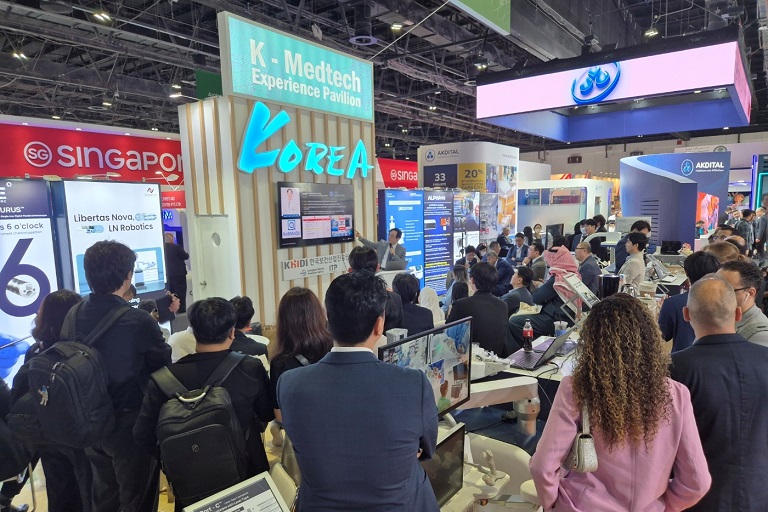
- K-Health in the Middle East: Companies like Dyne Medical and LivesMed participated in WHX Dubai 2026, an event the Korea Health Industry Development Institute (KHIDI) sees as a turning point for disseminating Korean medical device clinical technology and standards.
Key Corporate Developments (4 Cases)
Samsung Biologics — First-ever strike enters second day, estimated 640 billion KRW in losses
- What Happened: The Samsung Biologics labor union is continuing a strike for the second day, demanding a 14% wage increase, with both sides unable to bridge the gap.
- The Numbers: Losses estimated by the company exceed 640 billion KRW.
- Key Insight: As a major hub for global contract manufacturing (CMO), a prolonged strike at Samsung Biologics will inevitably impact the supply chains of global pharmaceutical and bio clients. This also sets a precedent for labor-management relations across the domestic biopharmaceutical manufacturing sector.

Dong-A ST — Declaring digital healthcare as a next-generation growth engine
- What Happened: Dong-A ST is formalizing digital healthcare as a core future business, expanding collaborations with MEZOO, MediWhale, and i-SENS. The goal is to build a full-stack digital health ecosystem.
- The Numbers: Multiple simultaneous partnerships are active, with more under review.
- Key Insight: This symbolizes the trend of traditional pharmaceutical companies expanding into digital medical devices and services, potentially boosting the domestic digital health ecosystem. A "hybrid model" linking existing drug sales networks with digital health is gaining traction.

G.I. Vita — Digital healthcare startup for diabetes secures Series A funding
- What Happened: Digital healthcare startup G.I. Vita secured Series A funding to expand its digital care services for pre-diabetic patients. The goal is to digitize offline medical protocols and build a data-linking ecosystem between medical staff and patients.
- The Numbers: 4.5 billion KRW in Series A funding.
- Key Insight: Diabetes management is one of the fastest-growing areas in both domestic and international digital therapeutics (DTx) markets. Spreading clinician-led, data-driven care models is expected to improve both cost efficiency and clinical outcomes.
K-Health (Dyne Medical, LivesMed, etc.) — Targeting the Middle East at WHX Dubai 2026
- What Happened: Domestic medical device companies including Dyne Medical and LivesMed participated in WHX Dubai 2026 to promote Korean clinical technology and standards to the Middle East.
- The Numbers: Evaluated by the KHIDI as a major turning point.
- Key Insight: As Middle Eastern nations increase investment in medical infrastructure, the bridgehead for K-Health is expanding. Securing brand awareness and clinical data is becoming critical in the increasingly competitive MedTech export market.
MFDS, Policy, and Regulations (3 Cases)
Implementation of "Market Immediate Entry Medical Technology" for innovative devices
- Details: On January 26, 2026, the Ministry of Health and Welfare and the MFDS launched this system, creating a fast track that reduces the entry time for innovative medical devices into clinical settings to as little as 80 days.
- Scope: All AI and big data-based innovative medical devices.
- Status: Officially announced and implemented on January 26, 2026.
- Industry Impact: By simplifying the new medical technology assessment and reimbursement listing procedures, which previously took years, the speed of market entry for domestic innovative device companies will drastically increase.
Persistent gaps between MFDS approval and actual use for AI medical devices
- Details: Despite receiving MFDS approval, some AI medical devices are effectively blocked from clinical use due to National Evidence-based Healthcare Collaborating Agency (NECA) criteria regarding the suspension of new medical technology assessments (specifically, the requirement to input 19 variables).
- Scope: AI-based clinical decision support software (AI SaMD).
- Status: An ongoing issue in early 2026.
- Industry Impact: Mismatched interpretations between the approval-assessment-reimbursement system are delaying market introduction and prolonging return on investment for companies. Reforming NECA assessment criteria is becoming an urgent task.

Abolition of "Grace Period for Sales Suspension" for GMP inspection violations
- Details: The grace period previously applied for violations during regular medical device GMP inspections has been abolished. An exception allows for a limited 30-day grace period for in-vitro diagnostic medical devices from the date of the inspection result.
- Scope: All medical device manufacturers, as well as in-vitro diagnostic manufacturers and importers.
- Status: Notified on March 26, 2026.
- Industry Impact: Regulations are tightening, increasing pressure on firms to invest in quality management. Importers and distributors of in-vitro diagnostics must proactively apply for re-inspection before GMP expiration.
Digital Health & AI Medicine (3 Cases)
- G.I. Vita: Secured 4.5 billion KRW in Series A funding to develop digital care services for pre-diabetics, aiming to accelerate the digital transformation of offline medical protocols.
- MFDS Innovative AI Designations: In 2025, 45 AI/big data-based products were designated as innovative medical devices, a 50% increase year-on-year, including AI diagnostics and clinical decision support software.
- Dong-A ST/MediWhale/i-SENS Collaboration: Dong-A ST is working to build an integrated digital health solution connecting diagnostics to digital care in partnership with fundus AI analysis startup MediWhale and continuous glucose monitor expert i-SENS.
Global MedTech Context
- FDA continues easing regulations for AI/wearables: In January 2026, the FDA released two guidance documents narrowing its oversight for low-risk AI decision support software and non-invasive wearables, potentially easing entry for Korean AI firms like Lunit and VUNO.
- FDA rejects full deregulation of AI devices: The FDA dismissed proposals for full deregulation of certain AI device types, maintaining a risk-based oversight principle. Korean firms must continue to prioritize rigorous clinical evidence for high-risk AI diagnostics via 510(k) or De Novo pathways.
- Korean Medical Device 2026 Market Overview (KOISRA): A new report on import trends, regulations, and opportunities shows that as foreign companies refine their entry strategies into Korea, domestic companies face a simultaneous need for market defense and niche innovation.
Investment, M&A, and IPO Trends
- G.I. Vita — Series A, 4.5 billion KRW: Raised funds to support service expansion and R&D for a pre-diabetic digital care startup.
Note: Only one additional investment/M&A transaction has been confirmed within the last 24 hours. Please check original sources for further deal information.
Insight of the Day
The Samsung Biologics strike and the abolition of the GMP grace period both underscore the challenge of maintaining manufacturing quality and supply stability. While the government's "market immediate entry" system speeds up innovation, the structural bottleneck caused by mismatched interpretations between MFDS approval and NECA assessment remains a hurdle. Meanwhile, the FDA’s "two-track" approach—easing rules for low-risk wearables while maintaining strict clinical evidence standards for high-risk AI—serves as a reminder that Korean companies must adopt a strategic, nuanced approach to global expansion. In an era where digital health investments and large-scale corporate collaborations are flourishing, the domestic healthcare ecosystem is entering a phase where "verified clinical data," not just scale, determines competitiveness.
Checkpoints for This Week
- Monitor the results of Samsung Biologics labor negotiations regarding strike duration and final loss reports.
- Follow updates on the discussion regarding revised criteria for NECA's suspension of medical technology assessments for AI devices.
- Watch for the follow-up report from the Korea Health Industry Development Institute on the results of the WHX Dubai 2026 Middle East export strategy.
Reader Action Items
- Medical Device Manufacturers/Importers: Double-check GMP expiration dates and confirm the timeline for proactive regular inspections for in-vitro diagnostic products.
- AI Startups/Investors: Review the requirements for the MFDS "market immediate entry" system and compare them with the US FDA guidance on low-risk AI to develop a dual-approval strategy.
- Digital Health Founders: Use G.I. Vita’s funding as a benchmark to reinforce your IR materials with concrete data regarding "clinical application workflows" and "clinician participation models" in the diabetes and chronic disease care market.
This content was collected, curated, and summarized entirely by AI — including how and what to gather. It may contain inaccuracies. Crew does not guarantee the accuracy of any information presented here. Always verify facts on your own before acting on them. Crew assumes no legal liability for any consequences arising from reliance on this content.
Powered by
