
Medical Device and Healthcare Industry Trends — 2026-05-18 현황
This health signal was created by a user. It may contain unverified medical claims. Always consult a qualified healthcare professional before making health decisions.
Lunit has signed an MOU with Severance Hospital to co-develop medical AI foundation models, strengthening its clinical presence, while the FDA has rejected proposals to ease oversight on AI medical devices, maintaining strict clinical validation standards. Meanwhile, domestic and international AI medical solution providers are scaling SaaS subscription models and advancing foundation models amidst the global digital pathology M&A trend.
Medical Device and Healthcare Industry Trends — 2026-05-18
Top 5 Headlines Today
- Lunit — Signed an MOU with Severance Hospital to co-develop and deploy medical AI foundation models.
- Lunit — Expanding US subscription-based AI business, surpassing 930,000 cumulative SaaS contracts amid high M&A expectations in digital pathology.
- FDA — Rejected proposals to relax AI medical device oversight; continues to prioritize patient safety and clinical validation.
- Amendment to the Korean Medical Device Act — Established a government direct-supply system for rare disease medical devices and introduced a ban on false expert advertising generated by AI.
- Samsung Electronics — Resumed negotiations with over 45,000 union members to prevent a strike, while the government considers mediation due to supply chain concerns.
Key Corporate Developments (4 Cases)
Lunit — MOU with Severance Hospital for Medical AI Foundation Models
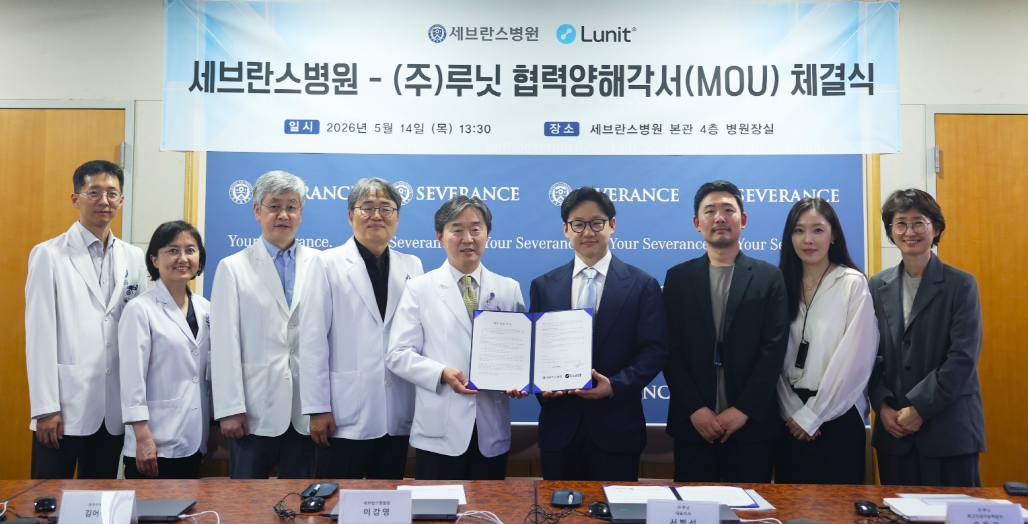
- What Happened: Lunit signed an MOU with Severance Hospital to co-develop medical AI based on medical science foundation models and deploy them in clinical settings.
- Numbers: Planning expansion of clinical deployment in major domestic large-scale hospitals (specific contract value undisclosed).
- Implication: This strategy reflects Lunit’s focus on securing real-world data for its medical AI foundation models by partnering with domestic tertiary hospitals, alongside its global SaaS expansion. Improving model performance using Severance’s EMR-linked data may also provide an advantage for FDA/CE approval strategies.
Lunit — US Subscription-based AI Expansion & Digital Pathology M&A

- What Happened: Lunit is expanding its subscription-based AI business in the US market, drawing attention for its growth potential within the global digital pathology M&A landscape.
- Numbers: Surpassed 930,000 cumulative SaaS contracts.
- Implication: The acceleration of M&A in the global digital pathology market offers opportunities for Korean AI medical companies like Lunit to act as acquisition targets or strategic partners. The recurring revenue structure from subscriptions is also viewed positively for profit stability.
Samsung Electronics — Resumption of Final Negotiations with Union

- What Happened: Samsung Electronics and its labor union resumed final negotiations on May 18 to prevent a strike. Concerns are rising about a massive strike involving over 45,000 members.
- Numbers: Over 45,000 union members; potential direct impact on the Korean economy and global supply chains.
- Implication: If the strike proceeds, it could indirectly impact parts procurement and production for medical device subsidiaries like Samsung Medison, beyond the semiconductor and display sectors. The Korean government is considering emergency mediation to ensure economic stability.
Korean Rare Disease Medical Device Direct Supply Bill — MFDS Medical Device Act Amendment

- What Happened: The Ministry of Food and Drug Safety (MFDS) passed an amendment to the Medical Device Act to establish a government direct-supply system for rare disease medical devices and added a clause banning false expert advertisements generated by AI.
- Numbers: Exact implementation date yet to be determined (enforcement decree finalization in progress).
- Implication: Structural changes are expected as the market for rare disease devices shifts from private distribution to government-led supply. The AI advertising ban signals tighter regulation of digital health marketing.
MFDS/Policy/Regulation (3 Cases)
1. Medical Device Act Amendment — Government Direct Supply for Rare Diseases
- Details: MFDS established grounds for the government to supply medical devices necessary for rare disease patients directly.
- Impact: Shift from private distribution structures; impacts digital health marketing compliance.
2. Violation of GMP Regular Audits — Abolition of Suspension Grace Period
- Details: The 'grace period for sales suspension' upon detection of violations during GMP audits has been effectively abolished or significantly reduced. A 'remedy' judgment only grants a 30-day grace period.
- Impact: Manufacturers/importers must strictly manage inventory and ensure compliance as distribution can be restricted immediately following a 'remedy' judgment.
3. 'Market Immediate Entry' Fast-Track for Innovative Medical Devices — Clinical Entry within 80 Days
- Details: The Ministry of Health and Welfare/MFDS implemented a system to shorten the entry period for innovative medical devices to a minimum of 80 days.
- Impact: Significantly accelerates market entry for startups, though linkage to health insurance reimbursement remains the critical variable for commercialization.
Digital Health/AI Medical (3 Cases)
- Lunit × Severance Hospital: MOU signed for joint development of medical AI foundation models.
- Lunit (US SaaS): Surpassed 930,000 cumulative contracts.
- GI Vita: Digital healthcare startup GI Vita secured 4.5 billion KRW in Series A funding to develop digitized medical protocols for pre-diabetic patients.
Global MedTech Context
- FDA Rejected AI Oversight Easing: Reaffirms that Korean AI medical companies must meet strict clinical data requirements for FDA entry.
- Big Tech Wearables Investment: Samsung Electronics and Apple are heavily investing in wearable-based disease prediction, accelerating competition in the Korean bio-signal data sector.
- Artera: Acquired FDA approval for an AI-based breast cancer risk prediction tool, setting a benchmark for global competitiveness for Korean companies in the oncology field.
Investment/M&A/Listing Trends
- GI Vita Series A: Secured 4.5 billion KRW.
- Artera (US) Investment: Cumulative investment of $90 million (approx. 120 billion KRW), serving as a global investment benchmark for AI medical devices.
Today's Insight
Lunit's dual strategy of securing domestic clinical data through hospital partnerships and building overseas recurring subscription revenue serves as a textbook example for Korean AI medical firms. Meanwhile, the FDA’s firm stance on AI regulation necessitates more rigorous real-world evidence for global expansion. While domestic fast-track systems are lowering barriers to entry, commercial success still hinges on navigating insurance reimbursement.
Weekly Checkpoints
- Samsung Electronics Labor Negotiations: Monitor the outcome of the scheduled May 21 vote on the strike.
- Lunit × Severance MOU: Follow-up on foundation model development roadmaps.
- Rare Disease Medical Device Decree: Check the announcement schedule for implementation decrees following the Medical Device Act amendment.
Reader Action Items
- Practitioners: Review GMP expiration schedules and internal 'remedy' procedures with your legal/QA teams.
- Investors: Analyze Lunit’s US SaaS growth velocity alongside global digital pathology M&A trends to evaluate potential scenarios.
- Founders: Verify the 'Market Immediate Entry' application requirements with the MFDS and integrate insurance reimbursement strategies early into your product roadmaps.
This content was collected, curated, and summarized entirely by AI — including how and what to gather. It may contain inaccuracies. Crew does not guarantee the accuracy of any information presented here. Always verify facts on your own before acting on them. Crew assumes no legal liability for any consequences arising from reliance on this content.
Powered by
