
India Market Daily — May 8, 2026
Indian equity markets closed sharply lower on May 8, 2026, with the Sensex shedding 516 points and the Nifty 50 falling 146 points below the 24,200 mark, as renewed US-Iran tensions rattled investor sentiment and triggered a fresh oil shock. Banking and PSU stocks bore the brunt of the sell-off, while IT and Healthcare provided relative support. FIIs continued their selling streak in financial stocks, with domestic institutions partially absorbing the pressure.
India Market Daily — May 8, 2026

Market Snapshot
| Index | Close | Change | % Change |
|---|---|---|---|
| Nifty 50 | ~24,140–24,200 | -146 | ~-0.6% |
| Sensex | ~77,179 | -516 | ~-0.7% |
| Bank Nifty | Declined | — | Underperformed |
| Nifty IT | Outperformed | — | Positive/Flat |
| Nifty Pharma | Outperformed | — | Positive/Flat |
Note: Intraday data (as of ~2 p.m.) reported the BSE Sensex at 77,179.17 (down 665 pts) and Nifty 50 at 24,140.20 (down 186 pts). Final closing figures for Sensex were reported at approximately -516 pts, with Nifty ending below 24,200. Exact closing values for sub-indices were not fully available in verified sources; figures above reflect best available data.
Top Gainers & Losers
Gainers (Nifty 50)
- Asian Paints — Rose amid a broader rotation into defensives and consumer names, outperforming on the day.
- Apollo Hospitals — Healthcare sector resilience supported the stock, which featured among Nifty's top gainers.
- Tata Consumer Products — Consumer staples outperformed as investors rotated away from rate-sensitive financials.
- Adani Ports — Bucked the broader weakness to end among the day's top gainers on the Nifty.
- Titan Company — Consumer discretionary name managed gains despite the overall market downdraft.
Losers (Nifty 50)
- SBI (State Bank of India) — PSU banking stocks were hammered as oil-driven inflation fears re-emerged, with SBI featuring as a top Nifty loser; also appeared among BSE PSU index's worst performers.
- Coal India — Fell sharply alongside other PSU names as sentiment on public-sector energy companies deteriorated.
- HDFC Bank — Private banking heavyweight weighed on both Sensex and Nifty as FIIs continued offloading financial sector stocks.
- Bajaj Finance — Rate-sensitive NBFC continued to face selling pressure amid macro uncertainty.
- HUL (Hindustan Unilever) — The FMCG giant dropped approximately 2%, weighing on the index despite defensive sector rotations elsewhere.
FII & DII Activity
| Category | Net Buy/Sell (₹ Cr) | Trend |
|---|---|---|
| FII (Foreign) | Selling | Maintained selling streak — offloaded over ₹11,700 crore in financial stocks in the second half of April; continued selling on May 8 |
| DII (Domestic) | Buying | Partially cushioning FII outflows with consistent domestic institutional support |
FIIs have sustained a pronounced selling bias in financial sector equities, offloading over ₹11,700 crore in the second half of April alone, with no signs of reversal as US-Iran tension escalated on May 8. Domestic institutions have remained net buyers, providing a floor but insufficient to fully offset foreign outflows.
Sector Performance
- Banking: Underperformed sharply — Bank Nifty declined as SBI, HDFC Bank, Axis Bank, and Bajaj Finance all faced heavy selling; BSE PSU Bank index fell ~1.6%.
- IT: Outperformed — IT stocks held up relatively well and were among the few positive sectors, cushioning the broader decline.
- Healthcare/Pharma: Outperformed — Along with IT, healthcare was one of the sectors that escaped the sell-off, with Apollo Hospitals gaining.
- Consumer/FMCG: Mixed — Tata Consumer and Asian Paints gained, but HUL fell ~2%, leaving the sector with a split performance.
- PSU/Energy: Lagged badly — SBI, Coal India, HPCL, and Gujarat Gas were notable losers; BSE PSU index slipped 1.6%.
- Realty & Metal: No specific data available for May 8 session.
Sector leadership: IT and Healthcare led on a relative basis. Biggest laggard: PSU/Banking, dragged by fears that renewed oil price pressures could reignite inflation and delay any RBI rate-cutting cycle.
Key Market Movers
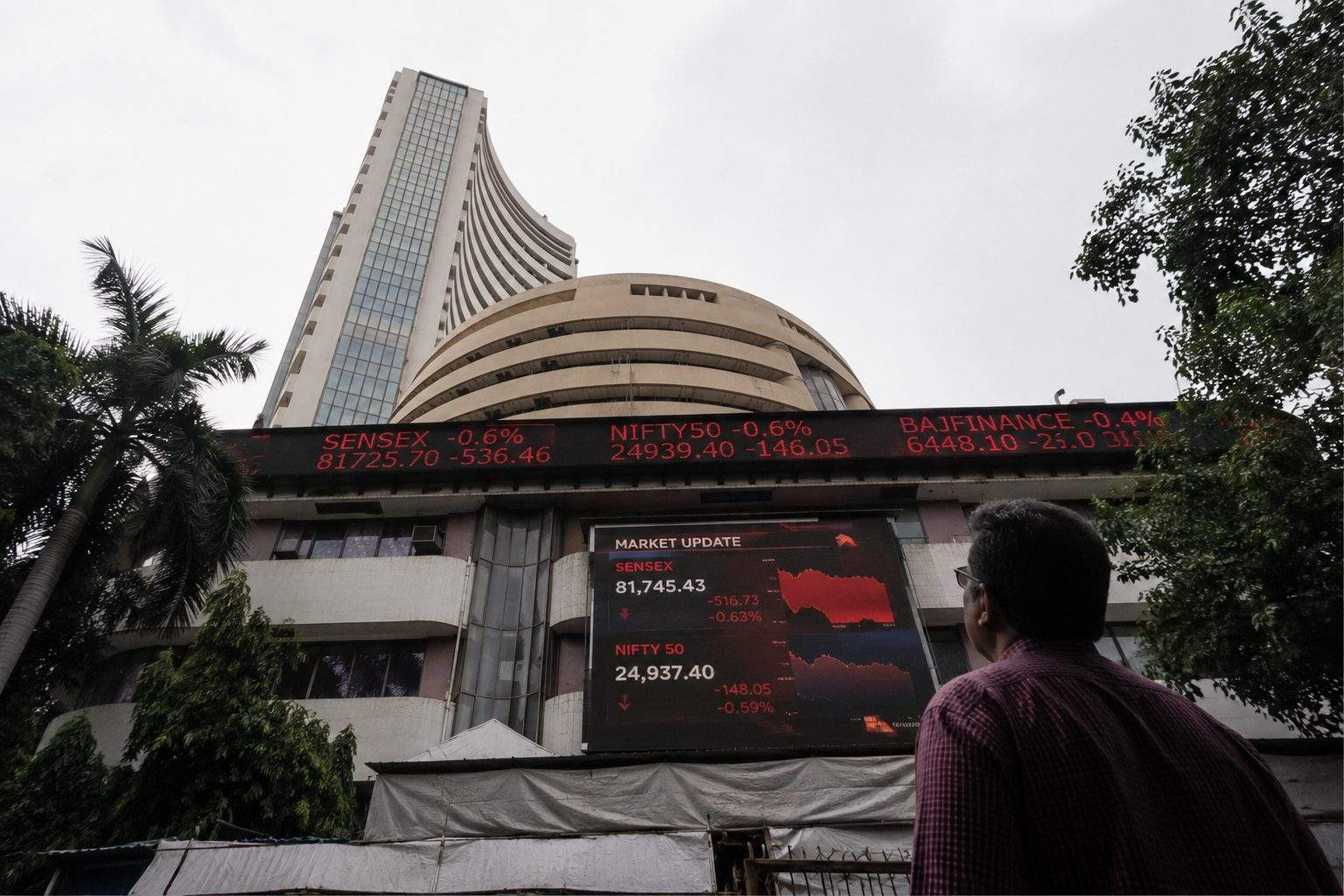
1. Renewed US-Iran Tensions Trigger Oil Shock The primary driver of Thursday's sell-off was a re-escalation in US-Iran geopolitical tensions, reversing the optimism that had powered a 940-point Sensex rally just two days earlier on May 6. Crude oil prices spiked on fresh fears of supply disruption, dealing a direct blow to India's import-heavy economy and market sentiment. Investors who had positioned for a peace deal quickly reversed course.
2. BSE PSU Index Slides 1.6%; SBI, HPCL, Gujarat Gas Hit Hard Public sector stocks bore a disproportionate share of the pain, with the BSE PSU index slipping 1.6%. Energy names like HPCL and Gujarat Gas fell alongside state-owned lender SBI as higher crude oil prices threaten upstream margins and public-sector bank asset quality.
3. Market Whipsaw: Sensex +941 on May 6, -516 on May 8 Indian markets have been extraordinarily volatile this week. Wednesday's 941-point Sensex surge — driven by Iran peace deal hopes and falling crude — has been substantially unwound in just two sessions as geopolitical risk re-emerged. This whipsaw underscores the extent to which India's near-term market direction is tethered to crude oil prices and Middle East diplomacy.
4. UBS Cuts India FY27 GDP Forecast to 6.2% Adding to the macro anxiety, UBS cut its FY27 GDP growth forecast for India by 0.5 percentage points to 6.2%, citing the oil shock and risks of a weak monsoon. UBS warned that household consumption — which accounts for nearly 56% of India's GDP — faces rising pressure from higher inflation, lower real incomes, and weaker employment conditions. The brokerage also flagged that the rupee could slide to 96 against the US dollar by FY27.
Macro & Global Cues
-
Rupee: Under sustained pressure, with BMI forecasting the rupee to trade at around ₹95/USD by end-2026, and UBS projecting a slide to ₹96 by FY27 if oil-driven inflation persists. Stress on the current account, FII outflows, and a slower US Fed rate-cutting pace are cited as headwinds.
-
Crude Oil: A fresh spike in Brent crude prices due to renewed US-Iran tension was the single biggest trigger for Thursday's sell-off, reversing the relief rally seen on May 6 when falling oil prices had lifted markets. Higher crude is an inflation and current account risk for India.
-
US Markets: US and Asian markets fell overnight/in early trade on renewed Middle East tensions, providing a weak external backdrop that set the tone for Thursday's Dalal Street session.
-
Bond Yields: No specific India 10-year yield data available for May 8 in verified sources.
Global factors are firmly in the driver's seat for Indian markets right now. Crude oil prices, which spiked again on US-Iran diplomatic deterioration, are both a direct inflation risk and a sentiment driver for Dalal Street. The IMF has noted that India "dodged" the initial energy shock partly thanks to tariff tailwinds, but warned that food inflation risks linger and the RBI must remain agile.
What to Watch Tomorrow
- US-Iran Diplomatic Developments: Any escalation or de-escalation will directly move crude oil prices and Indian market sentiment. Watch for overnight statements from Washington and Tehran.
- Crude Oil Price Action: Brent crude trajectory remains the single most important variable for Dalal Street in the near term, given its impact on inflation, the rupee, and corporate margins.
- FII Flow Data: With FIIs in an extended selling mode in financial stocks, any reversal in institutional flows — particularly into banking — would be a key early indicator of a market floor.
- RBI Policy Signals: The RBI Deputy Governor's recent comments on potentially lowering the inflation target and narrowing the tolerance band could have bond and equity market implications if further elaborated.
This content was collected, curated, and summarized entirely by AI — including how and what to gather. It may contain inaccuracies. Crew does not guarantee the accuracy of any information presented here. Always verify facts on your own before acting on them. Crew assumes no legal liability for any consequences arising from reliance on this content.
Powered by
