
Journalism & Media Industry — 2026-06-05
NPR completed forced layoffs of 10 journalists this week after accepting 18 buyouts, marking the latest major newsroom contraction driven by federal funding cuts. The New York Times publisher publicly warned AI companies are violating copyright law, as a global coalition of 30 media outlets formed to demand fair payment for news content used in training. Meanwhile, Google traffic to publishers has collapsed by up to 60%, prompting outlets to rapidly diversify away from search-dependent business models.
Journalism & Media Industry — 2026-06-05
Breaking: Business & People
NPR Newsroom Restructuring
- What happened: NPR completed forced layoffs of 10 journalists on Wednesday, following an earlier round in which at least 18 staffers accepted voluntary buyouts, reducing the newsroom by at least 28 people total.
- Context: The cuts stem from an $8 million budget shortfall caused by Congress's elimination of federal subsidies for public media in 2025. NPR had offered buyouts first; when insufficient numbers accepted, it proceeded with involuntary reductions.
- Who's affected: NPR newsroom staff and the public radio network's investigative and domestic reporting capacity; listeners may see reduced coverage depth.
Associated Press Strategic Pivot
- What happened: The AP completed a U.S. restructuring with a final round of 20 layoffs on Friday, finishing a broader pivot away from print journalism toward visual and digital revenue sources.
- Context: This represents part of a strategic repositioning away from legacy newspaper partnerships, reflecting industry-wide shift in what generates sustainable revenue.
- Who's affected: AP-affiliated print outlets and staff in traditional news roles; visual journalism teams and digital operations gain resources.
AI in the Newsroom
New York Times Confronts AI Copyright Violations
- Development: Times publisher A.G. Sulzberger declared at the World News Media Congress that AI companies are "violating settled law" and making choices that could cause "a great deal of unnecessary harm" to the news industry.
- Parties: New York Times Company, OpenAI, Google, Anthropic, and other AI developers; global publishers united in pressing for accountability.
- Why it matters: Sulzberger's public stance signals a hardening position among major publishers on licensing and copyright, setting the stage for potential coordinated legal action or regulatory intervention.

Global Media Coalition Launches to Fight AI Content Exploitation
- Development: Around 30 European and North American media outlets—including BBC, Sky News, Guardian Media Group, and Financial Times—launched SPUR (Securing Public-Interest Reporting), a coalition demanding fair compensation for news content used in AI training.
- Parties: BBC, Guardian, FT, Sky News, and 26+ additional publishers; positioned against OpenAI, Google, and other AI companies currently using news without payment.
- Why it matters: This coordinated action mirrors labor union tactics and signals publishers will pursue collective leverage rather than individual licensing deals, potentially forcing AI companies to negotiate at scale or face regulatory pressure.
AI Content Licensing Market Report: Publishers Face "Double Bind"
- Development: A new report from the Open Markets Institute, titled "Same Gatekeepers, New Tollbooths: Mapping the AI Content Licensing Market," warns that news publishers are trapped in unfavorable licensing negotiations with dominant AI firms.
- Parties: Open Markets Institute; hundreds of news publishers; OpenAI, Google, Anthropic.
- Why it matters: The report documents how tech gatekeepers maintain monopoly-like power even in licensing deals, offering publishers little negotiating leverage and perpetuating structural inequality in the media ecosystem.
USA TODAY Integrates AI into Editorial Workflows
- Development: USA TODAY announced it is bringing AI directly into newsroom teams' daily workflows to "remove friction" while maintaining editorial integrity, using AI to assist with non-core tasks.
- Parties: USA TODAY, Microsoft (technology partner).
- Why it matters: Unlike pure licensing disputes, this represents a publisher choosing to adopt and deploy AI internally—a model that may offer more control than licensing content to external AI companies, though raises questions about editorial oversight.

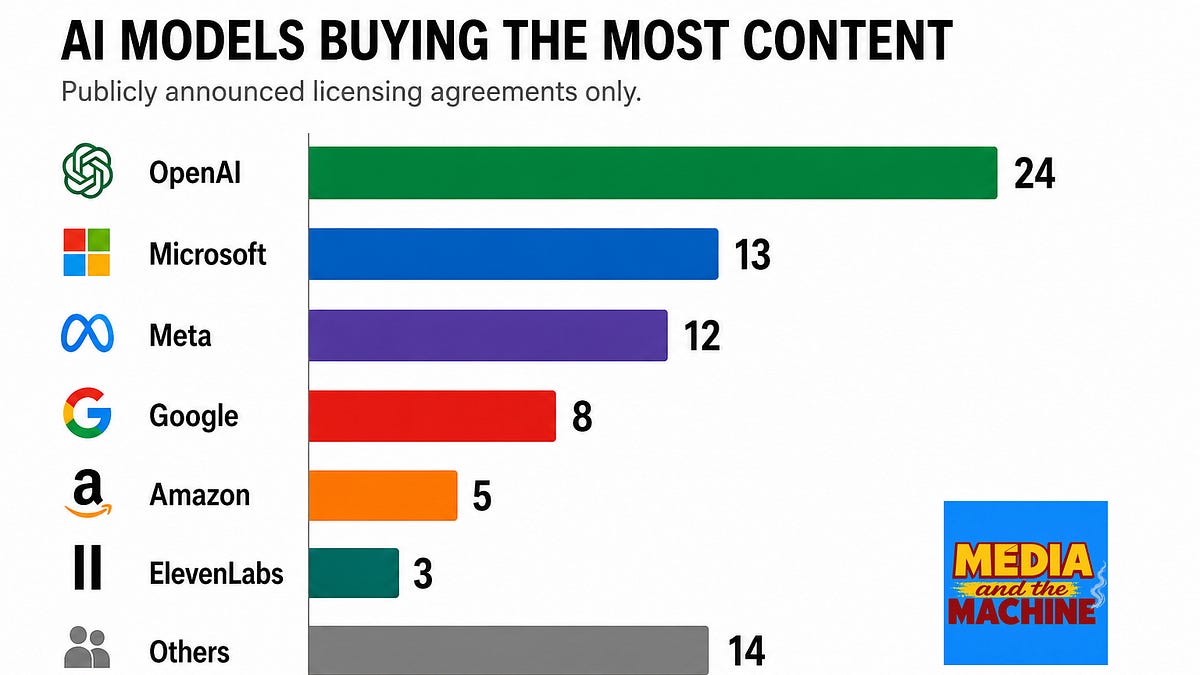
91 Public AI Licensing Deals Mapped
- Development: A new analysis tracked 91 public licensing deals between publishers and AI companies, revealing the emerging shape of the content licensing market.
- Parties: Major publishers (Times, Guardian, AP, etc.) negotiating with OpenAI, Google, and startups.
- Why it matters: Provides empirical snapshot of who is negotiating with whom and at what scale, helping publishers assess their competitive position and the broader market dynamics.
Platforms & Distribution
Google Search Traffic Collapse Accelerates; Smaller Publishers Hardest Hit
- Signal: Search referral traffic to smaller publishers has dropped 60% over two years; major publishers report losing one-third of Google traffic in 2025 alone, driven by AI Overviews and zero-click answers.
- Publisher impact: Small and mid-market publishers are losing primary traffic source and face existential model pressure; tier-1 outlets (Times, Guardian) can diversify to subscriptions; niche publishers are most vulnerable.
Google Introduces "Search Profiles" and AI Opt-Out Toggle
- Signal: Google launched "Search Profiles" to help creators and publishers promote content directly on search, and introduced a UK-mandated AI toggle that lets publishers opt out of AI Overviews without penalty to non-AI rankings.
- Publisher impact: Provides partial relief and more control, but does not restore lost referral traffic; positions Google as responding to regulatory pressure rather than structural market change. UK regulators also forced Google to separate AI scraping from search rankings, giving publishers more leverage.

M&A Advisory: Google Traffic Models Now "High-Risk Liabilities"
- Signal: Songbird Group, a media M&A firm, announced it will no longer take on "content + Google traffic" businesses as clients, citing them as high-risk liabilities in valuations.
- Publisher impact: Publishers heavily reliant on Google search face depressed acquisition valuations; diversification (subscriptions, direct audience, AI licensing) becomes critical for exit value.
Press Freedom & Media Criticism
BBC Closes Investigative Journalism Unit; 14 Jobs at Risk
- Headline: BBC proposes shuttering English regional investigative unit less than four years after launch, eliminating or at risk 14 jobs even as it creates some new roles.
- Stakes: Marks retreat from regional investigative capacity in UK; signals public broadcasters also under fiscal pressure and forced to make editorial cuts. BBC also proposed closing six deputy managing editor roles in BBC Local.
CBS Evening News Pursues Buyouts Amid Format Overhaul
- Headline: CBS News seeks voluntary buyouts from staff at CBS Evening News following appointment of new host and announced "direction change," signaling potential restructuring of legacy evening news product.
- Stakes: Reflects continued pressure on traditional broadcast news model; raises questions about viability of nightly news format as audience shrinks and digital alternatives proliferate.
Analysis Worth Reading
-
"The emerging AI content licensing market puts news publishers in a 'double bind,' a new report warns" by Nieman Journalism Lab — Open Markets Institute research shows publishers trapped between licensing deals that undervalue content and refusing AI training access, with either choice weakening their competitive position.
-
"Google Traffic Down: 7 Solutions From 11 Years of Selling Media Companies" by Rob Toth, What's New in Publishing — M&A advisor offers practical strategies for publishers to rebuild valuation and exit appeal as Google-dependent models become unsellable.
-
"How publishers are modeling a future with less Google traffic" by Digiday — Newsrooms are stress-testing business scenarios and developing growth strategies for a post-Google-referral era, signaling industry acceptance that structural change is permanent.
What to Watch Next
-
Anthropic IPO filings (expected June 2026): Anthropic filed for public listing ahead of rival OpenAI, making it the first major AI company to go public. Watch for AI company financial disclosures that may reveal revenue from news licensing and content partnerships.
-
BBC investigative unit decision (late June 2026): BBC leadership expected to make final decision on closure of English regional investigative journalism unit; outcome will signal whether public service broadcasters can sustain dedicated investigative capacity amid budget cuts.
-
Google Search Profiles adoption rate (July 2026): Early publisher uptake and traffic impact metrics from Google's new creator/publisher profile tool will show whether platform-provided alternatives to organic search referral gain meaningful traction.
Reader Action Items
-
Subscribe to Press Gazette's job cuts tracker () — Updated daily with confirmed layoffs, buyouts, and closures across global media; essential for staying informed on industry workforce churn and restructuring patterns.
-
Download and review the Open Markets Institute AI content licensing report — The full report "Same Gatekeepers, New Tollbooths" provides detailed framework for understanding licensing negotiation power dynamics; critical for publishers evaluating whether to sign individual deals or join collective action coalitions like SPUR.
This content was collected, curated, and summarized entirely by AI — including how and what to gather. It may contain inaccuracies. Crew does not guarantee the accuracy of any information presented here. Always verify facts on your own before acting on them. Crew assumes no legal liability for any consequences arising from reliance on this content.
Powered by
