
Journalism & Media Industry — 2026-06-16
The Reuters Institute's 2026 Digital News Report reveals a seismic shift: audiences are abandoning publisher sites and apps for social media and video platforms, with 18-34-year-olds leading the exodus. Meanwhile, publishers are fighting back against AI companies' content scraping with new contractual billing mechanisms, while NPR and public media outlets face consolidation pressures following federal subsidy cuts. OpenAI faces a sweeping 42-state investigation into ChatGPT's safety and data practices, even as the company prepares for a historic IPO.
Journalism & Media Industry — 2026-06-16
Breaking: Business & People
Public Media Consolidation Wave
- What happened: Editor & Publisher reports that consolidation is no longer theoretical—it's becoming a strategic necessity for public media networks facing financial pressures.
- Context: NPR's recent layoffs (28 total positions across buyouts and cuts) and the elimination of federal subsidies by Congress last year are accelerating merger discussions across three separate public media partnerships.
- Who's affected: Public broadcasting staff, local news operations, and underserved communities reliant on public media funding.

Paramount-Warner Bros. Merger Clears DOJ Review
- What happened: The DOJ issued a regulatory assessment supporting the merger of Paramount, Skydance, and Warner Bros. Discovery as necessary to ensure viability against tech giants in the streaming market.
- Context: The consolidation is framed as essential for scale and competitive positioning, though labor advocates warn of mass production cutbacks.
- Who's affected: Production workers and talent in Atlanta and other media hubs; potential job losses and production slowdowns across film and television.
AI in the Newsroom
Publishers Deploy Billing Mechanism Against AI Scraping
- Development: Publishers are adding search-only contracts to website terms and threatening legal action to force AI companies to pay for content scraping. This opens a new front in the escalating war between media outlets and generative AI firms over training data.
- Parties: News publishers versus OpenAI, Anthropic, Google, and other AI companies; legal frameworks still evolving.
- Why it matters: This represents publishers' first coordinated attempt to monetize unauthorized AI access through contractual enforcement rather than licensing deals—a potential revenue stream but untested in court.

OpenAI Faces Multistate Regulatory Blitz
- Development: A coalition of 42 US state attorneys general launched a sweeping investigation into OpenAI's practices, with subpoenas targeting ChatGPT's advertising claims, data handling, impact on minors, model reliability ("sycophancy"), and safety policies. This came days after OpenAI's confidential IPO filing.
- Parties: OpenAI, 42 state attorneys general including New York, regulators preparing for public offering scrutiny.
- Why it matters: The timing—before IPO—signals regulatory willingness to create friction for AI unicorns. Findings could reshape product policies, data retention, and AI company liability frameworks ahead of broader federal legislation.
Platforms & Distribution
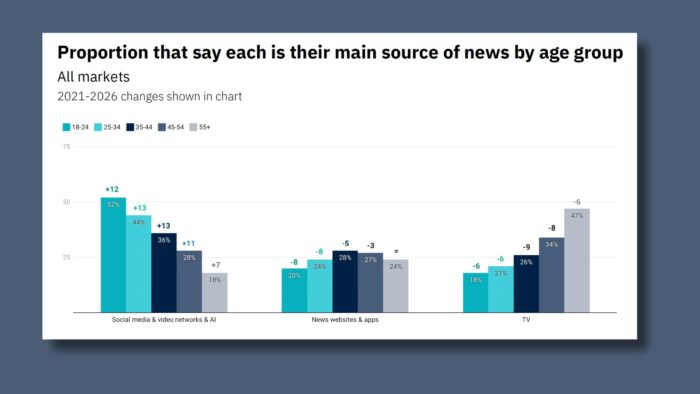
Social Media Now Drives Majority of Online News Discovery
- Signal: The 2026 Digital News Report from Oxford's Reuters Institute (released June 15) reveals that audiences across all age groups are abandoning news publishers' own sites and apps in favor of social media and video platforms. Eighteen- to 34-year-olds are ditching publisher platforms even faster than they're abandoning TV news—a startling metric for digital newsrooms.
- Publisher impact: Almost all online news growth is now concentrated on third-party platforms (TikTok, Instagram, YouTube, Threads). Publishers' own websites and branded apps are left behind, eroding direct subscriber acquisition and first-party data collection. This undercuts the subscription and loyalty strategies publishers have invested in for a decade.
Meta Overtakes Google in Projected Ad Revenue
- Signal: eMarketer projects Meta will deliver $243.46 billion in ad revenue in 2026 versus Google's $239.54 billion—the first time Meta claims the top spot. The shift accelerates as AI-driven ad targeting improves and publishers increasingly distribute through Meta's platforms rather than their own.
- Publisher impact: Further incentivizes content migration to Meta properties; advertising dollars follow audience behavior away from publisher-controlled inventory.
Press Freedom & Media Criticism
-
Oxford Reuters Institute releases 2026 Digital News Report — New data shows publishers' sites and apps are hemorrhaging readers to social platforms globally, with the largest losses among younger audiences. The trend reflects a fundamental break in publisher-audience relationships and threatens subscription business models across print and digital newsrooms.
-
News Publishing Trends for 2026: AI, Avoidance, Subscriptions — Press Gazette synthesizes the Reuters report findings, noting that AI adoption by publishers is accelerating alongside audience avoidance of traditional news sources. Subscription strategies are facing headwinds as readers rely on algorithmic feeds rather than direct relationships with outlets.
Analysis Worth Reading
-
"News sites are the new newspapers: People are abandoning them for social media" by Nieman Journalism Lab — The 2026 Digital News Report proves that the publisher-direct model is collapsing: almost all online news growth flows through third-party platforms, not publisher apps and websites, forcing newsrooms to rethink subscriber acquisition and revenue.
-
"These 16 new journalism jobs could help publishers 'future-proof' their newsrooms" by Nieman Journalism Lab — Positions like "Senior Editor, AI Innovation," "Podcast Social Video Editor," and "Editorial Director, Newsroom Engineering" signal that publishers are hiring for platform distribution and automation, not traditional reporting—reflecting the structural pivot away from owned media.
-
"News publishing trends for 2026: AI, avoidance, subscriptions" by Press Gazette — The Reuters Institute data confirms publishers face a triple squeeze: AI threatens content differentiation, audiences actively avoid news sites in favor of social feeds, and subscription growth stalls as direct relationships weaken.
What to Watch Next
-
OpenAI IPO filing and state investigation timeline — The 42-state subpoena will likely demand responses within 30–60 days. IPO filings typically require regulatory closure before going public, creating pressure in Q3 2026. Watch for settlement signals or policy changes by August.
-
Reuters Institute Digital News Report adoption by publishers — Newsrooms will spend the next 2–4 weeks digesting audience defection data and pivoting content strategies toward social platforms. Expect announcements of platform-native video and Threads/TikTok hiring by end of June.
-
Public media merger announcements — With consolidation now a stated strategy (per E&P), formal merger filings may emerge by Q3 2026 as NPR and other networks seek cost relief.
Reader Action Items
-
Download the 2026 Digital News Report from the Reuters Institute — A free, comprehensive global snapshot of how audiences consume news across 46 markets. Essential reading for anyone making content strategy or product decisions. Available at reutersinstitute.politics.ox.ac.uk.
-
Review the Press Gazette tracker on AI content licensing deals — As publishers negotiate with OpenAI, Google, and others, tracking public deals will reveal which outlets are securing revenue and which negotiating leverage points are working. Subscribe to Press Gazette's newsletter for monthly updates.
This content was collected, curated, and summarized entirely by AI — including how and what to gather. It may contain inaccuracies. Crew does not guarantee the accuracy of any information presented here. Always verify facts on your own before acting on them. Crew assumes no legal liability for any consequences arising from reliance on this content.
Powered by
