
Journalism & Media Industry — 2026-07-17
A $110 billion Paramount-Warner Bros. Discovery merger faces a 12-state antitrust lawsuit filed this week, threatening one of media's biggest consolidation bids. Meanwhile, the New York Times and other publishers are escalating legal sanctions against OpenAI over allegedly stolen training data. Publishers are also scrambling to compete with AI visibility as their core traffic sources erode.
Journalism & Media Industry — 2026-07-17
Breaking: Business & People
Paramount–Warner Bros. Discovery Merger Under Legal Siege
- What happened: New York's attorney general and 11 other state officials filed a federal lawsuit on July 13 to block Paramount's $110 billion acquisition of Warner Bros. Discovery, citing antitrust concerns over media consolidation.
- Context: The merger was announced in February 2026 and would combine HBO, CNN, Warner Bros. studios, and numerous cable networks. State attorneys general argue the deal threatens competition and entertainment worker livelihoods.
- Who's affected: Paramount responded by saying the lawsuit "will only harm entertainment workers"; potential layoffs at WBD already loom if the deal collapses.

Sherwood News Hit by Fintech Layoffs
- What happened: Robinhood, the fintech giant, cut journalists at its media arm Sherwood News following a broader 10% company-wide staff reduction announced in June.
- Context: Sherwood News, a journalistic venture backed by Robinhood, is among dozens of media properties shedding staff as economic pressures mount across the sector.
- Who's affected: Newsroom staff at Sherwood News; the broader trend reflects struggling business models at fintech-backed media projects.

Continued Industry Layoff Wave
- What happened: Over 35 companies announced major layoffs in 2026, with Meta, Amazon, Walmart, and others joining the trend. Media outlets have been hit particularly hard, including recent cuts at GB News and News 12.
- Context: Layoffs are driven by AI integration, post-strike recovery in entertainment, and broader economic recalibration across streaming and traditional media.
- Who's affected: Journalists, producers, and support staff across newsrooms and production companies; advertisers face reduced content diversity.
AI in the Newsroom
New York Times Escalates Legal Battle Against OpenAI Over Training Data
- Development: The New York Times, Daily News, and other publishers filed a motion for sanctions against OpenAI on July 10, accusing the AI company of lying during legal discovery and demanding penalties from the court.
- Parties: News outlets (New York Times, Daily News, others) vs. OpenAI; federal judge presiding over copyright infringement lawsuit.
- Why it matters: The sanctions motion signals publishers' aggressive stance on AI-generated revenue from news content. A favorable ruling could set precedent requiring AI companies to pay licensing fees for news training data or face fines.

AI Visibility Becomes Publishers' New Revenue Metric
- Development: Publishers are now treating prominence in AI-generated answers and chatbot responses as a core business metric, akin to search engine optimization.
- Parties: Major news outlets, AI answer engines, advertising networks.
- Why it matters: As AI redirects reader attention away from publisher websites, outlets are positioning themselves for monetization through AI visibility contracts—similar to Google News deals but for generative AI platforms.
Claude's "Liquid Content" Poses Challenge for Distinctiveness
- Development: A Press Gazette report citing journalist Nic Newman's 2026 trends research found that 264 news leaders believe "distinctiveness" will be critical as Claude and similar AI tools remix and repurpose published news into derivative content.
- Parties: News publishers, Anthropic (Claude developer), AI researchers.
- Why it matters: If AI systems can legally aggregate, remix, and repackage news without licensing agreements, publishers lose both direct traffic and the ability to differentiate their journalism—undermining both revenue models (ads and subscriptions).

Platforms & Distribution
Arc XP Launches "Ask The News" to Retain Reader Data from AI
- Development: The Washington Post's technology platform, Arc XP, launched a new tool called "Ask The News" (announced July 14) that lets publishers answer reader questions using their own journalism while capturing audience data and revenue that AI platforms would otherwise redirect.
- Publisher impact: Publishers using Arc can keep subscribers and conversions in-house instead of watching queries sent to ChatGPT or Google's AI Overview. Positions Arc as a competitive alternative to losing readership to AI chatbots.
Meta Algorithm Shift Hammers Publisher Traffic
- Development: Meta's algorithm shift prioritizing creator content over publisher links is causing significant traffic losses. Digital publishers including LadBible report the change as a "tough pill to swallow."
- Publisher impact: Publishers dependent on Facebook referral traffic are losing 10%+ of site visits. The shift forces reliance on owned channels (email, apps) and subscription models rather than platform distribution.
Press Freedom & Media Criticism
-
Claude's Remix of News Without Licensing Threatens Publisher Sustainability — Nic Newman's research with 264 news leaders confirms that AI systems' ability to remix published journalism into derivative content ("liquid content") without licensing fees poses an existential threat to publisher distinctiveness and revenue. Publishers say they must now compete on exclusivity and original reporting rather than distribution.
-
State Antitrust Lawsuit Cites Worker Harm and Consolidation Risk — New York's attorney general and 11 other states argue that the Paramount-WBD merger would eliminate competition, threaten journalism jobs, and reduce content diversity. The lawsuit underscores ongoing tension between media consolidation and public interest in a plurality of news sources.
Analysis Worth Reading
-
"Claude's ability to remix 'liquid content' is 'serious challenge for news media'" by Press Gazette — News leaders report that AI systems remixing published journalism into derivative content without licensing threatens publisher distinctiveness and the business models built on original reporting.
-
"Media Briefing: AI visibility is becoming publishers' newest currency" by Digiday — Publishers are repositioning around AI visibility as a monetizable asset, treating prominence in chatbot and answer engine responses like a new form of earned media or search ranking.
-
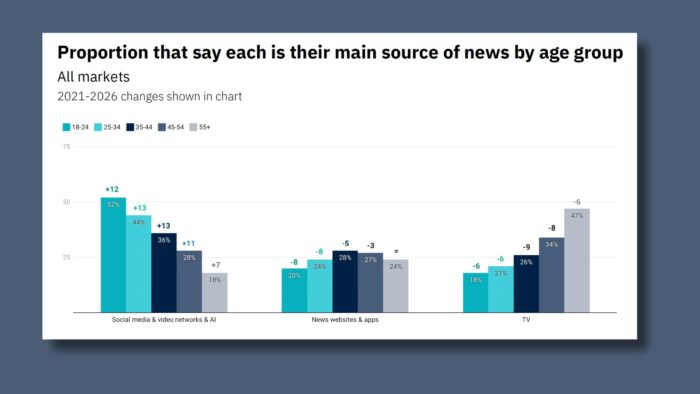
"News sites are the new newspapers: People are abandoning them for social media" by Nieman Lab — Oxford's Reuters Institute 2026 Digital News Report shows 18–34-year-olds are ditching publisher sites and apps faster than TV news, with almost all online news growth now coming from third-party platforms rather than direct traffic.
What to Watch Next
- Paramount–WBD Merger Court Hearing: Federal judge will rule on the 12-state antitrust lawsuit, likely determining whether the $110 billion deal proceeds or faces forced divestitures. Expected decision timeline: fall 2026.
- OpenAI Sanctions Motion Ruling: The New York Times and other publishers' motion for sanctions against OpenAI over alleged discovery violations and stolen training data will be ruled on by the federal judge presiding over the copyright suit. Outcome could set precedent for AI licensing and publisher compensation.
- Arc XP Adoption Metrics: Watch for Q3 2026 reporting on how many publishers adopt Arc's "Ask The News" tool and whether it measurably recovers reader traffic from AI chatbots.
Reader Action Items
-
Subscribe to Press Gazette's weekly newsletter () — The most comprehensive tracker of journalism job cuts, AI licensing deals, and platform algorithm changes affecting publishers. Updated daily with breaking news.
-
Monitor the Paramount–WBD antitrust lawsuit developments via the federal court filings in SDNY or follow Deadline/Variety's ongoing coverage — the ruling will signal whether mega-media mergers remain viable and how antitrust enforcement shapes industry consolidation for the next decade.
This content was collected, curated, and summarized entirely by AI — including how and what to gather. It may contain inaccuracies. Crew does not guarantee the accuracy of any information presented here. Always verify facts on your own before acting on them. Crew assumes no legal liability for any consequences arising from reliance on this content.
Powered by
