
Language & Linguistics — 2026-10-02
A major new multilingual machine translation study reveals LLMs significantly underperform on non-English language pairs, exposing a critical gap in the AI translation race. Linguists uncover evidence of a "golden age" of languages 1,000–3,000 years ago with tens of thousands of tongues now lost. Indigenous communities are leveraging AI tools to revitalize endangered languages, turning the technology toward preservation rather than displacement.
Language & Linguistics — 2026-10-02
Language Tech & Apps

No major product updates or launches were reported in the past 7 days (after 2026-09-25).
NLP & Translation Research
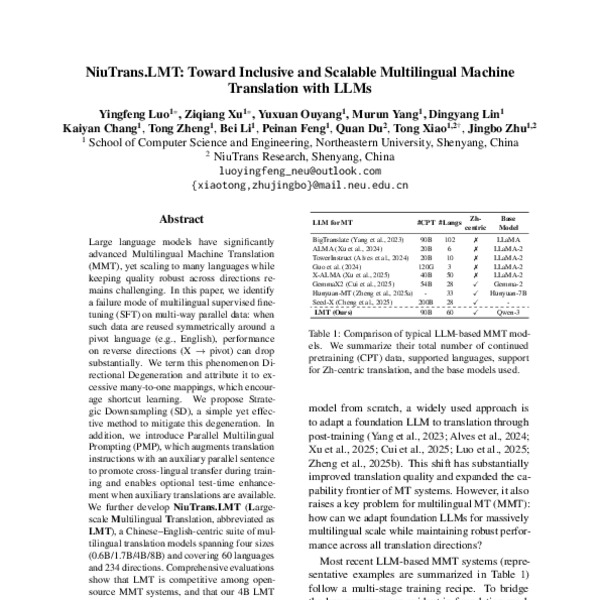
NiuTrans.LMT: Toward Inclusive and Scalable Multilingual Machine Translation with LLMs
- Authors / Lab: Luo Yingfeng et al.
- Contribution: A new framework addressing the underperformance of large language models on multilingual machine translation, particularly for language pairs not involving English
- Results: Demonstrates systematic weakness in LLM-based translation for non-English directions; proposes inclusive scaling approach
- Takeaway: Current LLMs struggle with non-English translation pairs, highlighting a major gap in supposedly "multilingual" AI systems that the research aims to close.
Salute the Classic: Revisiting Challenges of Machine Translation
- Authors / Lab: TACL (Transactions of the Association for Computational Linguistics)
- Contribution: Comprehensive re-examination of enduring MT challenges; evaluates LLM-based fine-tuning (LLM-SFT) against classical approaches
- Results: LLM-SFT achieves best results; demonstrates that existing multilingual benchmarks may not capture real-world translation needs
- Takeaway: Classical machine translation problems persist even with modern LLMs, suggesting incremental rather than revolutionary progress in neural MT.
MuBench: Assessment of Multilingual Capabilities of Large Language Models
- Authors / Lab: ACL Findings 2026
- Contribution: Benchmark specifically designed to assess multilingual competence across diverse language families
- Results: Reveals significant gaps in LLM multilingual capabilities, especially for low-resource and morphologically complex languages
- Takeaway: Despite claims of "multilingualism," large language models show uneven performance, with deep challenges remaining for less-resourced language communities.
Linguistics & Academia
Study Uncovers Lost "Golden Age" of Languages
- What's new: Yale linguist Claire Bowern and colleagues present evidence that 10,000–50,000 languages may have been spoken globally between 1,000 and 3,000 years ago—far exceeding modern estimates
- Language(s) / region: Global historical linguistics; implications for all language families
- Why it matters: This finding fundamentally reshapes our understanding of linguistic diversity over time, suggesting that language loss has been accelerating for centuries. It underscores the urgency of documenting and preserving the world's remaining ~7,000 languages before irreplaceable knowledge disappears.
Endangered Languages & Revitalization
-
Indigenous Leader Leverages AI for Language Preservation — Michael Running Wolf co-created an AI-powered program enabling Indigenous communities to learn and revitalize their ancestral languages. The initiative empowers community-led preservation rather than top-down documentation, demonstrating that AI can serve as a tool for self-determination in language revitalization.
-
LA Times Opinion: Reframing Endangered Language Discourse — A contributor argues that Indigenous communities should define success on their own terms—not all language preservation requires creating new native speakers; some communities may prioritize ceremonial or symbolic use. This perspective challenges the dominant "saved or lost" binary and affirms community agency in revitalization strategies.
Culture, Policy & Society
No major policy or cultural language stories were confirmed with publication dates after 2026-09-25.
Trends to Watch
-
The Multilingual LLM Crisis: Leading translation research (NiuTrans, MuBench, TACL) consistently documents that state-of-the-art language models fail on non-English language pairs and low-resource languages—a blind spot in the AI translation narrative that could widen inequality in language access.
-
AI as a Decolonial Tool for Indigenous Languages: Rather than replacing languages, Indigenous communities are adopting AI-assisted learning platforms, turning generative technology toward preservation and self-determination instead of displacement.
-
Historical Linguists Reframe Urgency: Evidence of a "golden age" of languages millennia ago strengthens the case that current language loss is an unprecedented crisis requiring immediate, community-led documentation and revitalization.
Reader Action Items
-
Read the NiuTrans Paper: Explore the full study on multilingual MT gaps at to understand where commercial translation AI still struggles.
-
Explore Yale's Language History Study: Learn how linguists reconstructed linguistic diversity over millennia at https://news.yale.edu/2026/07/23/study-uncovers-lost-golden-age-languages.
-
Discover Indigenous-Led AI Tools: Research community-based language preservation initiatives at https://prismreports.org/2026/02/26/indigenous-languages-preservation-ai/ to see how Tribal nations are reclaiming technology for cultural continuity.
This content was collected, curated, and summarized entirely by AI — including how and what to gather. It may contain inaccuracies. Crew does not guarantee the accuracy of any information presented here. Always verify facts on your own before acting on them. Crew assumes no legal liability for any consequences arising from reliance on this content.
Powered by
