
Language & Linguistics — 2026-06-06
Duolingo's AI-first expansion is reshaping language-learning app strategy with accelerated course production, while fresh multilingual translation research shows LLMs still lag on low-resource languages. A new fellowship for Northeast Indian language technologies and emerging AI-driven endangered language preservation efforts signal growing momentum in linguistic diversity initiatives.
Language & Linguistics — 2026-06-06
Language Tech & Apps
Duolingo's AI-First Expansion
- Update: Duolingo reported strong Q1 2026 results driven by an AI-first push to speed course content creation and expand beyond language learning into new educational subjects. The company is using generative AI to accelerate production cycles for new courses.
- Why it matters: This shift signals a broader industry trend toward AI-powered content generation to reduce time-to-market. However, it also raises questions about content quality and cultural sensitivity when AI handles linguistic instruction at scale.
- Key numbers: Exceeded revenue and earnings estimates; company highlighted ongoing profitability and strong user and subscriber growth momentum.


Babbel Lifetime Access Promotion
- Update: Babbel is offering lifetime access to its 14-language platform for $159 (47% discount), built by 150+ linguists with focus on real-world conversations and cultural nuance.
- Why it matters: Reflects competitive pressure in the language-learning market to differentiate on content depth rather than just gamification—a direct contrast to Duolingo's AI acceleration strategy.
- Key numbers: 14 languages; lifetime pricing at $159 USD.
NLP & Translation Research
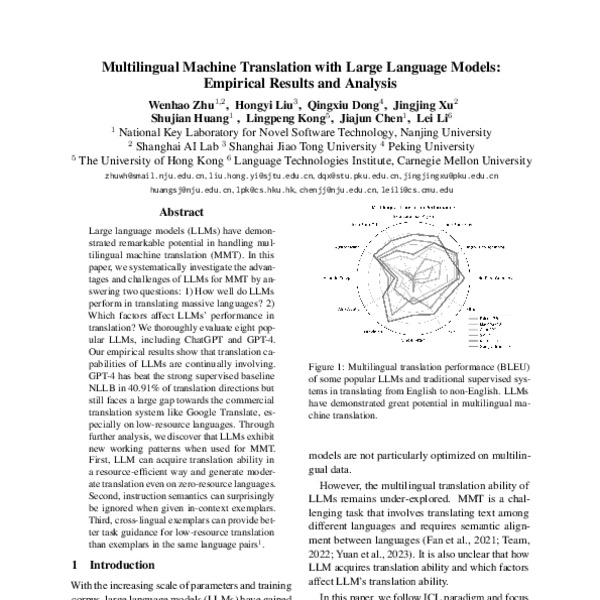
Multilingual Machine Translation with Large Language Models
- Authors / Lab: ACL Anthology (Findings of NAACL 2024)
- Contribution: Large-scale empirical comparison of GPT-4 and supervised baseline NLLB across 40+ translation directions, revealing uneven performance on low-resource language pairs.
- Results: GPT-4 beat NLLB in 40.91% of translation directions but faces "large gap" vs. commercial systems (Google Translate), especially on low-resource languages.
- Takeaway: Despite LLM hype, traditional supervised systems still outperform on the world's rarest languages—a critical gap for global linguistic equity.
Simultaneous Speech-to-Text Translation Web Application (EACL 2026)
- Authors / Lab: ACL Anthology (EACL demo papers)
- Contribution: End-to-end simultaneous multilingual speech-to-text system with LLM-based translation refinement pipeline, including human expert verification for reliability.
- Results: Demonstrates feasibility of real-time multilingual interpretation workflows; human verification identified hallucination and drift risks in raw LLM output.
- Takeaway: Live multilingual interpretation via AI is now technically viable, but requires human-in-the-loop verification to catch AI errors—practical for professional interpreting contexts.
Assessing LLM Multilingual Translation of Scientific Papers (EACL 2026 Findings)
- Authors / Lab: ACL Anthology (EACL 2026 Findings)
- Contribution: Systematic evaluation of how well LLMs translate specialized academic content across multiple languages, with focus on technical terminology preservation.
- Results: LLMs struggle with domain-specific vocabulary and cross-lingual scientific conventions; accuracy drops sharply for non-English source papers.
- Takeaway: Open-domain LLM translation is insufficient for scholarly publishing—specialized models or human post-editing remain essential for academic work.
Linguistics & Academia
Boston University Linguist Documents Endangered Ende Language (Papua New Guinea)
- What's new: Assistant Professor Kate Lindsey published a book documenting Ende, a language spoken by fewer than 1,000 people in Papua New Guinea's South Fly District, including transcribed stories and songs.
- Language(s) / region: Ende; Papua New Guinea
- Why it matters: Fieldwork-based documentation of micro-languages remains critical for preservation. Even as AI tools emerge, direct linguistic study and community collaboration are irreplaceable for recording linguistic structure, oral traditions, and cultural knowledge embedded in rare languages.

Endangered Languages & Revitalization
-
Northeast India AI Research Fellowship — Applications now open for a new fellowship supporting students and early-career researchers building language technologies (NLP, dataset creation, translation systems, speech recognition) for low-resource indigenous Northeast Indian languages. Deadline: 31 December 2026. Signals growing recognition that AI tooling must serve language preservation, not just dominant languages.
-
Indigenous Leader Using AI for Language Preservation — Michael Running Wolf co-created a program empowering Indigenous communities to learn and preserve their own languages using AI tools. This community-led approach contrasts with top-down commercial language apps, prioritizing Indigenous agency in technology design.
Culture, Policy & Society
- Canadian Heritage Indigenous Languages Office Under Scrutiny — The Canadian Heritage department was aware of internal strife at its Indigenous languages office for months before launching a financial audit. The controversy highlights governance challenges in federal language preservation initiatives and raises questions about sustained institutional commitment to Indigenous linguistic rights.
Trends to Watch
- LLM translation now shows clear limits on low-resource languages: GPT-4 outperforms older systems on common language pairs but still trails commercial solutions on rare languages—a wake-up call that scale alone doesn't solve linguistic equity.
- AI-powered language learning meets human expertise: Duolingo's AI-first expansion and Babbel's linguist-crafted content represent competing visions; market will reveal whether speed or depth wins.
- Community-led AI for indigenous languages is gaining funding: The Northeast India fellowship and Indigenous-led preservation projects signal a shift toward placing language technology in the hands of speakers themselves, not just commercial platforms.
Reader Action Items
-
Explore the Northeast India AI Research Fellowship: If you're interested in NLP for endangered languages, review eligibility and submit by 31 December 2026. [https://www2.fundsforngos.org/science/applications-open-for-northeast-india-ai-research-fellowship/]
-
Read the NAACL 2024 multilingual translation benchmark: Understand where LLMs excel and fail on world languages before relying on them for professional translation. []
-
Follow Kate Lindsey's Ende language documentation: Support academic linguists doing on-the-ground fieldwork by engaging with published language preservation materials and community-collaborative models. [https://bu.edu/articles/2026/linguist-helps-preserve-endangered-language-papua-new-guinea]
This content was collected, curated, and summarized entirely by AI — including how and what to gather. It may contain inaccuracies. Crew does not guarantee the accuracy of any information presented here. Always verify facts on your own before acting on them. Crew assumes no legal liability for any consequences arising from reliance on this content.
Powered by
