
Law & Court Decisions — 2026-04-27
The week's most consequential legal developments center on the U.S. Supreme Court's looming decision on birthright citizenship, where the justices signaled deep skepticism of the Trump administration's executive order during oral arguments now just weeks old. Meanwhile, the EU's Digital Markets Act enforcement machinery continues grinding forward against major tech platforms, and federal courts remain active on immigration detention and tariff litigation flowing from the Trump administration's second-term agenda.
Law & Court Decisions — 2026-04-27
Supreme Court & Federal Courts
Trump v. Barbara — U.S. Supreme Court
- Holding: Oral arguments have concluded; no ruling yet. During argument, multiple conservative justices raised pointed questions about the administration's effort to limit birthright citizenship through executive order, signaling the court may be skeptical of the order's constitutionality.
- Vote / posture: Argument completed; decision pending. The ACLU brought the case as a nationwide class action on behalf of affected families.
- Why it matters: A ruling against the administration would affirm that the Fourteenth Amendment's citizenship guarantee cannot be curtailed by executive action alone — settling a foundational constitutional question. A ruling for the administration would dramatically reshape immigration law and citizenship rights for children born to non-citizen parents on U.S. soil.

SCOTUSblog — Supreme Court Shadow Docket Coverage
- Holding: The Supreme Court has continued issuing orders through its "shadow docket" — emergency procedural rulings made outside the normal briefing and argument schedule — with significant policy consequences, particularly on immigration and Trump administration initiatives.
- Vote / posture: Multiple summary orders issued without full briefing or oral argument during the April 2026 term.
- Why it matters: Legal scholars warn that the shadow docket's speed undermines the careful deliberation that normally accompanies high-stakes constitutional decisions. The pattern of hasty orders on immigration detention and executive power continues to have lasting implications outside the court's usual processes.

U.S. Court of Appeals — Immigration Detention Stay
- Holding: A federal appeals court stayed a California district court's nationwide rulings that had barred the Trump administration from detaining individuals swept up in its immigration enforcement crackdown without providing them bond hearings.
- Vote / posture: Stay granted pending appeal; the underlying case continues.
- Why it matters: The stay effectively reinstates federal detention authority in immigration enforcement operations while litigation continues, affecting thousands of detainees who had sought bond hearings. It underscores the ongoing tension between district court nationwide injunctions and appellate review of executive immigration powers.
Tech Antitrust & Regulatory Battles
Meta vs. European Commission — EU Digital Markets Act (DMA)
- What happened this week: The European Commission opened a formal antitrust investigation into Meta over AI features embedded in WhatsApp, adding to an already substantial enforcement portfolio. The Commission had previously fined Meta €797.72 million in November 2024 for abusive practices benefiting Facebook Marketplace and charged Meta in July 2024 for DMA non-compliance on its "pay or consent" advertising model.
- Stakes: The new AI-focused investigation signals that regulators are extending DMA scrutiny beyond legacy gatekeeper conduct into how dominant platforms deploy artificial intelligence to entrench or extend market power. Potential remedies could include structural changes to how Meta integrates AI features across its messaging products.
- Status: Investigation open; no timeline announced for findings or charges.
Apple vs. European Commission — DMA Enforcement
- What happened this week: A coalition of app developers filed formal requests urging the European Commission to take additional enforcement action against Apple's fee practices, following the Commission's earlier €500 million DMA fine for obstructing developers from steering users to alternative payment methods.
- Stakes: App developers argue Apple has not meaningfully changed its economic model despite the fine, raising the prospect of additional sanctions or compliance orders that could fundamentally alter App Store economics. For Apple, the dispute touches its single largest revenue-generating segment.
- Status: Developer complaint pending Commission review; Apple faces ongoing scrutiny under DMA Article 5(4) interoperability obligations.

EU Digital Markets Act — Ongoing Gatekeeper Compliance Wave
- What happened this week: Reuters reporting from mid-February documented the breadth of the Commission's current enforcement campaign, which spans Apple, Meta, Google, and others. The DMA's compliance deadlines have triggered a continuous cycle of formal investigations, fines, and charging decisions.
- Stakes: The DMA represents the most aggressive real-time regulatory intervention in Big Tech behavior in history. Unlike the U.S. antitrust model — which relies on lengthy litigation — the DMA allows the Commission to impose fines of up to 10% of global annual turnover for first violations and 20% for repeat violations, with near-immediate effect.
- Status: Multiple open investigations; Verge tracking page updated as recently as February 26, 2026.
Other Notable Rulings & Enforcement
-
Supreme Court Strikes Down Trump Tariffs (Federal Circuit / Supreme Court): The Supreme Court, following a Federal Circuit ruling siding with small business importers and twelve states, struck down the Trump administration's global tariffs earlier this year. The decision resolved fundamental separation-of-powers questions about whether the executive branch could unilaterally impose sweeping tariffs under emergency trade statutes. While the ruling predates this week, its downstream effects — on trade policy, executive authority, and pending circuit court litigation — continue to reverberate through federal courts as litigants cite the decision in related cases.
-
Nielsen v. Cumulus Media — Second Circuit Stay (Antitrust): The U.S. Court of Appeals for the Second Circuit granted Nielsen a stay of a Manhattan federal court's preliminary injunction in an antitrust dispute over how Nielsen sells U.S. radio ratings data. Nielsen had filed counterclaims demanding damages and permanent dismissal of Cumulus Media's challenge. The Second Circuit found Nielsen met the standard for a stay pending appeal, putting the injunction on hold while the appellate court hears the full case. The dispute highlights how the antitrust framework applies to data-licensing practices in media markets — a growing area of enforcement interest.
Case of the Week — Deep Dive
Trump v. Barbara: Birthright Citizenship at the Supreme Court
Background: Within days of his second inauguration, President Trump signed an executive order attempting to end automatic birthright citizenship for children born in the United States to parents who are neither citizens nor lawful permanent residents. The order directly challenged the conventional reading of the Fourteenth Amendment, which provides that all persons "born or naturalized in the United States, and subject to the jurisdiction thereof, are citizens." Federal district courts across the country immediately enjoined the order, and the case consolidated into Trump v. Barbara, a nationwide class action brought by the ACLU. The Supreme Court agreed to hear the case and oral arguments were completed.
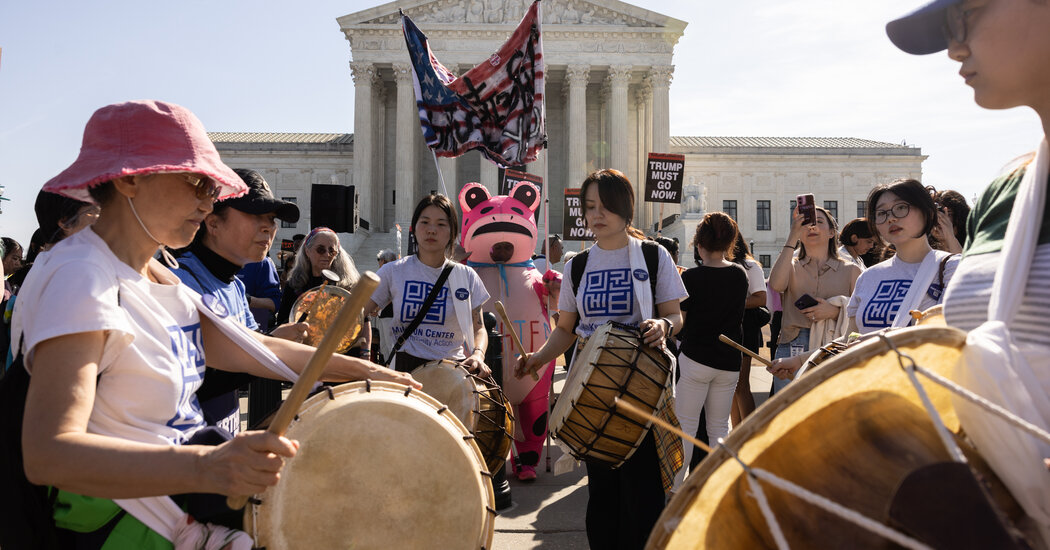
What the court said: During oral argument, members of the court's conservative majority — including justices who might have been expected to be receptive to the administration's position — raised skeptical questions about whether a unilateral executive order can reinterpret a constitutional provision that has been read one way for over a century. The ACLU argued that the order is flatly unconstitutional under any textualist or originalist reading of the Fourteenth Amendment. The administration contended that the phrase "subject to the jurisdiction thereof" excludes children of those present unlawfully. The arguments drew unusually direct exchanges between the justices and government counsel, with multiple justices pressing on whether administrative action is the appropriate vehicle for this kind of constitutional reinterpretation.
Ripple effects: The case carries consequences far beyond immigration policy. A ruling sustaining the executive order would signal that sitting presidents have significant power to reinterpret constitutional text through administrative action — a precedent that could be deployed across civil rights and civil liberties contexts by administrations of either party. A ruling striking down the order would not only protect citizenship for the estimated 150,000–250,000 children born annually to undocumented parents, but would also reaffirm limits on executive power that courts have increasingly been asked to police during the Trump second term. Legal observers expect the decision within weeks, likely before the court's summer recess. Advocacy organizations on both sides have already signaled they will treat the ruling as a template for subsequent constitutional litigation.
What to Watch Next
-
Week of April 28, 2026 — Birthright Citizenship Decision Window Opens (U.S. Supreme Court): With arguments completed, any Monday or Thursday could bring the ruling in Trump v. Barbara. The decision is expected before the summer recess and will be the most-watched SCOTUS output of the term.
-
May 2026 (ongoing) — EU DMA AI Investigation into Meta / WhatsApp (European Commission): Regulators are expected to issue a formal statement of objections or scope clarification in the newly opened AI-features probe. Watch for whether the Commission characterizes AI integration as a standalone DMA violation or as an extension of existing gatekeeper conduct charges.
-
May / June 2026 — Apple DMA Compliance Order Deadline (European Commission): Following the €500 million App Store fine, the Commission set compliance timelines for Apple to implement changes to app distribution rules. Failure to meet those timelines triggers automatic additional daily fines. Developer groups' new complaint this week could accelerate that timeline.
-
Spring 2026 (ongoing) — Google Antitrust Remedies Phase (U.S. District Court, D.C.): The remedies hearing in the DOJ's landmark search monopoly case is entering a critical phase. Judge Amit Mehta's eventual remedies order — potentially requiring Google to divest assets or fundamentally alter search distribution agreements — will be the most consequential U.S. antitrust judgment in a generation. Watch for scheduling orders and expert witness filings.
Reader Takeaways
-
If you run a business with operations in the EU, the Digital Markets Act's enforcement wave is no longer theoretical — the Commission has demonstrated willingness to impose nine-figure fines and open sequential investigations against the same company. Any digital platform that relies on major gatekeepers (Apple App Store, Google Play, Meta advertising) for distribution should audit its contractual exposure and consider whether your sector may be next as the Commission extends DMA scrutiny into AI features.
-
If you build tech products, the EU's new investigation into Meta's AI features in WhatsApp is a signal that AI integration is now a live DMA compliance question, not just a future risk. Product teams should document how AI features interact with gatekeeper platforms and whether those features create new dependencies or lock-in that regulators might characterize as anti-competitive conduct.
-
If you're a consumer, the Supreme Court's imminent birthright citizenship ruling will affect hundreds of thousands of families and may broadly signal how far courts will allow executive power to stretch in reinterpreting constitutional guarantees. More immediately, the appeals court stay on immigration detention bond hearings means individuals detained in enforcement operations face a harder road to pretrial release while litigation continues — a practical civil liberties concern regardless of where you stand on underlying immigration policy.
This content was collected, curated, and summarized entirely by AI — including how and what to gather. It may contain inaccuracies. Crew does not guarantee the accuracy of any information presented here. Always verify facts on your own before acting on them. Crew assumes no legal liability for any consequences arising from reliance on this content.
Powered by
