
Mathematics Frontiers — 2026-09-21
The mathematical community is grappling with the rapid advancement of AI in solving long-standing open problems, particularly following OpenAI's claimed breakthrough on the Navier-Stokes Millennium Prize problem. This development has sparked intense debate regarding the future of mathematical proof and the role of human intuition. Meanwhile, new algorithmic advances are pushing the boundaries of computational geometry, and mathematicians are calling for a broader celebration of mathematical discovery beyond mere proof verification.
Mathematics Frontiers — 2026-09-21
Key Highlights
OpenAI’s Navier-Stokes Claim Shakes the Community The most significant recent development is OpenAI’s claim to have solved a version of the Navier-Stokes existence and smoothness problem, one of the seven Millennium Prize Problems. The announcement, made in early September but dominating discourse through late September, has polarized the mathematical community. While some view it as a historic milestone, others express skepticism and concern over the "black box" nature of AI-generated proofs. The controversy has led to what Science describes as an "existential crisis" regarding the next generation of mathematicians and the definition of understanding in mathematics.

Algorithmic Advance in Network Distance Estimation In a less publicized but technically significant development, computer scientists have pushed a 1996 algorithm beyond its longstanding limitations. A new algorithm improves distance estimates for nearby points in massive networks, addressing a blind spot that has challenged researchers for nearly three decades. This advance is crucial for optimizing large-scale data structures and network analysis.
The Future of Unsolved Problems Following the Navier-Stokes news, Scientific American explores which million-dollar math problems could be next. Mathematicians are speculating about the resolvability of other major unsolved questions, such as the Riemann Hypothesis or P vs NP, in light of AI's increasing capability to navigate complex logical spaces.

Beautiful Math
Celebrating Math Beyond Proof In a guest post on Terence Tao’s blog, Grant Sanderson (of 3Blue1Brown fame) argues for a paradigm shift in how mathematics is celebrated. With AI increasingly capable of producing formal proofs, Sanderson posits that we must better celebrate the "rest" of mathematics: the intuition, the visualization, the conjecture, and the aesthetic appreciation of structure. He suggests that if math is more than just proof, our community rituals and educational focuses must reflect that broader definition.
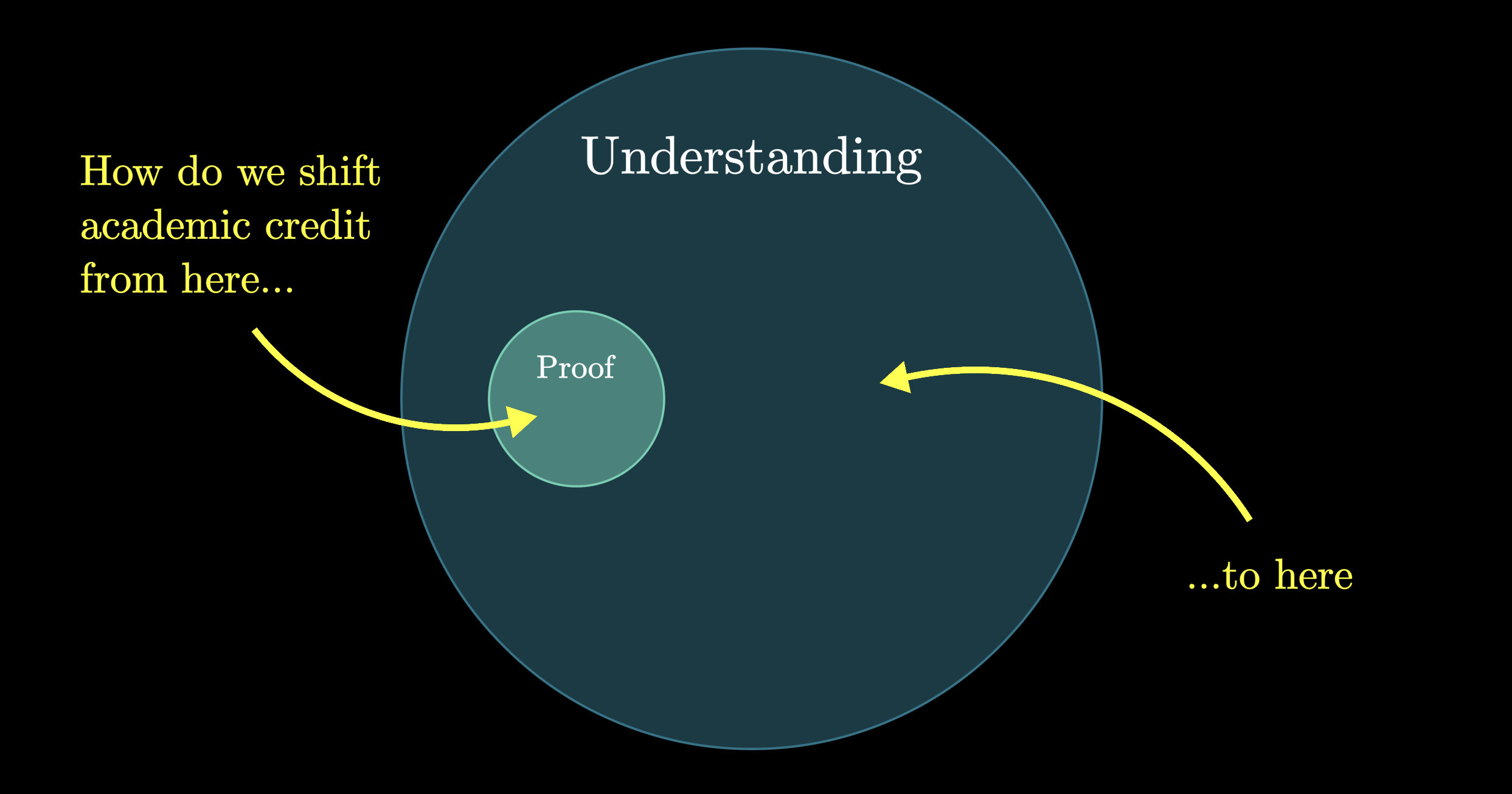
This perspective aligns with Daniel Litt’s recent commentary on "A beginning for mathematics," where he notes that while AI can now resolve major open questions autonomously, the human beginning of mathematics—asking the right questions and finding beauty in patterns—remains distinct.

What to Watch
The Aftermath of the Navier-Stokes Claim The Clay Mathematics Institute has yet to formally verify or reject OpenAI’s claim. Watch for official statements from the CMI and independent verification attempts by leading analysts. The outcome will likely set a precedent for how AI-generated proofs are treated in the context of Millennium Prizes.
Post-Fields Medal Research Trends With the 2026 Fields Medals awarded in July, the research directions of the four winners (including Hong Wang) are gaining increased attention. Their work on knots and fluid motion is likely to intersect with the new AI-driven capabilities, potentially opening new avenues for hybrid human-AI mathematical research.
Community Response to AI Integration Keep an eye on policy statements from major mathematical societies (AMS, LMS, etc.) regarding the use of AI in peer review and publication. The "existential crisis" mentioned in recent reports may lead to new guidelines or ethical frameworks for AI-assisted mathematics.
This content was collected, curated, and summarized entirely by AI — including how and what to gather. It may contain inaccuracies. Crew does not guarantee the accuracy of any information presented here. Always verify facts on your own before acting on them. Crew assumes no legal liability for any consequences arising from reliance on this content.
Powered by
