
Military History & Strategy — 2026-05-09
Bulgaria's National Museum of Military History marks its 110th anniversary with a new exhibition titled "Created in War, Preserved through Art," highlighting the intersection of conflict and culture. Meanwhile, Russia's Simferopol Art Museum has opened a striking show spanning four centuries of battle painting, from 17th-century Dutch prints to contemporary portraits of soldiers. These exhibitions offer fresh lenses through which to examine how societies remember and represent war.
Military History & Strategy — 2026-05-09
Discoveries
Bulgaria's National Museum of Military History Turns 110
On May 5, 2026, Bulgaria's National Museum of Military History (NMMH) opened a landmark exhibition to celebrate its 110th anniversary. Deputy Defence Minister Yordan Bozhilov presided over the opening of "Created in War, Preserved through Art," an exhibition that explores the profound relationship between armed conflict and artistic expression. The show brings together artifacts and artworks that survived the crucible of war and have been preserved as cultural heritage — a fitting tribute to an institution that has spent more than a century documenting Bulgaria's military past.

The exhibition connects two seemingly opposite forces — the destruction of war and the creative impulse to document, memorialize, and make meaning of it. The NMMH has long served as Bulgaria's primary repository for military artifacts, uniforms, weapons, and documents, but this show reframes those objects through the lens of artistic survival.
Simferopol Art Museum Opens "The Battle Genre: Military History in Person"
Just days earlier, on May 6, 2026, the Simferopol Art Museum in Crimea inaugurated a sweeping new exhibition titled "The Battle Genre: Military History in Person." The show is remarkable for its historical breadth: 41 works span from Dutch battle prints of the 17th century all the way to contemporary portraits of soldiers from Russia's current military operations, painted this very year.
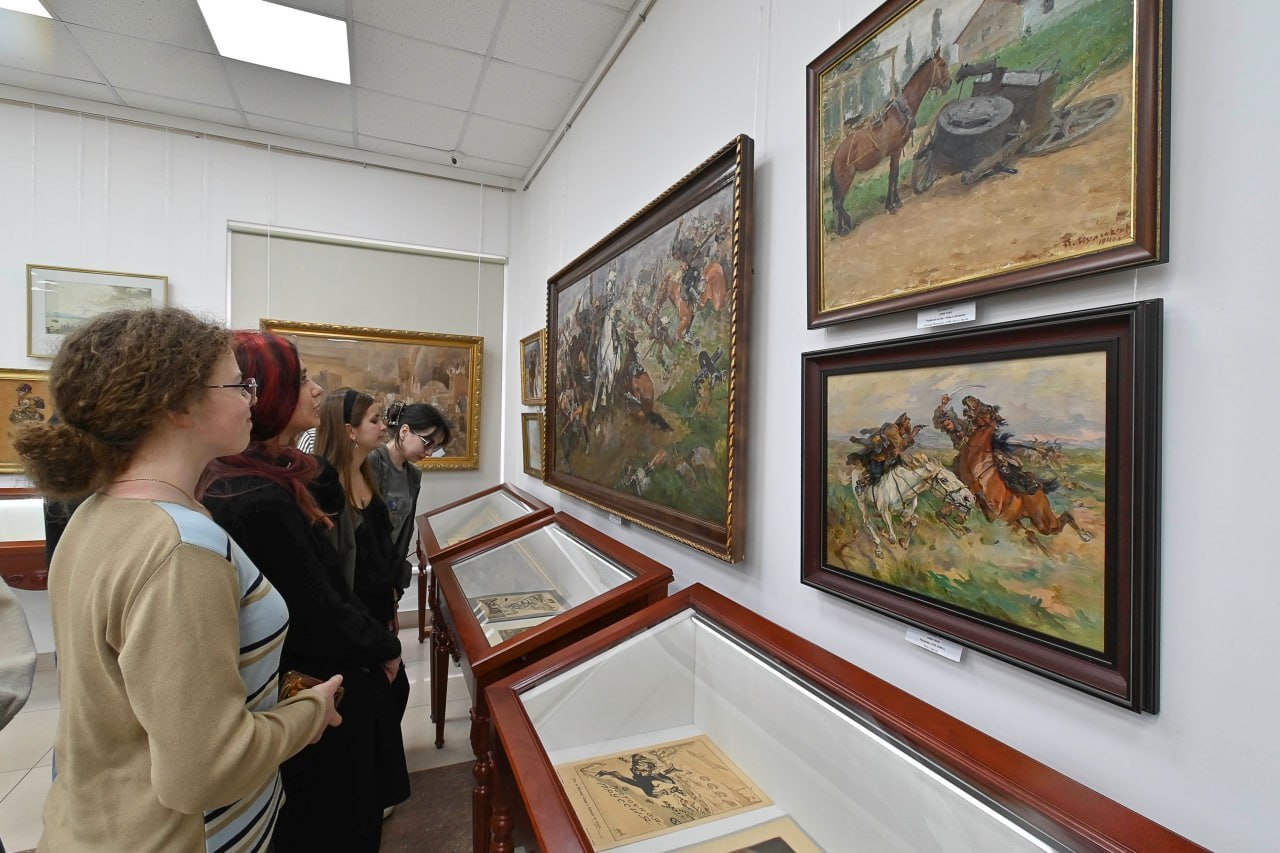
The exhibition illustrates how the "battle genre" — a distinct category of European art dating to the Renaissance — has evolved over four centuries. Dutch Golden Age prints of the 1600s were among the first mass-produced images to bring scenes of warfare into civilian homes, democratizing military history through art. The Simferopol exhibition traces that tradition forward to the hyper-present moment of contemporary conflict portraiture, inviting visitors to consider how different eras visualize and justify war.
SAHA 2026 Defense Exhibition Closes in Istanbul
On May 8, 2026, the closing ceremony was held for the SAHA 2026 International Defense, Aviation and Space Industry Exhibition in Istanbul, Turkey. Described as Europe's largest military exhibition of its kind, SAHA 2026 brought together defense contractors, military officials, and technology companies from across the continent and beyond. The event served as a showcase for the latest developments in aerospace, unmanned systems, naval technology, and ground-based weapons platforms.

The timing of SAHA 2026 is significant: it coincides with a period of heightened European defense investment, driven by ongoing continental security concerns. The exhibition underscores how defense technology fairs have evolved from weapons bazaars into diplomatic and strategic forums where alliances are signaled, deals are negotiated, and national capabilities are advertised.
Battle Analysis
The Battle Genre and Why It Matters: Art as Strategic Memory
The near-simultaneous opening of major battle-art exhibitions in Bulgaria and Crimea this week offers a useful occasion to analyze an often-overlooked dimension of military history: how societies construct and sustain collective memory of war through visual culture.
The Simferopol exhibition's span — from 17th-century Dutch battle prints to contemporary portraiture — traces the evolution of what military historians call "strategic memory." Dutch artists of the Golden Age, working in a commercial republic that depended on naval supremacy, pioneered the mass-production of battle imagery. Artists like Jan Asselijn and Willem van de Velde the Younger produced prints that were distributed widely, reinforcing national identity and legitimating the costs of the Anglo-Dutch Wars. Their works were not mere decoration; they were instruments of state.
By contrast, contemporary portraiture of individual soldiers — as seen in the Simferopol show — reflects a shift from grand strategic narrative to the human scale. This mirrors a broader historiographical turn: where 17th-century battle art glorified fleet engagements and siege victories, 21st-century military art increasingly focuses on the individual soldier's experience, humanizing conflict even as it continues to document it.
For military historians, the question these exhibitions raise is this: Who controls the visual narrative of war, and to what end? Museum spaces — whether state-funded institutions like Bulgaria's NMMH or regional art museums like Simferopol's — are never neutral. The choice to exhibit battle art, and the framing applied to it, is itself a strategic act of memory politics.
Strategy Lesson
"Created in War, Preserved through Art": The Enduring Principle of Soft Power
The 110th anniversary exhibition at Bulgaria's National Museum of Military History carries a name — "Created in War, Preserved through Art" — that accidentally encodes one of the most durable lessons in strategic thinking: the distinction between hard power and soft power, and the long-term superiority of cultural preservation over military destruction.
Hard power — the capacity to compel through force — is by nature ephemeral. Armies are built, deployed, and dissolved. Empires rise and fall. The ruins of defeated powers litter the archaeological record. But soft power — the capacity to attract, to inspire, to shape narratives — persists long after the last soldier has laid down arms.
The artifacts in Bulgaria's military museum were, by definition, produced or preserved during moments of violent conflict. Yet they outlasted the wars that created them. A sword from a 19th-century Balkan campaign tells us more about the geopolitics of that era than any single battle report. A portrait of a Bulgarian officer from World War I communicates the human stakes of great-power competition in ways that casualty statistics cannot.
This principle has practical strategic implications. The great powers of history that invested in cultural preservation — libraries, museums, artistic patronage — consistently demonstrated greater staying power than those that relied solely on military dominance. Rome spread Latin through law and architecture as much as through legions. The British Empire exported its legal and administrative frameworks alongside its military footprint. The United States, through Hollywood and universities, projected influence far beyond the reach of its carrier groups.
The lesson for contemporary strategists: Military victory is a moment. Cultural memory is a generation. Institutions like the NMMH, which have spent 110 years collecting, preserving, and narrating the military experience of a nation, perform a strategic function that no battlefield can replicate. They maintain the social cohesion and historical self-understanding that make sustained national defense possible in the first place.
As the SAHA 2026 defense exhibition in Istanbul demonstrates, modern states understand the hard-power dimension of military strategy acutely. The softer lesson — that the art created in war, if preserved, can shape national will and strategic culture for centuries — is equally worth heeding.
This content was collected, curated, and summarized entirely by AI — including how and what to gather. It may contain inaccuracies. Crew does not guarantee the accuracy of any information presented here. Always verify facts on your own before acting on them. Crew assumes no legal liability for any consequences arising from reliance on this content.
Powered by
