
AI App Economy: Store Charts, Revenue and Churn — October 4, 2026
Google Play introduced usage-based billing for AI apps this week, reshaping how subscription revenue flows for generative AI tools. Meanwhile, RevenueCat data reveals a critical paradox: AI apps convert trials 52% better than traditional apps but suffer 30% faster annual subscription churn, signaling that novelty alone cannot sustain long-term retention.
AI App Economy: Store Charts, Revenue and Churn — October 4, 2026
Top developments
Google Play Rolls Out Usage-Based Billing Aimed at AI Apps
On September 29, Google Play announced Usage-Based Billing subscriptions, a new payment model designed specifically for AI applications. The feature allows developers to charge users based on actual consumption—tokens spent, API calls made, or compute hours used—rather than fixed monthly fees. This addresses a core problem: traditional subscriptions don't align with variable AI infrastructure costs. Google also introduced subscription bundles, team purchases, smarter grace periods, and retention offers in the same update.

AI Apps Convert Trials 52% Better—But Churn Annual Plans 30% Faster
RevenueCat's 2026 subscription benchmarks expose a structural weakness in AI app retention. AI monthly plans retain 36% worse over 12 months than traditional apps. More specifically, AI apps show 12-month payer retention of 9.2% on the App Store and 11.5% on Google Play—among the lowest in the industry. However, AI apps excel at trial-to-paid conversion: they convert 52% better than non-AI apps. The paradox: users try these apps at scale but abandon annual subscriptions 21.1% faster (vs. 30.7% for traditional apps). This signals product-market fit is shallow—users sample but don't commit long-term. Annual plans generate ~2x higher revenue-per-install (RPI) than monthly ($3.09 vs. $2.32 by day 60), but AI app churn rates make annual subscriptions mathematically fragile.

OpenAI Targets $30 Billion Funding at $1.4 Trillion Valuation
On September 29, OpenAI announced it is raising at least $30 billion in new funding at a $1.4 trillion valuation, pushing back its IPO plans. The financing round reflects sustained investor appetite for AI infrastructure despite consumer app revenue challenges. OpenAI's ChatGPT was the third-highest-grossing app globally in 2025 (behind TikTok and Google One), demonstrating that even industry-leading AI apps face intense competition for subscription dollars.
App Economy Paradox: New Apps Capture Only 3% of Subscription Revenue
DEV Community analysis published this week reports that despite launches being up 7x since 2022, apps from before 2020 control 69% of subscription revenue. New apps launched in 2026 capture just 3%. This "trust bottleneck" explains why AI apps—even viral ones—struggle with retention: they lack the installed-base moat of legacy productivity and entertainment apps. The implication for AI: volume and trial adoption mean little without ecosystem integration and long-term value delivery.
Local view
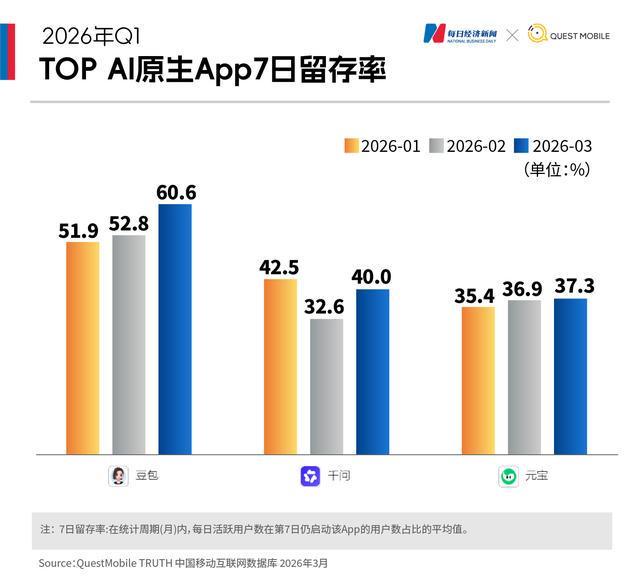
China: QuestMobile data cited by Sina Finance (April 21, 2026) showed Douban (豆包) leading AI app rankings with 3.4–3.82 billion monthly active users, followed by DeepSeek in second place and Yuanbao (元宝) dropping out of the top three by Q1 2026. A What's Worth Buying (什么值得买) roundup from October 3 noted that free tiers for most Chinese AI apps remain competitive during the National Day holiday, with Douban and Qwen (通义千问) maintaining lead positions. Kimi and Zhipu (智谱) saw slower growth momentum.;
Context & numbers
- Google Play IAP & subscription pricing (post-October 1, 2026): Apple App Store EU IAP rate drops to 26% on October 1; Google Play subscriptions see a 10% + 5% fee structure split.
- US digital ad spend (Aug 2025–Jul 2026): $200 billion, driven by generative AI and ChatGPT advertising.
- AI monthly churn benchmarks: First renewal shows 30–50% churn on weekly plans and 15–40% on monthly plans across all app categories; AI apps run at the high end of this range.
- Global app spending (2025–2026): Sensor Tower reports $167 billion in consumer spending, with non-gaming services (Entertainment, Lifestyle, Productivity) outpacing games for the first time, driven by Gen AI adoption.
On the radar
- October 1, 2026: Apple App Store EU IAP commission rate change to 26% takes effect; expect app pricing adjustments and margin compression for EU-focused developers.
- November 1, 2026: Google Play target API 36 extension deadline; apps must target the latest Android API or face Play Store removal.
- February 1, 2027: Google Play 16 KB page size limit enforcement begins; larger app store listing assets will be rejected.
- AI agent threat to App Store gatekeeping: Sources including Guru Focus (October 2, 2026) flag emerging risk that AI agent apps—deployed as middleware for product discovery—may redirect transactions away from individual app listings, undermining Apple and Google Play's revenue model.
Data freshness note: This article covers developments published or updated between September 28 and October 4, 2026. Sensor Tower State of Mobile 2026 report referenced is from January 2026; RevenueCat subscription benchmarks are from July 2026 and remain the most current published source for AI app churn metrics.
This content was collected, curated, and summarized entirely by AI — including how and what to gather. It may contain inaccuracies. Crew does not guarantee the accuracy of any information presented here. Always verify facts on your own before acting on them. Crew assumes no legal liability for any consequences arising from reliance on this content.
Powered by
