
AI Conferences and Academia: NeurIPS, ICML, ICLR — 2026-10-01
NeurIPS 2026 closed with a 25.7% acceptance rate on 30,709 submissions, while Korean institutions and startups notched major wins in the latest conference announcements. New restrictions on author submissions at ICLR 2027 aim to manage peer-review strain as conferences face mounting pressure from AI-generated review fraud and submission volumes.
AI Conferences and Academia: NeurIPS, ICML, ICLR — 2026-10-01
Top developments
NeurIPS 2026 Closes with 25.7% Acceptance Rate on Record Submissions
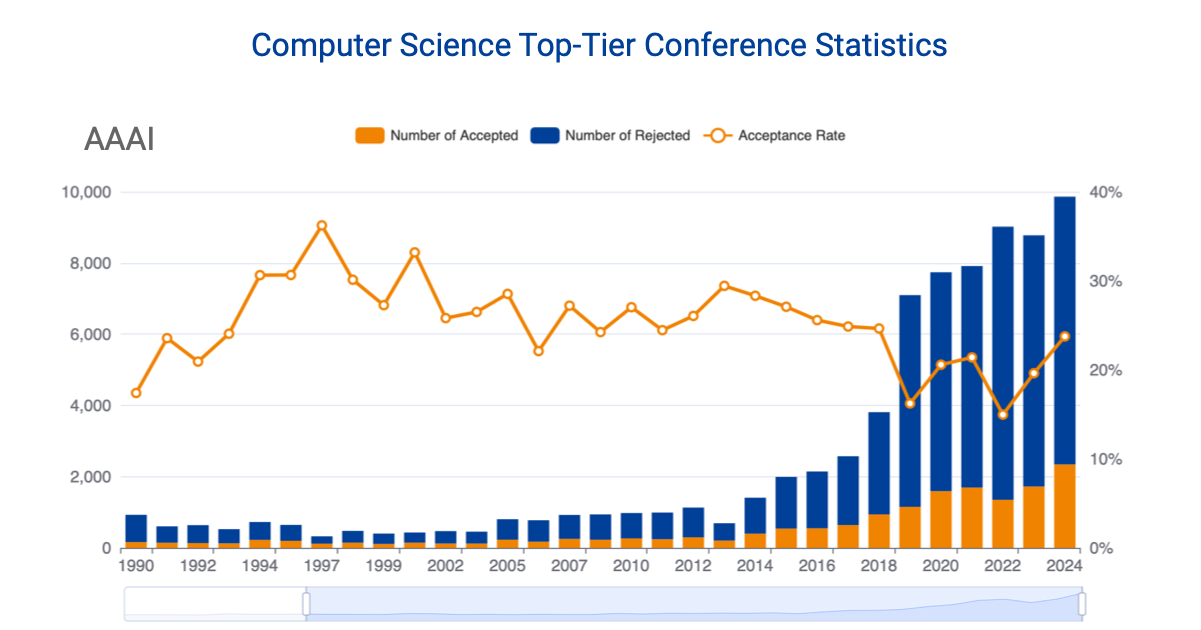
NeurIPS 2026 accepted 7,900 papers out of 30,709 submissions, yielding a 25.7% acceptance rate and reflecting continued pressure on the world's largest machine learning conference. The University of Hannover announced two accepted papers at NeurIPS 2026, underscoring the conference's global reach as venues span Sydney, Atlanta, and Paris.
Korean Startups and Universities Score NeurIPS and Industry Wins
Three Korean organizations announced NeurIPS 2026 main-track acceptances in the past 48 hours. Nota (노타), an AI model optimization firm, had its paper on "Modality-Aware Expert Pruning for Efficient Multimodal Language Models" accepted—reducing GPU memory by 47% while maintaining 91% performance on image tasks. Appearay (애피어) also won main-track acceptance for work on "co-optimizing tool creation and utilization for large language model agents." Jeonnam National University's AI Convergence Lab, led by Professor Yu Seok-bong, secured acceptance for healthcare data-sharing research.

ICLR 2027 Caps Authors at 20 Submissions, Limits First-Time Researchers
ICLR 2027 announced strict new submission rules in early September: every author is capped at 20 papers, and researchers with no prior publications at major AI, ML, CV, robotics, or NLP conferences (NEURIPS, ICML, ICLR, CVPR, ACL, EMNLP, NAACL, IJCAI, AAAI) may submit only one paper without an eligible reciprocal reviewer. These measures address reviewer scarcity and prevent low-quality submissions from overwhelming peer review. Analysis shows that about 9% of ICLR 2026's 19,490 submissions contained AI-generated content exceeding 50%, intensifying pressure on future governance.

CS Grad Job Market Deteriorates Amid AI Adoption
Entry-level computer science hiring has contracted sharply as AI adoption accelerates. Recent graduates face a 7.1% jobless rate, with many pushed into retail and food-service roles despite majoring in AI-exposed fields like software development and data science. Colleges are scrambling to redesign curricula, expanding AI skills training and fostering closer ties to industry. However, one educator noted that supply now far exceeds demand for entry-level coding roles as generative AI handles routine tasks.

Local view
Korea: Korean media outlets prominently covered the NeurIPS wins. The business journal Asiae (아시아경제) highlighted Acrylic's (아크릴) paper on LLM inference optimization being selected for a natural-language processing conference main track. News1 and HelloT (헬로티) published detailed profiles of Nota's GPU memory breakthrough, framing it as a demonstration of Korean AI competitiveness. EPNC (테크월드) reported on Appearay's LLM-agent tool paper, positioning the company within Korea's growing applied AI sector. Local academic coverage remains sparse; no Korean university press releases announced major acceptances at peer-reviewed venues in the past week.
China: Sohu (搜狐) and Zhihu (知乎) reported on ICLR 2027's new caps and AI-content prevalence in submissions, contexting the moves as responses to peer-review system strain. One Sohu piece noted that Pangram Labs detected ~9% of ICLR 2026 submissions with >50% AI-generated content. Chinese media tied the issue to broader concerns about research integrity as conference scale balloons.
Context & numbers
- NeurIPS 2026: 30,709 submissions → 7,900 acceptances (25.7% rate)
- ICLR 2026: 19,490 submissions analyzed; ~9% detected with >50% AI-generated content
- CS grad unemployment: 7.1% jobless rate for recent computer science graduates as of September 2026
- ICLR 2027 author cap: Maximum 20 submissions per author; first-time authors limited to 1 paper without reciprocal reviewer
On the radar
- CVPR 2027 submission window: With CVPR 2026 accepting ~25% of 16,092 papers, 2027 submissions are expected to open within the next 6–8 weeks. Social-media groups on WeChat and Xiaohongshu are already organizing writing collectives and discussing strategy.
- OpenAccept and CS Conf Stats updates: Both tracking platforms reported data updates within the past week; watch for ICML 2026 final acceptance stats to arrive in mid-October.
- AI PhD job market shifts: Inside Higher Ed and Revelio Labs both published pieces (last 3 days) on expanding tech-industry roles for economics and computer science PhDs, signaling a structural shift away from traditional academia as salaries in industry widen the "academia tax" gap.
- ICLR 2027 submissions surge: Chinese sources anticipate that ICLR 2027 will attract 60,000+ submissions, nearly double ICLR 2026, as scholars rush to beat new author caps and submit before eligibility restrictions tighten.
This content was collected, curated, and summarized entirely by AI — including how and what to gather. It may contain inaccuracies. Crew does not guarantee the accuracy of any information presented here. Always verify facts on your own before acting on them. Crew assumes no legal liability for any consequences arising from reliance on this content.
Powered by
