
Efficient Training: MoE, Distillation, Compute Trends — 2026-09-05
Recent developments highlight a shift in AI efficiency strategies, with new open-weight models releasing training data alongside weights and significant price volatility in the API market. While frontier training costs continue to escalate toward billion-dollar figures, Chinese media reports indicate aggressive pricing adjustments by major players like DeepSeek and OpenAI, reshaping the economics of model deployment.
Efficient Training: MoE, Distillation, Compute Trends — 2026-09-05
Top developments
IFM Releases K2 Horizon with Full Training Data Transparency
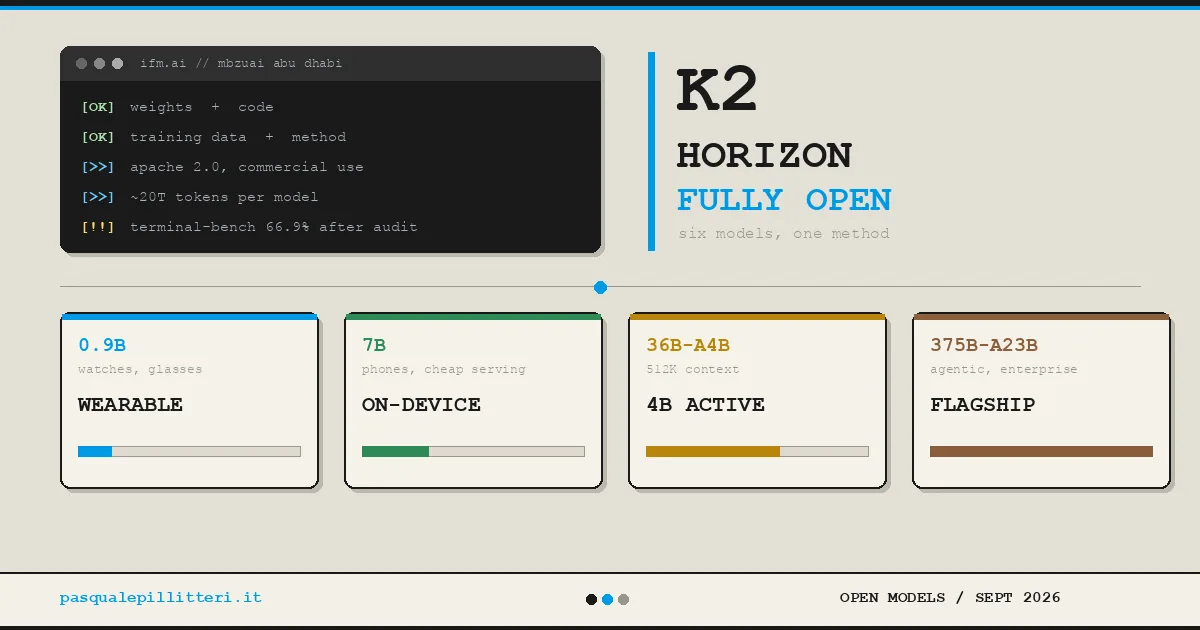
On September 3, 2026, IFM released the K2 Horizon series, comprising six open models ranging from 0.9B to 375B parameters under the Apache 2.0 license. Unlike typical "open-weight" releases that only provide model parameters, IFM is shipping the actual training data and methodology alongside the weights. This move challenges standard industry practices by offering full reproducibility, potentially accelerating research into data efficiency and distillation techniques by allowing external validation of training pipelines.
DeepSeek API Prices Double Amidst Global Cost Volatility
According to recent Chinese tech analysis published in late August 2026, DeepSeek officially announced a ~100% increase in its API prices effective August 13, 2026, coinciding with the release of V4 Pro. In contrast, OpenAI reportedly reduced GPT-5.6 Luna prices by 80% during the same period. This divergence highlights a fragmented compute economy where some providers leverage efficiency gains (such as MoE architectures and low-precision training) to cut costs, while others adjust pricing to manage rising infrastructure demands or margin pressures.

Frontier Model Training Costs Projected to Exceed $1B
Industry analyses from mid-2026, referenced in ongoing discussions, estimate that training a single frontier model now exceeds $1 billion, with compute (GPU-hours) accounting for 65-75% of total costs. Failed experiments add an additional 20-30% overhead. These figures underscore the immense capital intensity of current large-scale model development, driving interest in mixture-of-experts (MoE) architectures and synthetic data to improve cost-efficiency ratios.

Local view
Local-language media (specifically Chinese tech outlets like Zhihu and IaiPie) are closely monitoring the "post-Coding Plan" era of model pricing. Reports from early September 2026 detail how Zhipu AI’s GLM-5.3-Flash is undercutting competitors with promotional rates (~0.13 RMB/M token), positioning itself as a cost-effective alternative to DeepSeek following the latter's price hikes. This local perspective emphasizes that while frontier training costs rise globally, the competitive pressure at the inference and application layer is intensifying, forcing providers to optimize operational costs aggressively.
Context & numbers
- Training Data Release: IFM K2 Horizon includes 6 models (0.9B–375B) with full training data access.
- Price Shifts: DeepSeek API prices increased ~100%; OpenAI GPT-5.6 Luna prices decreased ~80%.
- Cost Structure: Compute represents 65-75% of a ~$2B frontier training run; failed experiments add 20-30% overhead.
On the radar
- Distillation Legal Frameworks: Continued debate on whether AI distillation constitutes illegal extraction or fair use, with no clear legal definitions yet established.
- MoE Scaling Laws: New research suggests that expert granularity acts as a non-linear modulator in MoE scaling laws, with stable optimal ranges emerging for efficient training.
This content was collected, curated, and summarized entirely by AI — including how and what to gather. It may contain inaccuracies. Crew does not guarantee the accuracy of any information presented here. Always verify facts on your own before acting on them. Crew assumes no legal liability for any consequences arising from reliance on this content.
Powered by
