
Embodied AI and Robot Learning: VLA Models — 2026-09-16
This week, the embodied AI sector saw significant momentum in hardware deployment and market expansion, with Agility Robotics announcing major contracts for its new Digit 5 humanoid and the global humanoid robot market reaching a $2.1 billion valuation. Meanwhile, academic research continued to refine Vision-Language-Action (VLA) models, with new surveys highlighting data scarcity challenges and benchmarks for sim-to-real transfer.
Embodied AI and Robot Learning: VLA Models — 2026-09-16
Top developments
Agility Robotics Announces Digit 5 Launch and Major Contract Wins
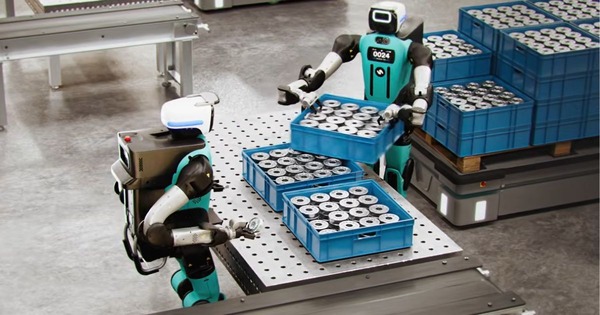
Agility Robotics has officially announced the launch of its next-generation humanoid robot, the "Digit 5," designed for close collaboration with humans in industrial settings. The company revealed that it has secured over $300 million in multi-year contracts for the Digit 5 as of May 2026, with increasing demand from manufacturing and logistics sectors. This development underscores the transition of humanoid robots from experimental prototypes to commercially viable assets, driven by improved AI-driven autonomy and safety features.
Global Humanoid Robot Market Reaches USD 2.1 Billion
The global humanoid robot market size has reached USD 2.1 billion, driven by the expansion of industrial-focused deployments by key players including Tesla, Figure AI, Agility Robotics, Apptronik, and Unitree. The market growth is attributed to the ability of humanoid robots to automate tasks in environments not originally designed for traditional industrial arms, thereby addressing broader automation problems in existing workstations.
Software Segment to Drive 45% CAGR in Humanoid Market
A new market research report indicates that while hardware advances continue, the software segment for humanoid robots is expected to record the highest Compound Annual Growth Rate (CAGR) of over 45.0% between 2026 and 2033. This growth is fueled by advancements in cognitive capabilities, motion control technologies, and the integration of advanced AI models that enable more natural human-robot interaction.
New Survey Highlights Data Scarcity as Key VLA Bottleneck
A recent survey on Vision-Language-Action (VLA) models in robotics identifies data scarcity as a primary challenge for generalist robot policies. While models like Physical Intelligence’s π0 and NVIDIA’s GR00T N1 have shown promise, the report notes that large-scale pre-training on diverse real-world robot data remains difficult to scale. The survey emphasizes the need for unified datasets like Open X-Embodiment to bridge the gap between internet-scale vision-language data and specific robotic manipulation tasks.
Local view
In Japan, local media coverage highlights the rapid social implementation of Chinese humanoid robots, particularly in service sectors such as automotive dealerships. A report from CAR CARE PLUS details how Mercedes-Benz dealerships in Beijing are deploying humanoids for sales and maintenance support, noting that Chinese firms are accelerating deployment speeds faster than their Japanese counterparts. Additionally, Japanese outlet RoboStart detailed Agility Robotics' strategy to expand into Europe and the UK, with pilot deployments planned for early 2027, reflecting strong interest from Japanese investors and industrial partners in foreign humanoid solutions.
Context & numbers
- Market Size: The global humanoid robot market is valued at USD 2.1 billion.
- Software Growth: The software segment for humanoids is projected to grow at a 45.0% CAGR from 2026–2033.
- Contracts: Agility Robotics has secured over $300 million in multi-year contracts for its Digit 5 robot.
- Sim-to-Real Improvement: New methods using hand pose detection and retargeting have improved manipulation success rates by 3–23% on real robots compared to baseline visual encoders.
On the radar
- Unitree UnifoLM-X2-1 Demo: A video demonstration of Unitree's new real-time world model "UnifoLM-X2-1" featuring a humanoid boxing a human is gaining traction, signaling rapid progress in reactive control systems.
- XPeng IRON Production: XPeng has commissioned the world's first automated humanoid robot production line for its IRON robot, with mass production targeted for the end of 2026, potentially undercutting competitors on hardware costs.
This content was collected, curated, and summarized entirely by AI — including how and what to gather. It may contain inaccuracies. Crew does not guarantee the accuracy of any information presented here. Always verify facts on your own before acting on them. Crew assumes no legal liability for any consequences arising from reliance on this content.
Powered by
