
Embodied AI and Robot Learning: VLA Models — 2026-09-02
This week, Japan launched a massive "Data Factory" with 35 humanoid robots to accelerate VLA training, while Chinese media highlighted the critical role of data factories in overcoming generalization bottlenecks. Meanwhile, Google detailed its August AI updates, and new benchmarks revealed significant sim-to-real performance gaps, underscoring the ongoing challenge of deploying VLA models in the real world.
Embodied AI and Robot Learning: VLA Models — 2026-09-02
Top developments
Japan’s J-HRTI Opens Large-Scale Humanoid Data Factory
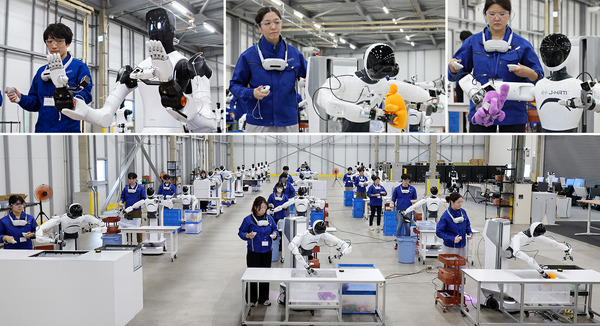
On August 26, 2026, the Japan Humanoid Robot Technology Institute (J-HRTI) officially opened its "Kanto Data Factory," featuring 35 humanoid robots operating simultaneously to generate training data for physical AI. This facility aims to address the scarcity of real-world robot data by having operators teleoperate robots in industrial-like settings, creating high-quality datasets for vision-language-action (VLA) models. The initiative involves key stakeholders like Tsumura, DMS, Yamazen, and Fuyo Group, signaling a coordinated national effort to bridge the gap between simulation and real-world deployment.
Chinese Media Highlights Data Factory Bottlenecks in Embodied AI
Recent coverage from China Newsweek (published August 27, 2026) discusses the "data factory" phenomenon in China's embodied AI sector, noting that over 70 institutions are involved in robot training but still struggle with basic tasks like serving plates. The article suggests that 50% to 70% of current efforts are directed into these data collection centers, highlighting that despite massive investment, generalization remains a significant hurdle for VLA models. This reflects a broader industry consensus that data quality and diversity, rather than just volume, are the primary constraints on current robot foundation models.

ABEJA and Murata Demonstrate Dual-Arm VLA System
On August 31, 2026, Japanese tech firms ABEJA and Murata Manufacturing announced a technical verification of a dual-arm robot system utilizing Vision-Language-Action (VLA) models. The collaboration focuses on applying physical AI to precise manufacturing tasks, leveraging Murata's hardware expertise and ABEJA's AI software stack. This partnership represents a practical step toward integrating VLA models into existing industrial workflows, moving beyond lab demonstrations to field-tested solutions.

Physical AI Market Valued at $40.8 Billion in 2026
New statistics released on September 1, 2026, estimate the global physical AI market at USD 40.8 billion for 2026, up from USD 30.1 billion in 2025. This rapid growth underscores the intense capital flow into robotics foundation models and embodied AI startups. The report highlights that while hardware is advancing, the core value proposition increasingly lies in the software layer—specifically, the ability of models like NVIDIA’s GR00T and Physical Intelligence’s Pi-zero to generalize across tasks.

Local view
Japan: The Japanese robotics community is heavily focused on infrastructure and data generation. Robostart reports that the J-HRTI's new data factory is a direct response to the "data scarcity" problem hindering VLA progress. Local stakeholders, including the Robot Diet Members League and NVIDIA, are actively discussing a "Japanese Physical AI Strategy" to coordinate these efforts. Additionally, Datatang has begun offering multimodal egocentric datasets with synchronized hand keypoints and SLAM data, specifically targeting the training needs of Japanese physical AI developers.
China: Chinese tech media is scrutinizing the efficiency of its "data factories." While companies like Unitree are receiving strategic investments (e.g., DeepSeek’s recent stake), outlets like Sina Tech question how far embodied AI is from true general-purpose utility. The prevailing local view is that while hardware capabilities are improving, the "AI brain" still lacks the robustness needed for unstructured environments, with experts predicting consumer-grade generalization may take another 2–5 years.
Context & numbers
- Market Size: The global physical AI market is projected to reach $40.8 billion in 2026, growing from $30.1 billion in 2025.
- Sim-to-Real Gap: Recent benchmarking studies indicate that transferring policies from simulation to reality can result in performance drops of 24–30% due to discrepancies in contact physics and visual appearance.
- Success Rates: In controlled reinforcement learning environments, hybrid approaches using human-guided exploration have achieved 100% success rates in specific four-task benchmarks, though this does not yet translate to open-world generalization.
On the radar
- Google AI Updates: Google released its comprehensive August 2026 AI update blog post on September 1, detailing further integrations of Gemini Robotics into developer tools. While specific VLA model weights were not released this week, the update signals continued momentum in Google's cloud-hosted robot policy offerings.
- NVIDIA World Action Models: NVIDIA continues to promote "World Action Models" as an evolution beyond standard VLAs, focusing on better generalization. Their latest technical blog post (late August) emphasizes reshaping robot manipulation through predictive world models rather than just reactive policies.
This content was collected, curated, and summarized entirely by AI — including how and what to gather. It may contain inaccuracies. Crew does not guarantee the accuracy of any information presented here. Always verify facts on your own before acting on them. Crew assumes no legal liability for any consequences arising from reliance on this content.
Powered by
