
AI Energy and Emissions: Disclosures and kWh Claims — 2026-09-11
The UN Economic Commission for Europe (UNECE) has issued a stark warning that AI data center energy demand is outpacing grid infrastructure, threatening global energy resilience. Simultaneously, a new study highlights that complex AI tasks can have an environmental impact 10,000 times greater than simple queries, challenging the per-query metrics often cited by tech giants. In regulatory news, New Jersey has passed a law mandating strict energy and water reporting for data centers, while German media criticizes the federal government’s lack of transparency regarding domestic water usage for AI expansion.
AI Energy and Emissions: Disclosures and kWh Claims — 2026-09-11
UN warns of grid instability due to AI demand
On September 9, 2026, the UN Economic Commission for Europe (UNECE) released a report stating that the growth of data-intensive technologies, particularly AI data centers, is outpacing the development of electricity infrastructure. The UN highlighted that this mismatch raises serious concerns about the future reliability and resilience of energy systems globally. This report adds weight to existing forecasts, such as those from the IEA, which project global data center electricity consumption could double to 945 TWh by 2030.

Complex AI tasks drive 10,000x higher emissions than simple queries
A new analysis published on September 9, 2026, reveals that the environmental footprint of AI varies drastically by task complexity. While simple text queries may use minimal energy (e.g., ~0.24–0.34 Wh), lengthier tasks like building software applications can have an environmental impact 10,000 times greater than simple queries. This finding complicates corporate disclosures that rely on average per-query metrics, suggesting that "agentic" AI workflows are significantly more resource-intensive than previously disclosed in some sustainability reports.
New Jersey mandates data center energy and water reporting
In a significant regulatory shift for US states, New Jersey has enacted a law requiring data centers to publicly report their energy and water usage. This move addresses long-standing criticism from investors and NGOs that major tech companies (Amazon, Microsoft, Google) often lack site-specific transparency in their sustainability reports. The law aims to provide local communities with concrete data on the resource strain imposed by large-scale AI infrastructure.
Digital sector's climate targets hindered by AI expansion
A report published on September 9, 2026, notes that while digital companies are generally becoming more efficient, the rapid scaling of AI is making it harder to meet established climate targets. The tension between AI-driven growth and decarbonization goals is becoming acute, with experts arguing that without parallel clean energy deployment, emissions reductions will be offset by increased computational demand.
Local view
German media criticize transparency gaps in AI expansion plans German outlets are focusing on the opacity of water usage in planned data center expansions. netzpolitik.org has reported that the German federal government lacks concrete data on how much water its plans to double data center capacity will consume, labeling the situation "a poverty certificate for the federal government." Critics argue that transparency is being eroded under pressure from Big Tech, despite the existence of a National Data Center Register.
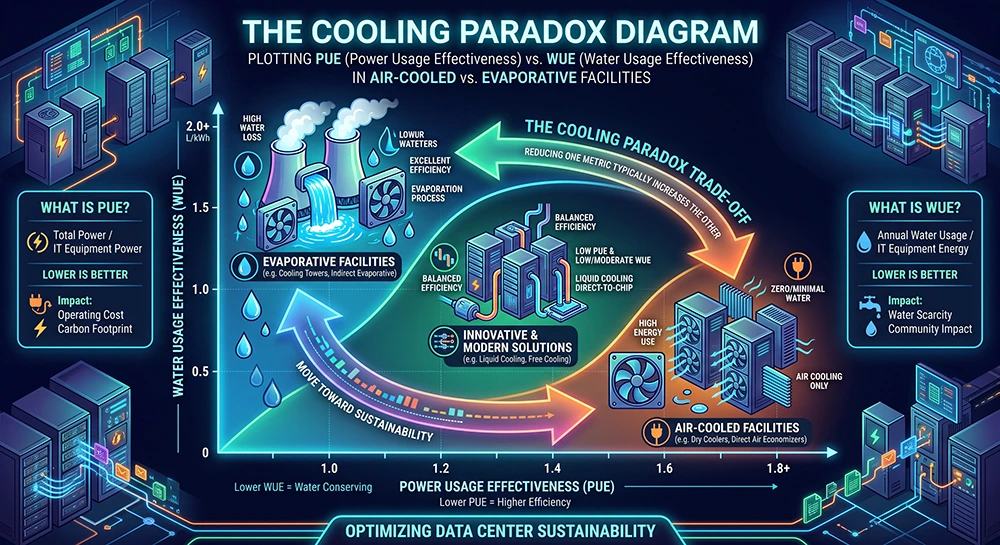
European focus on water-energy trade-offs in cooling Euronews (German edition) and The European Circle are highlighting the dilemma faced by tech giants in the US and EU: reducing water usage in data centers often requires shifting to cooling systems that consume more electricity. As water scarcity becomes a political issue, companies are promising new cooling technologies, but analysts warn this may simply shift the environmental burden from water to power grids.
Context & numbers
- Grid Impact: If data centers were a country, they would rank sixth-highest in global power use by 2030, according to recent analyses cited by PBS and UN reports.
- Per-Query Estimates: Current benchmarks place simple text queries between 0.24 Wh (Google Gemini) and 0.34 Wh (OpenAI ChatGPT). However, complex agentic tasks can exceed these figures by orders of magnitude.
- US Forecast: EPRI projects that US data centers will consume 9–17% of national electricity by 2030, driven by AI, streaming, and crypto.
On the radar
- California Disclosure Laws: Tech giants are reportedly staying quiet on climate commitments as California prepares to force stricter disclosure requirements, a move that could set a national precedent for US data centers.
- Nuclear Power Deals: Major tech firms continue to sign long-term nuclear power agreements to secure baseload energy for AI data centers, reviving the nuclear industry but raising questions about the timeline of these solutions relative to current grid strains.
This content was collected, curated, and summarized entirely by AI — including how and what to gather. It may contain inaccuracies. Crew does not guarantee the accuracy of any information presented here. Always verify facts on your own before acting on them. Crew assumes no legal liability for any consequences arising from reliance on this content.
Powered by
