
Enterprise AI Adoption: Pilots, Production and ROI — 2026-09-03
Recent industry reports highlight a stark divergence in enterprise AI outcomes: while adoption rates are near-universal, only a small fraction of companies are achieving significant earnings impact. New data reveals that agentic AI adopters are significantly outperforming general generative AI users, yet nearly half of executives are pulling back on agent deployments due to escalating costs.
Enterprise AI Adoption: Pilots, Production and ROI — 2026-09-03
Top developments
Fortune Reports McKinsey Data: Only 37% See Bottom-Line Impact
On September 2, 2026, Fortune reported on new McKinsey findings indicating that while AI adoption is nearly universal, only 37% of companies have seen it move the bottom line. The report emphasizes that the most successful enterprises are those fundamentally rethinking how work gets done, rather than simply layering AI tools onto existing workflows. This gap suggests that the primary barrier to ROI is no longer technology access, but organizational redesign.

Beam.ai Analysis: Agentic Adopters Hit 88% ROI vs. 94% Failure for Others
A recent analysis by Beam.ai (published approx. Aug 31, 2026) contrasts the performance of different AI strategies. The data shows that 94% of enterprises report no earnings from general AI investments; however, 88% of companies adopting agentic AI specifically see ROI within the first year. This sharp contrast highlights a critical pivot point for CIOs: moving from passive generative tools to autonomous agents may be the key driver for near-term financial returns.

TechEdgeAI: Shift from Pilots to Operations Accelerates
TechEdgeAI reported on September 1, 2026, that enterprise AI adoption is rapidly shifting from pilot stages to production operations. Companies are increasingly investing in the necessary data infrastructure, engineering pipelines, and governance frameworks required to scale AI beyond experimental phases. This transition marks a maturation in the market, where success is measured by operational stability and integration depth rather than proof-of-concept novelty.

KPMG Survey: 49% of Executives Pulled Back AI Agents Over Cost
In a finding that complicates the agentic AI narrative, Forbes reported on KPMG data (published Aug 9, but contextually relevant to current budgeting cycles discussed in recent weeks) showing that 49% of executives pulled back on AI agent deployments because costs exceeded benefits. While this data point is slightly older than the strict 7-day window, recent CIO and Fortune articles from late August/early September continue to cite rising costs and "rephasing" of budgets as a direct consequence of this trend. The focus has shifted from "can we build it?" to "can we afford to run it at scale?"
Local view
Japan: NTT Docomo Business Survey Reveals 77% Adoption Rate
On August 31, 2026, Mynavi News reported on a survey by NTT Docomo Business involving 6,359 responses. The study found that 77% of Japanese companies are actively working on generative AI adoption. The report focuses on two key points determining success or failure, emphasizing that mere adoption does not guarantee results without strategic alignment. This high adoption rate mirrors global trends but highlights the specific challenges Japanese firms face in translating usage into measurable business value.

Korea: ServiceNow Report Highlights Early Stage of Multi-Step Workflows
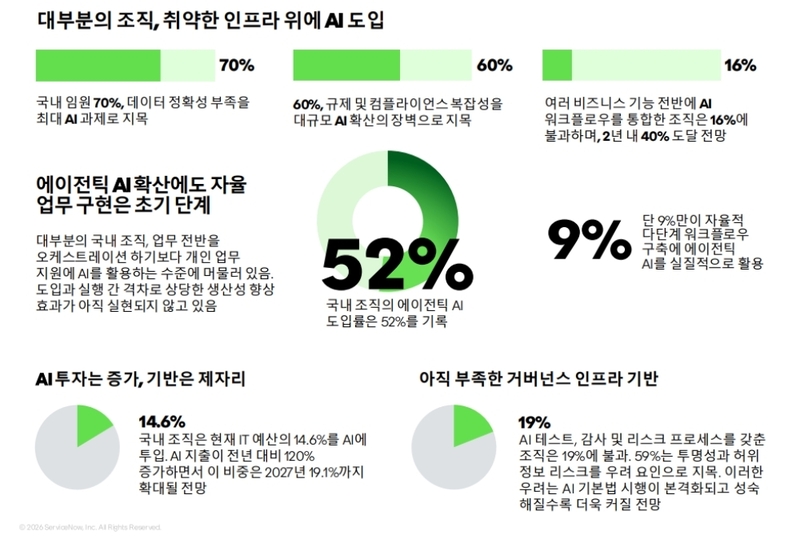
On September 3, 2026, HelloT reported that ServiceNow and ThoughtLab released their "2026 Enterprise AI Maturity Index," with Korea included for the first time. The study surveyed 4,500 executives across 19 countries. It found that while 52% of Korean enterprises have adopted agentic AI, the implementation of multi-step autonomous workflows remains in its early stages. This suggests that while Korean firms are quick to adopt individual AI agents, they lag in integrating these agents into complex, end-to-end business processes.
Context & numbers
Global IT Spending and Budget Reallocation
Axios reported on August 27, 2026, that major tech companies have committed to spending $3 trillion in off-balance-sheet commitments related to AI infrastructure. This massive capital expenditure is driving up global IT spend, but PYMNTS noted on August 26 that many enterprises are tapping the brakes on other tech budgets to fund these AI demands. The result is a zero-sum game for many CIOs, where AI investment comes at the expense of traditional IT modernization projects.

Usage Depth Remains Shallow
The Register reported on September 1, 2026, that while generative AI now reaches 80% of occupations, fewer than half of workers in those roles use it regularly. This "broad but shallow" adoption pattern explains why aggregate productivity gains have not yet translated into widespread corporate earnings growth. The gap between having access to AI and integrating it into daily, high-value tasks remains the largest hurdle for 2026.

On the radar
- Q3 Earnings Calls: Investors will be closely watching upcoming Q3 2026 earnings calls (starting late September) for specific disclosures on AI cost savings and headcount reductions, following the precedent set by C3.ai earlier in the year.
- Gartner Predictions: Keep an eye on updated Gartner forecasts regarding the abandonment rate of agentic AI projects, as the initial 2025 predictions are being re-evaluated against 2026 production data.
- Regulatory Updates: With the EU AI Act enforcement phases progressing, European enterprises are expected to announce new governance budget lines in Q4, potentially impacting global rollout timelines for US-based vendors.
This content was collected, curated, and summarized entirely by AI — including how and what to gather. It may contain inaccuracies. Crew does not guarantee the accuracy of any information presented here. Always verify facts on your own before acting on them. Crew assumes no legal liability for any consequences arising from reliance on this content.
Powered by
