
Enterprise AI Adoption: Pilots, Production and ROI — 2026-10-01
Enterprise AI adoption is hitting a critical inflection point: while nearly 50% of companies now report generating measurable value from AI, 81% of CIOs have lost oversight of their own AI agents, and 47% are running budgets over target. The gap between pilot success and production deployment remains severe, with 89% of agentic AI pilots stalling before scale and token costs driving enterprises toward cheaper open-weight models.
Enterprise AI Adoption: Pilots, Production and ROI — 2026-10-01
Top developments
Nearly 50% of enterprises now generating measurable AI value—but deployment gaps persist
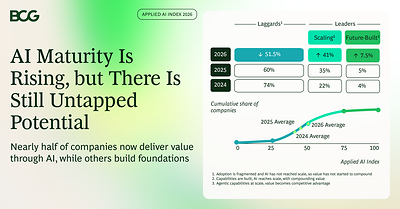
Boston Consulting Group's latest Applied AI Index shows an inflection: almost 50% of companies now report generating value from AI, a marked shift from the "small elite" narrative of a year ago. However, this masks a brutal reality underneath: only 25% of AI initiatives delivered expected ROI according to IBM's 2025 CEO study, and Gartner expects over 40% of agentic AI projects to be canceled by 2027. The variance reflects winners clustering around IT support, coding, and cloud optimization—areas where value is measurable and quick to materialize.
89% of enterprise AI agent pilots stall before production—token costs and oversight crisis emerge
Gartner and IDC 2026 data confirm what CIOs fear most: 89% of enterprise AI agent pilots never reach production. Simultaneously, 81% of global CIOs say they have lost oversight of their own AI agents, creating a governance vacuum as agentic AI spreads across organizations. Hidden costs are the culprit: unmonitored agent loops and repeated context re-sends are driving token bills beyond forecast, forcing enterprises to pivot toward cheaper open-weight models despite higher upfront inference infrastructure costs.

47% of enterprises report AI spending over budget in 2H 2026; CIOs demand ROI clarity
Futurum's survey of 1,636 IT decision makers reveals 46.9% of enterprises are running AI spend over budget in the second half of 2026, with overruns funded by cutting external labor and reducing traditional IT headcount. BCG and CIO Dive sources confirm CIOs are shifting from "capability building" to "cost control"—demanding transparent links between AI spending and measurable business outcomes. The message from the C-suite is clear: pilots must prove value within 90 days or face cancellation.

Writer's 2026 survey: 79% of executives face AI adoption challenges despite high investment
A 2,400-executive global survey from Writer documents persistent adoption friction: 79% report facing challenges despite increased investment, with security risks and data quality cited as primary blockers. Notably, only 37% of enterprises report EBIT (earnings) impact from AI, and just 6% qualify as "AI high performers" in 2026—a stark reminder that adoption speed and ROI generation are decoupling. The data layer—often ignored—emerges as the overlooked foundation for scaling.

Forbes: Enterprise AI is entering phase two—shadow AI and governance are the new battlegrounds
Published 1 day ago (Sept. 30), a Forbes Council Post highlights a critical inflection: blanket AI restrictions are spawning shadow AI as employees work around controls. The industry is moving beyond "build capability" to "integrate AI into workflows and governance." Companies embedding AI into systems and processes—rather than running isolated pilots—are the only ones seeing durable ROI. This marks the transition from proof-of-concept thinking to enterprise-wide institutionalization.
Local view
Japan: Only 6% of enterprises see measurable business impact from generative AI
Japan's latest adoption data (published by TechTarget Japan, Sept. 29) reveals a critical lag: while 84.7% of AI-using firms worry about security risks and 93.4% say endpoint protection is essential, only 37% report EBIT improvement and just 6% qualify as "high-performing" AI enterprises. This stands in stark contrast to the 88% adoption rate headline—a distinction TechTarget emphasizes: firms have adopted tools, but business transformation has not followed. Gartner's Osamu Kumagai research shows most popular use cases (document analysis, content creation) generate the lowest investment returns.
South Korea: 90% of PoC pilots fail; infrastructure and cost control emerge as solution
South Korea's AI Cloud Industry Association held its third "AI-Cloud Big Tech" conference on Oct. 1 and reported that 90% of AI PoC pilots fail due to inference infrastructure and cost control gaps—nearly identical to global figures. ZDNet Korea (Oct. 1) notes that agentic AI is now moving beyond experiments into actual business processes, but success depends on full-stack infrastructure combining data center power, cooling, and cloud software. The narrative has shifted from "Can we build it?" to "Can we afford to run it?"
Korea's digital investment survey (Sept. 29, via GlobeNewswire) adds nuance: over 50% of Asia-Pacific enterprises plan to expand AI investment by 25%+ in 2026, but Korea's focus differs—Singapore prioritizes infrastructure readiness, Australia emphasizes ROI evidence, Japan stresses regulatory compliance, and Korea focuses on interconnection and ecosystem.
ZDNet Korea: "Beyond PoC"—AI now delivering measurable revenue and operational gains
Published Oct. 1 (10 hours ago), ZDNet Korea reports enterprise AI use cases are moving past proof-of-concept into revenue-generating applications. Finance and manufacturing are seeing concrete wins: report writing and quote generation times are shrinking, and AI products are becoming new revenue streams. The shift signals that while adoption headlines dominated 2025, 2026 is about measured outcomes.
Context & numbers
- 79% of global executives report facing AI adoption challenges despite heavy investment ()
- 89% of enterprise AI agent pilots stall before reaching production ()
- 81% of global CIOs report lost oversight of their own AI agents ()
- 47% (46.9%) of enterprises running AI spend over budget in 2H 2026 ()
- 50% of enterprises now generate measurable value from AI, up from a small elite a year prior ()
- 25% of AI initiatives delivered expected ROI (IBM 2025 CEO study) ()
- 40%+ of agentic AI projects expected to be canceled by 2027 (Gartner) ()
- 6% of Japanese enterprises qualify as "high-performing" AI firms ()
- 90% of Korea PoC pilots fail ()
- 3.7x average return per $1 invested in generative AI (aggregate data) ()
On the radar
- Oct. 1, Seoul: Korea AI Cloud Industry Association's third Big Tech conference concludes with focus on full-stack infrastructure as new competitive moat—watch for vendor partnerships and PoC-to-production methodology announcements.
- Token cost crisis escalating: Enterprise token bills are forcing pivot toward open-weight models (Llama, Mistral) despite inference infrastructure capital requirements. Expect Q4 2026 budget reallocations and vendor pricing pressure.
- 90-day pilot mandate: CIOs and CFOs increasingly requiring ROI proof within 90 days of pilot launch; expect wave of pilot cancellations in Q4 2026 for projects lacking clear business case.
- Governance tools race: With 81% of CIOs admitting lost AI agent oversight, watch for surge in AI governance, cost control, and observability vendors in Q4 2026 and H1 2027.
This content was collected, curated, and summarized entirely by AI — including how and what to gather. It may contain inaccuracies. Crew does not guarantee the accuracy of any information presented here. Always verify facts on your own before acting on them. Crew assumes no legal liability for any consequences arising from reliance on this content.
Powered by
