
Enterprise AI Adoption: Pilots, Production and ROI — 2026-09-15
New global surveys reveal a widening gap between AI investment and realized returns, with nearly half of CIOs reporting budget overruns and only 31% of large enterprises achieving full business integration. While Japanese firms report a 77% adoption rate for generative AI, tangible EBIT impact remains limited to 40%, highlighting the persistent "pilot-to-production" bottleneck. Meanwhile, major vendors like C3.ai are executing massive cost-restructuring programs to align operational expenses with slowing revenue growth.
Enterprise AI Adoption: Pilots, Production and ROI — 2026-09-15
Top developments
Half of CIOs Report AI Spending Overruns
A new survey by the Futurum Group of 1,636 global enterprise technology decision makers reveals that 47% of organizations are currently over budget on their artificial intelligence spending. Only 32% report spending in line with plans, while just 6% are under budget. This data underscores the financial strain on IT departments as they attempt to scale generative AI and agentic systems without clear ROI benchmarks. The findings suggest that the "wait and see" approach is ending, replaced by urgent calls for better cost governance and clearer value attribution models.

UiPath Survey: Only 31% of Large Enterprises Achieve Full AI Integration
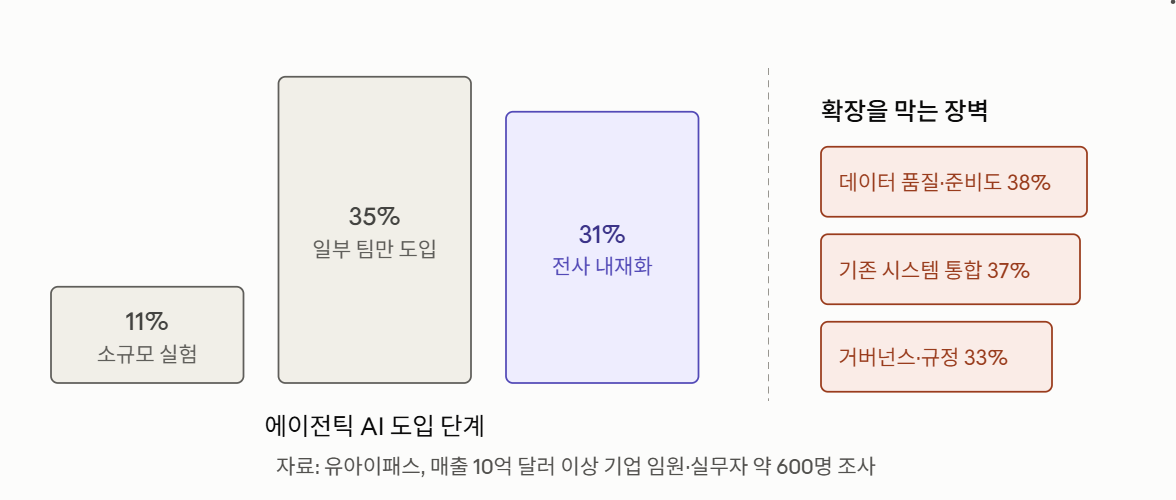
Automation software vendor UiPath released a global survey of 590 executives from companies with over $1 billion in revenue, finding that only 31% have fully embedded AI across their business operations. While most large enterprises have moved past initial proof-of-concept (PoC) stages, they struggle with orchestration and scaling. The survey highlights that the primary barrier to production is not technical feasibility but the lack of unified governance and integration frameworks. For CIOs, this indicates that pilot success does not correlate with enterprise-wide deployment without significant structural changes to workflow management.
AWS-Strand Partners Study: Korean Enterprise Adoption Hits 58%
An AWS-commissioned study by Strand Partners indicates that AI adoption among Korean enterprises has risen by 10 percentage points year-over-year to 58%. However, the study reveals a critical governance gap: while 81% of AI-using companies report productivity gains, only 27% possess a formal AI strategy. Furthermore, consistent metrics for measuring performance remain scarce, creating a "measurement vacuum" that complicates board-level reporting. This suggests that while adoption volume is high, strategic maturity lags significantly behind usage rates.

C3.ai Discloses $135M Cost Savings via 40% Headcount Reduction
In its Q1 FY2027 earnings call, enterprise AI software provider C3.ai disclosed annualized cost savings of $135 million resulting from a restructuring program that reduced headcount by approximately 40%. The company, which has pivoted toward more efficient AI delivery models, cited these cuts as essential to improving its cost structure amid slower-than-expected customer scaling. This move reflects a broader trend among AI-native firms shifting from growth-at-all-costs to profitability-focused operations, signaling to investors that the sector is entering a consolidation phase.

KT Report: Financial Sector Leads AX Execution at 60%
Korean telecom giant KT released an "AX Insight Report" indicating that 60% of major domestic financial institutions have entered the execution phase of AI Transformation (AX), compared to only 30% of public sector agencies. The report identifies distinct barriers for each sector: financial institutions struggle with proving ROI and ensuring model trustworthiness, while public agencies face challenges with budget allocation, performance measurement, and data linkage. These findings provide a localized view of the pilot-to-production gap, showing that regulated industries face higher hurdles for full-scale deployment.

Local view
In Japan, the Nikkei Cross Trend reported that only 24% of marketers feel generative AI has contributed to tangible business outcomes, despite widespread tool adoption. A separate survey by Mynavi Tech Plus found that 77% of Japanese companies are actively working on generative AI implementation, but the definition of "success" remains vague for many. The disconnect between high participation rates and low perceived impact is a central theme in Japanese business media, with stakeholders calling for better case studies and clearer ROI frameworks to justify continued investment.
Context & numbers
- Global AI Spending Forecast: Total enterprise AI spending is projected to hit $2.52 trillion in 2026, yet 84% of finance leaders report difficulty measuring ROI.
- Production vs. Pilots: While 80% of enterprise apps now embed an AI agent, only 31% run one in production, and 88% of pilots never ship.
- Abandonment Rates: Gartner predicts that over 40% of agentic AI projects will be canceled by 2027 due to unclear business value and escalating costs.
On the radar
- Q3 Earnings Season: Watch for further disclosures from major SaaS providers regarding AI-related cost-cutting measures and headcount reductions as they attempt to protect margins against rising compute costs.
- Vendor Consolidation: With C3.ai’s restructuring complete, other mid-tier AI vendors may announce similar operational efficiencies or strategic pivots to survive the shift from hype to hard ROI accountability.
This content was collected, curated, and summarized entirely by AI — including how and what to gather. It may contain inaccuracies. Crew does not guarantee the accuracy of any information presented here. Always verify facts on your own before acting on them. Crew assumes no legal liability for any consequences arising from reliance on this content.
Powered by
