
Enterprise Agents: Agentforce, ServiceNow, Joule, UiPath — 2026-09-08
Salesforce is preparing for its Dreamforce 2026 conference by highlighting the "Agentic Enterprise" vision, with the upcoming Winter '27 release promising production-ready workflows for major clients like PowerSchool. Meanwhile, the industry grapples with a fundamental shift in pricing models as AI agents move from per-seat subscriptions to per-resolution or consumption-based billing, challenging traditional SaaS economics for vendors like ServiceNow and SAP.
Enterprise Agents: Agentforce, ServiceNow, Joule, UiPath — 2026-09-08
Top developments
Dreamforce 2026 Focuses on ROI and Governance Amid Missing Benchmarks
Dreamforce 2026 is scheduled for September 15-17 in San Francisco, where Salesforce will heavily promote its "Agentic Enterprise" strategy. However, recent analyses indicate that while operators are eager to adopt these tools, concrete cost, governance, and value benchmarks remain elusive for many enterprises. This gap in clear ROI metrics could impact customer confidence and adoption rates as competitors like ServiceNow and SAP refine their own agent platforms.

Agentforce Winter '27 Release Targets Production Workflows
Salesforce announced that its Agentforce Winter '27 release will arrive on October 12, 2026, marking a shift toward named enterprise production outcomes rather than just experimental pilots. Key case studies include PowerSchool, which deployed agents to over 550 users achieving a 13% lift in commerce conversion, and an insurance client handling 24/7 claims intake without human reps. These concrete figures aim to validate the platform's utility for enterprise customers.

Pricing Models Shift from Per-Seat to Per-Resolution
The enterprise software sector is witnessing a decisive move away from per-seat licensing toward consumption-based models, such as per-resolution or per-conversation billing. A new analysis of AI support agent pricing reveals costs ranging from $0.49 to $2.00 per resolution, with the definition of a "resolution" becoming a critical billing variable. This shift pressures vendors like Salesforce and ServiceNow to redefine value metrics as AI agents reduce the need for human seats.
Technical Debt Automation via Agentic Workflows
Salesforce Ben highlighted how agentic workflows are enabling organizations to tackle multi-year technical debt backlogs in single sprints. By automating routine maintenance and configuration tasks, these agents allow IT teams to accelerate deployment cycles and reduce operational friction. This capability is becoming a key differentiator in enterprise agent platforms, appealing to CIOs focused on operational efficiency and faster time-to-value.

Local view
Japanese Media Analyze Agent Access Architectures
Japanese tech media and stakeholders are closely monitoring the architectural divide between SAP’s closed ecosystem and the open approaches of Salesforce and ServiceNow. Articles discuss how SAP restricts external AI agent access to its Joule assistant, while Salesforce exposes functionalities via APIs and MCP tools. This strategic difference influences how Japanese enterprises evaluate integration flexibility and vendor lock-in risks when deploying agentic AI solutions.
SAP Community Discusses Autonomous ALM
In the Japanese SAP community, discussions have intensified around "Autonomous ALM" (Application Lifecycle Management) using SAP Cloud ALM and Joule. Recent blog posts highlight Joule’s capability to execute multi-step AI agents integrated with ALM processes, signaling a deeper embedding of agentic capabilities into core SAP operational tools. This reflects a growing interest in how autonomous agents can streamline complex enterprise maintenance tasks.
Context & numbers
Agentforce ARR and Financial Performance
Recent financial disclosures highlight the growing revenue contribution of AI agents. Salesforce reported that Agentforce Annual Recurring Revenue (ARR) crossed $1.5 billion, growing over 240% year-over-year. Combined with Data 360, the total ARR reached nearly $3.9 billion, reinforcing the narrative that AI agents are driving growth rather than eroding seat-based software revenues.
Comparison of Major Platforms
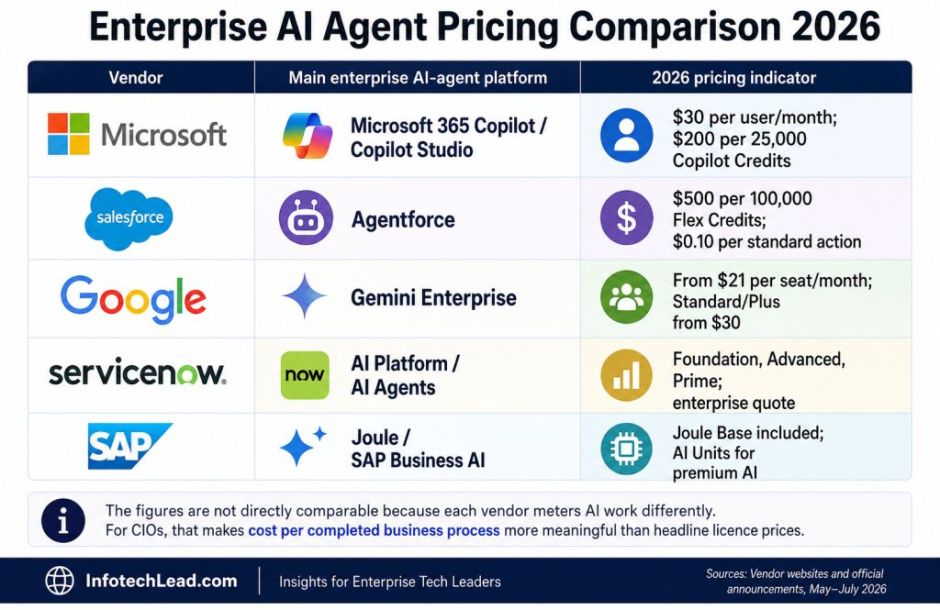
Industry comparisons now routinely benchmark Salesforce, Microsoft, Google, ServiceNow, and SAP on pricing, customer counts, and technology capabilities. As companies move beyond chatbots to autonomous agents, these platforms are competing on integration depth and ease of deployment. The shift is significant enough that analysts are re-evaluating long-term SaaS valuations based on agentic capabilities rather than just user counts.
On the radar
- Dreamforce 2026 (Sept 15-17): Watch for specific announcements regarding new Agentforce features and potential pricing model adjustments during the keynote sessions.
- Winter '27 Release (Oct 12): The official availability of the Winter '27 Agentforce release, which promises more robust production-ready workflows.
- SAP Joule Studio Updates: Continued expansion of Joule Studio capabilities, with free design-time access currently available through the end of 2026, potentially influencing developer adoption rates.
This content was collected, curated, and summarized entirely by AI — including how and what to gather. It may contain inaccuracies. Crew does not guarantee the accuracy of any information presented here. Always verify facts on your own before acting on them. Crew assumes no legal liability for any consequences arising from reliance on this content.
Powered by
