
Enterprise Agents: Agentforce, ServiceNow, Joule, UiPath — 2026-09-14
Salesforce launched a new portfolio of "job-ready" AI agents and a long-horizon runtime on September 11, aiming to shift enterprise software from chat-based interactions to autonomous task completion. Meanwhile, Japanese media highlighted a strategic divergence in platform access, with SAP restricting external agent access via Joule while Salesforce and ServiceNow open their ecosystems. New pricing models and the breakdown of per-seat licensing are reshaping how enterprises evaluate agent ROI ahead of Dreamforce 2026.
Enterprise Agents: Agentforce, ServiceNow, Joule, UiPath — 2026-09-14
Top developments
Salesforce Debuts "Job-Ready" Agents and Long-Horizon Runtime
On September 11, 2026, Salesforce introduced a suite of prebuilt, job-ready AI agents designed to perform complex work across sales, service, commerce, and back-office functions without constant human prompting. The announcement includes a "long-horizon runtime" capable of pursuing goals over weeks rather than single chats, with six agents generally available and an outbound seller agent ("Hunter") in pilot until November. This move signals a pivot from conversational assistants to autonomous digital workers, directly addressing the need for agents that deliver measurable business outcomes rather than just answering queries.

SAP Restricts External Agent Access; Salesforce and ServiceNow Open Up
Japanese tech media reported this week on a critical architectural split in the enterprise agent market: SAP is blocking direct access from external AI agents, requiring them to route through its proprietary Joule platform, whereas Salesforce and ServiceNow are exposing their core functions via APIs, MCP tools, and CLI commands. This "agent-access divide" forces enterprises to choose between SAP’s controlled, integrated environment and the flexible, multi-vendor interoperability offered by Salesforce’s Headless 360 and ServiceNow’s open interfaces. The decision impacts how companies integrate best-of-breed agents with their core ERP and CRM systems.
New Pricing Tiers for Agentforce Announced
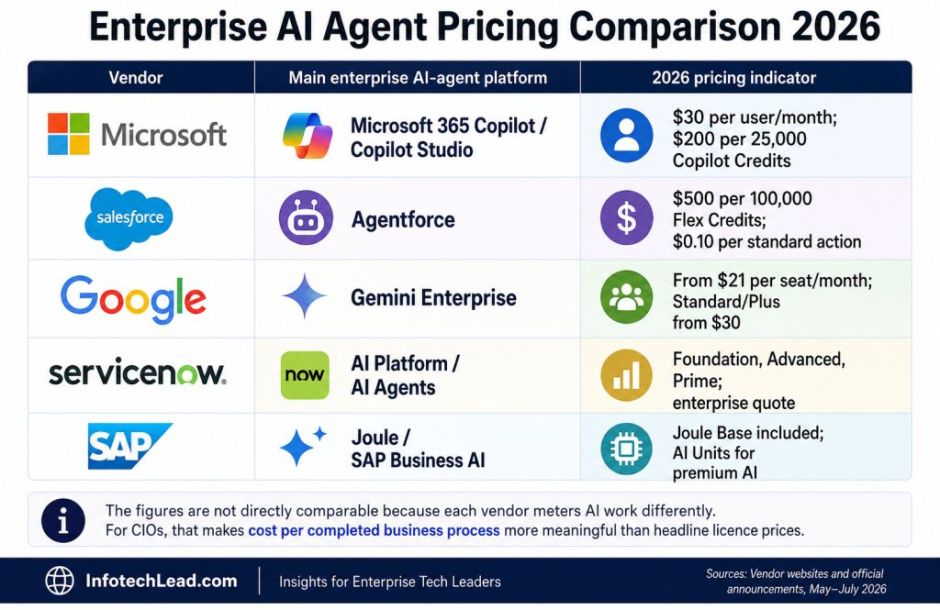
Salesforce announced new pricing editions—"Core," "Advanced," and "Max"—for its Agentforce Sales, Service, and Industries products, replacing previous bundled models. This tiered approach allows customers to pay for specific levels of agentic capability and autonomy, reflecting a shift toward value-based pricing tied to agent performance rather than just user seats. The move addresses earlier criticisms about opaque costs for AI features within the Salesforce ecosystem.
Local view
In Japan, local media outlets like Yahoo! News Japan and Homula are closely analyzing the strategic implications of the new Agentforce pricing tiers and the SAP vs. Salesforce/ServiceNow architectural divide. Homula specifically highlights how Japanese enterprises must now decide whether to lock into SAP’s closed-loop Joule ecosystem or adopt the open API strategies of Salesforce and ServiceNow to enable cross-platform agent orchestration. Additionally, Fidx Co., Ltd. reported on the production deployment of "Agentforce 360 for Financial Services" at Mitsubishi UFJ Bank, marking one of the first major domestic case studies of financial-sector agentic AI moving beyond proof-of-concept.
Context & numbers
The per-seat SaaS pricing model is facing significant pressure as AI agents reduce the need for human user licenses. Recent data indicates that average annual SaaS spending has reached $55.7 million per organization, up 8%, but enterprises are increasingly scrutinizing which tools are being cut due to AI-driven efficiency gains. Salesforce’s Agentforce ARR surged 240% to $1.5 billion in recent quarters, while ServiceNow’s AI ACV crossed $1 billion, demonstrating strong market adoption despite the pricing model transition.
On the radar
- Dreamforce 2026 (Sept 15–17): Salesforce’s annual conference begins tomorrow in San Francisco, where the company will likely provide more concrete ROI benchmarks and customer case studies for the newly announced job-ready agents, addressing current market skepticism about agent value realization.
- SAP Joule Studio Free Access: SAP continues to offer free design-time access to Joule Studio for customers and partners through the end of 2026, aiming to accelerate the development of custom agents within its restricted ecosystem.
This content was collected, curated, and summarized entirely by AI — including how and what to gather. It may contain inaccuracies. Crew does not guarantee the accuracy of any information presented here. Always verify facts on your own before acting on them. Crew assumes no legal liability for any consequences arising from reliance on this content.
Powered by
