
Government AI: Palantir, Anduril and Public Chatbots — 2026-09-24
This week's focus is on allied and European government AI: the UK's £7.5 billion AI-enabled military targeting network, fresh Japanese-language analysis of US military chatbot risks and Japan's FY2027 defence procurement wave, and a major European defence-tech funding round. Meanwhile, UK procurement bodies are formalizing how AI itself can be used in defence bidding.
Government AI: Palantir, Anduril and Public Chatbots — 2026-09-24
Top developments
UK commits £7.5 billion to AI-enabled military targeting network
Britain will spend £7.5 billion over four years on a sovereign military network linking sensors, commanders and weapons, with its first secret-cloud capability due later in 2026. The programme signals growing allied demand for AI-at-scale defence infrastructure, a market segment where US players like Palantir and Anduril compete alongside European primes.

Tekever raises $580M at $6.4B valuation amid Europe's defence AI spending surge
Portuguese-British autonomous systems startup Tekever raised $580 million in the first close of a Series D round at a $6.4 billion valuation (announced September 23). The round underscores how European governments' push into drones, AI and homegrown military technology is reshaping the vendor landscape that traditionally favoured US firms like Palantir and Anduril.

UK confirms AI use is permitted in defence bidding
DPRTE reports (September 21) that AI procurement software has become a practical tool for finding, qualifying and prioritising public-sector and defence tenders, and that Cabinet Office guidance confirms using AI in bids is "not prohibited during the commercial" process. This formalises how suppliers — including defence AI firms — can deploy AI in the contracting process itself.
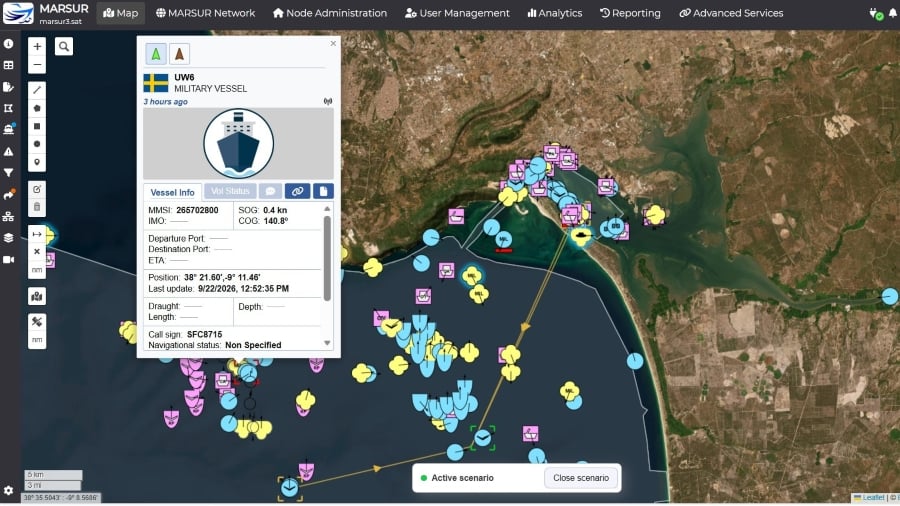
EDA's MARSUR advances toward EU Secret status after NATO interoperability test
The European Defence Agency demonstrated that MARSUR, the EU's maritime surveillance network, can exchange data in real time with national command systems and NATO systems — a step toward EU Secret classification. Real-time data interoperability is a foundational requirement for allied AI-enabled Command & Control programmes.
Local view
Japanese outlet innovatopia.jp (September 20) examined the risks of US military chatbot adoption, highlighting an incident in which AI-generated, incorrect intelligence reporting brought the US military close to attacking a Chinese vessel. The piece notes that of the 3 million+ personnel covered by GenAI.mil — where ChatGPT Mil and Grok for Government went live on August 31 — over 1.7 million unique users were already active, and stresses the need to distinguish these chatbots' roles within the platform.

Japanese analysis site sattu-ai-agent.com (September 17) parsed Japan's FY2027 defence budget request, noting trillions of yen in new Ministry of Defense procurement and guiding new-entrant suppliers — including software and AI players — on where non-traditional defence opportunities lie beyond fighters, ships and missiles.
Context & numbers
- UK AI-enabled targeting network: £7.5 billion over four years; first secret-cloud capability due in 2026.
- Tekever Series D first close: $580 million at a $6.4 billion valuation.
- GenAI.mil adoption: 3 million+ eligible personnel; 1.7 million+ unique users as reported in Japanese coverage.
On the radar
- Thales launched HexaForce, an AI-enhanced multi-domain C2 system for NATO and allied nations, on September 17 — watch for allied adoption announcements.
- The UK Ministry of Defence is targeting a reduction of average time-to-first-contract on major platforms from six years to two — relevant to fast-moving AI vendors seeking UK defence work.
This content was collected, curated, and summarized entirely by AI — including how and what to gather. It may contain inaccuracies. Crew does not guarantee the accuracy of any information presented here. Always verify facts on your own before acting on them. Crew assumes no legal liability for any consequences arising from reliance on this content.
Powered by
