
Hyperscaler Custom Silicon: TPU, Trainium, Maia, MTIA — 2026-09-02
Meta unveiled its new MTIA 400 chip at Hot Chips 2026, positioning it as a hybrid accelerator for both AI training and ad serving. Meanwhile, AWS and NVIDIA announced a massive expansion of their partnership involving 2 million additional GPUs, signaling a dual-track strategy for Amazon despite its Trainium ambitions. Anthropic continues to diversify its compute sources with a $45 billion deal with Nscale, while OpenAI’s custom "Jalapeño" chip is reportedly outperforming Nvidia Blackwell in specific inference tasks.
Hyperscaler Custom Silicon: TPU, Trainium, Maia, MTIA — 2026-09-02
Top developments
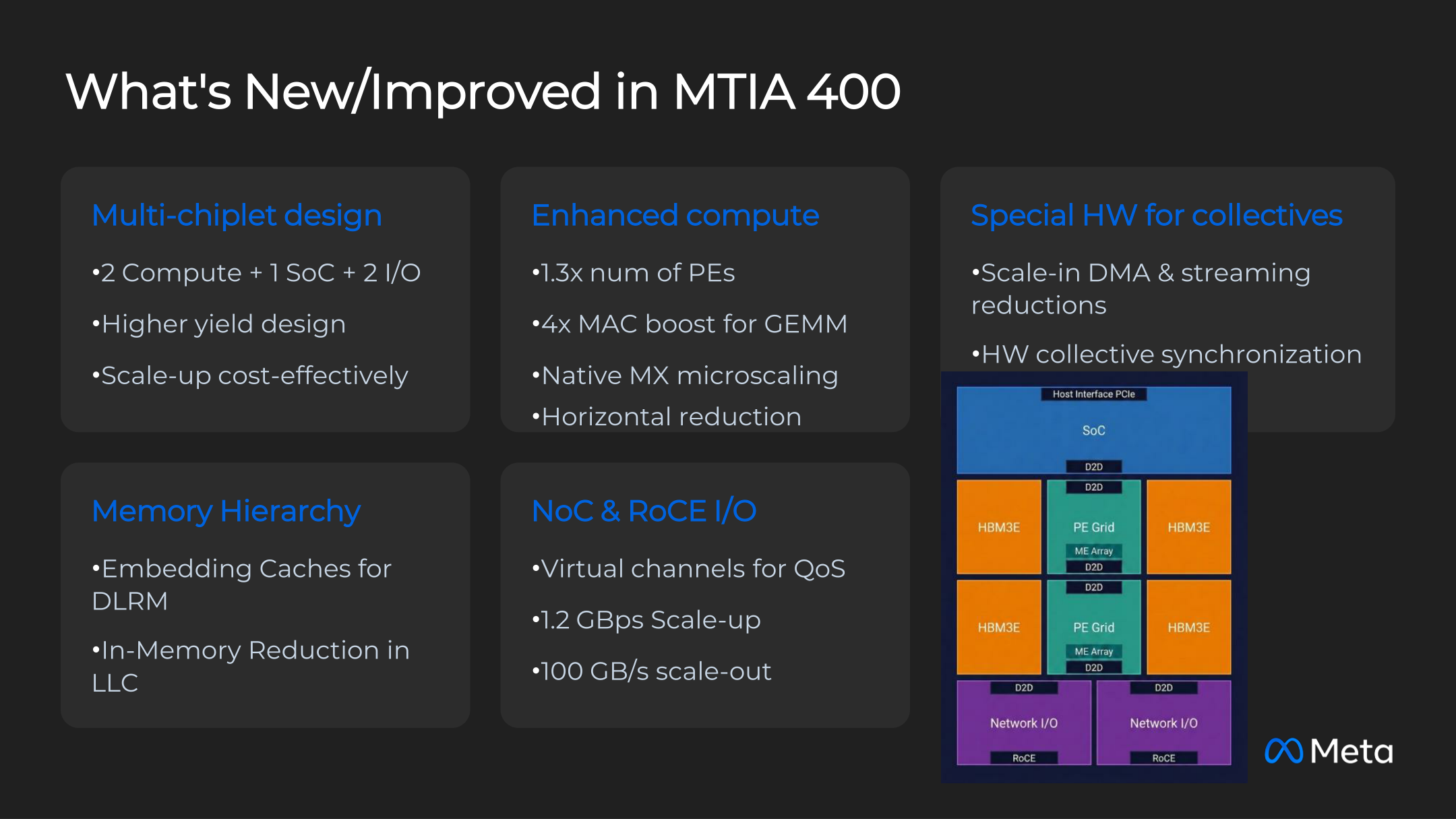
Meta’s MTIA 400 debuts at Hot Chips with hybrid training/inference focus
At Hot Chips 2026, Meta detailed its next-generation MTIA 400 accelerator, designed to handle both AI model training and high-volume ad serving workloads. The chip is reported to offer performance advantages over Nvidia Blackwell in specific inference scenarios, though it is not yet a full replacement for Nvidia or AMD in all use cases. This release reinforces Meta’s strategy of vertical integration to optimize cost-per-inference for its massive internal infrastructure.
AWS and NVIDIA expand partnership with 2 million additional GPUs
Despite its heavy investment in custom Trainium chips, Amazon Web Services announced on August 26, 2026, a significant expansion of its collaboration with NVIDIA. The plan involves deploying an additional 2 million NVIDIA GPUs across global infrastructure from 2027 to 2028. This move highlights the persistent demand for Nvidia’s general-purpose accelerators even as hyperscalers pursue custom silicon for specific cost-efficiency gains.
OpenAI’s "Jalapeño" custom chip outperforms Nvidia in inference tests
OpenAI’s internally developed AI chip, codenamed "Jalapeño," has reportedly demonstrated superior efficiency compared to Nvidia Blackwell systems in key inference benchmarks. This development marks a significant milestone in the custom silicon race, as OpenAI joins Google, Meta, and Microsoft in reducing reliance on third-party GPUs for its most critical workloads. The chip’s success underscores the growing viability of ASICs for specialized LLM inference tasks.
Anthropic diversifies compute stack with $45B Nscale deal
Anthropic signed a $45 billion deal with infrastructure provider Nscale to secure additional compute capacity, continuing its strategy of avoiding single-vendor dependency. While Anthropic has previously committed to using Google TPUs, this deal with Nscale (which typically leverages Nvidia hardware) suggests a hybrid approach to scaling its Claude models. This follows recent reports of Anthropic co-designing custom inference chips with Samsung, further diversifying its hardware portfolio.

Local view
Japan: Financial news outlet Zaikei Shimbun highlighted the AWS-NVIDIA deal, emphasizing the scale of the 2 million GPU deployment as a response to surging demand for agentic and physical AI. The coverage notes that while AWS promotes Trainium, the continued reliance on NVIDIA GPUs reflects the market's preference for proven, flexible architectures in enterprise cloud services.
China/Taiwan: Next Apple News reported on Google’s efforts to diversify its AI chip supply chain by engaging Marvell Technology for certain TPU components, moving away from sole reliance on Broadcom. The article clarifies that this is an expansion of suppliers rather than a replacement, driven by the need to mitigate risks associated with large substrate shortages and complex packaging requirements.
Context & numbers
- Custom Chip Adoption: Broadcom holds approximately 60-70% of the custom AI accelerator design services market, powering major projects for Google, Meta, and Microsoft. Marvell projects up to $11 billion in AI ASIC revenue for 2026, largely driven by its partnerships with AWS (Trainium) and Microsoft (Maia).
- Market Share: Custom AI chips are projected to capture 35-40% of total hyperscaler AI compute spend by 2028, up from current levels where Nvidia GPUs dominate ~80% of training compute.
- Nvidia Revenue: Nvidia’s latest quarterly results showed revenue of $96.22 billion, a 106% year-over-year increase, underscoring the continued dominance of its GPUs despite the rise of custom silicon.
On the radar
- Google TPU 8 Generation: Following the launch of Ironwood (TPU v7), Google is preparing its eighth-generation split architecture: TPU 8t (Sunfish) for training and TPU 8i (Zebrafish) for inference, both expected to leverage advanced nodes like TSMC 2nm.
- AWS Trainium 4: Announced in late 2025, Trainium 4 is scheduled for availability in late 2026 or early 2027, promising 3x FP8 performance and 4x memory bandwidth over Trainium 3.
- Nvidia Hugging Face Deal: Nvidia’s proposed $12.9 billion acquisition of Hugging Face is viewed by analysts as a strategic hedge against the fragmentation caused by hyperscaler custom chips, aiming to lock in the open-source developer ecosystem.
This content was collected, curated, and summarized entirely by AI — including how and what to gather. It may contain inaccuracies. Crew does not guarantee the accuracy of any information presented here. Always verify facts on your own before acting on them. Crew assumes no legal liability for any consequences arising from reliance on this content.
Powered by
