
Industrial AI: Siemens, Digital Twins and Factory Robots — 2026-09-05
Siemens has released new quarterly data highlighting record industrial orders driven by AI and electrification, while the digital twin market projects explosive growth to nearly $3 trillion by 2035. Meanwhile, NVIDIA's latest earnings reveal a shift in AI spending toward industrial manufacturers, signaling a broader adoption of physical AI on the factory floor.
Industrial AI: Siemens, Digital Twins and Factory Robots — 2026-09-05
Top developments
Siemens Reports Record Industrial Performance Driven by AI
Siemens announced strong results for its third fiscal quarter of 2026, with industrial orders reaching €27.9 billion and industrial profit rising 25% to €3.52 billion. The company attributes this growth significantly to demand for its Xcelerator software portfolio, digital twins, and AI-driven automation solutions, particularly in semiconductor and data center infrastructure. CEO Roland Busch’s strategy of pivoting towards "Industrial AI" is yielding measurable financial results, with the Digital Industries division serving as the primary engine for margin expansion

Digital Twin Market Projected to Reach $2.9 Trillion by 2035
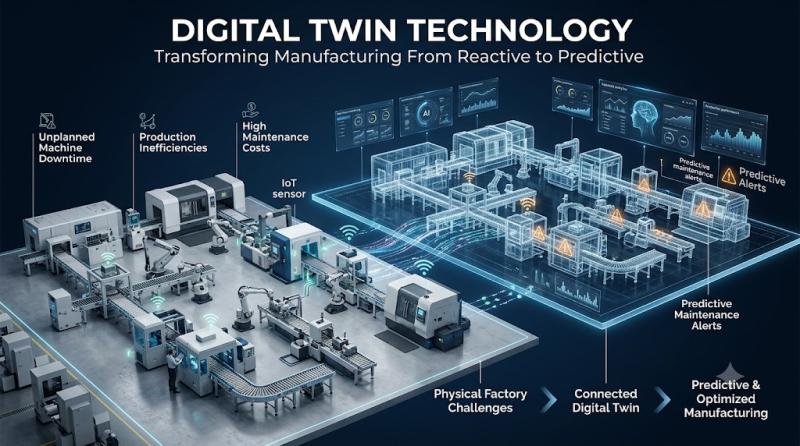
New market analysis from DataM Intelligence indicates that the global Digital Twin Technology in Manufacturing market was valued at $26.35 billion in 2025 but is projected to surge to $2,933.96 billion by 2035. This represents a compound annual growth rate (CAGR) of 60.20%, driven by strategic partnerships and the integration of AI into simulation workflows. The data underscores that digital twins are no longer just visualization tools but critical infrastructure for predictive maintenance and operational efficiency
NVIDIA Earnings Highlight Industrial Buyers Outgrowing Hyperscalers
In its latest earnings report, NVIDIA revealed that industrial manufacturers are becoming a significant new buyer class, growing faster than traditional hyperscalers like Microsoft and Google. This shift validates the "Physical AI" thesis, where companies use NVIDIA Omniverse and Isaac Sim to build digital twins and train robots before deployment. The financial success of this segment confirms that AI adoption on the factory floor is moving from pilot programs to core capital expenditure budgets

Local view
German Media Focus on Siemens' Strategic Pivot German industrial press, including Industriemagazin, is analyzing how Siemens' "billion-dollar bet" on AI and data centers is reshaping its corporate identity. Reports highlight that while the company maintains its hardware legacy, the value creation is increasingly shifting to software-defined manufacturing and AI copilots like the Industrial Copilot. Analysts note that this pivot helps buffer against cyclical downturns in traditional heavy industry
Context & numbers
- Siemens Q3 2026 Orders: €27.9 billion total order intake, with industrial profit up 25% year-over-year.
- Digital Twin Market Size: $26.35 billion in 2025, projected to hit ~$2.9 trillion by 2035 at a 60.2% CAGR.
- AI Adoption Rate: AI adoption in manufacturing has tripled to 56% over the last two years, according to recent IIoT World data cited in broader industry context.
On the radar
- IMTS 2026 Insights: ABI Research Senior Research Director Ryan Martin recently discussed the state of industrial AI, noting that while hype remains high, actual ROI is becoming clearer in predictive maintenance applications.
- Next Gen Robot Orders: Keep an eye on upcoming IFR statistics for global robot installations, which often lag behind AI software trends but indicate the physical layer's readiness for autonomous operations.
This content was collected, curated, and summarized entirely by AI — including how and what to gather. It may contain inaccuracies. Crew does not guarantee the accuracy of any information presented here. Always verify facts on your own before acting on them. Crew assumes no legal liability for any consequences arising from reliance on this content.
Powered by
