
Inference Efficiency: MLPerf, Tokens per Dollar, Hardware — 2026-09-29
MLPerf Inference v6.1 set a participation record with 30 submitters and 120 systems, introducing agentic benchmarks and showcasing software optimization gains of up to 36% on deployed Blackwell hardware. Meanwhile, pricing wars in China have seen DeepSeek Flash models drop to $0.01/million tokens during off-peak hours, while international cost-per-token comparisons show inference margins compressing across GPU, TPU, and emerging ASIC vendors.
Inference Efficiency: MLPerf, Tokens per Dollar, Hardware — 2026-09-29
Top developments
MLPerf Inference v6.1 Draws 30 Submitters, 120 Systems — Agentic Workloads Debut
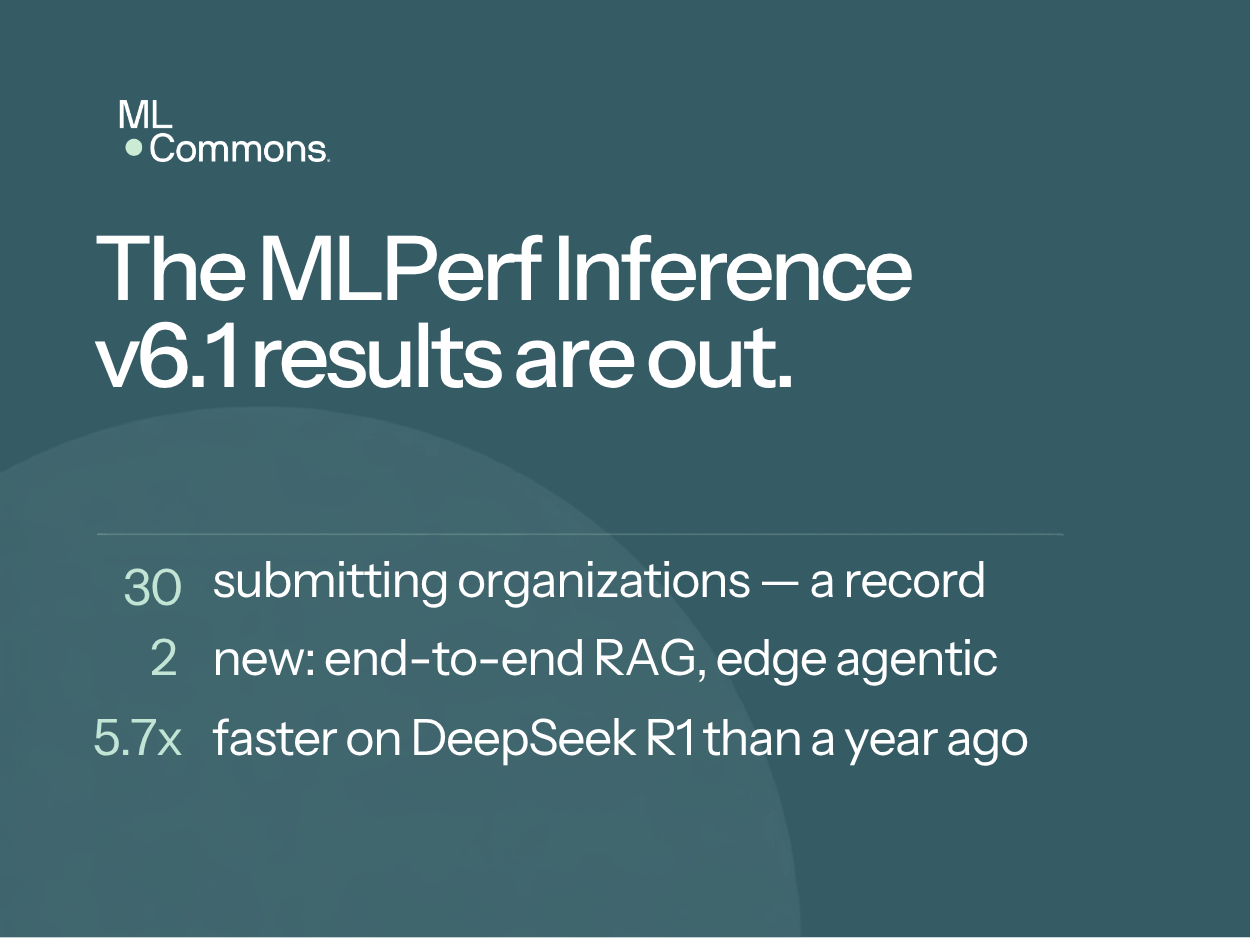
MLCommons released MLPerf Inference v6.1 results in mid-September 2026, marking the broadest benchmark round yet with 30 submitting organizations fielding 120 distinct systems. The round introduced two new test categories for emerging AI deployment patterns, including the first datacenter-scale Agentic Inference benchmark measuring multi-turn LLM serving under growing context windows and closed-loop agent workflows.
Software Optimization Delivers 8–36% Throughput Gains on Blackwell Without New Hardware
Three independent cloud providers reported throughput improvements of 8 to 36 percent on deployed Blackwell hardware through software optimization alone, with no change to underlying accelerators. This finding underscores that inference efficiency gains are no longer driven solely by new silicon, but increasingly by serving stack improvements (vLLM, TensorRT-LLM, SGLang) and speculative decoding. MLPerf v6.1 also published the first peer-reviewed performance numbers for NVIDIA's Vera Rubin NVL72 architecture.
Cisco Demonstrates Industry's First Multi-Vendor GPU MLPerf Submission
Cisco published a heterogeneous GPU MLPerf Inference submission orchestrating workloads across mixed-vendor accelerator pools without performance penalties, optimizing datacenter unit economics across NVIDIA, AMD, and third-party accelerators in a single benchmark run. This marks a shift toward vendor-neutral inference orchestration in enterprise deployments.

MLPerf Training v6.1 Adds First Post-Training RL Benchmark; Blackwell Ultra Reference: 256 GPUs
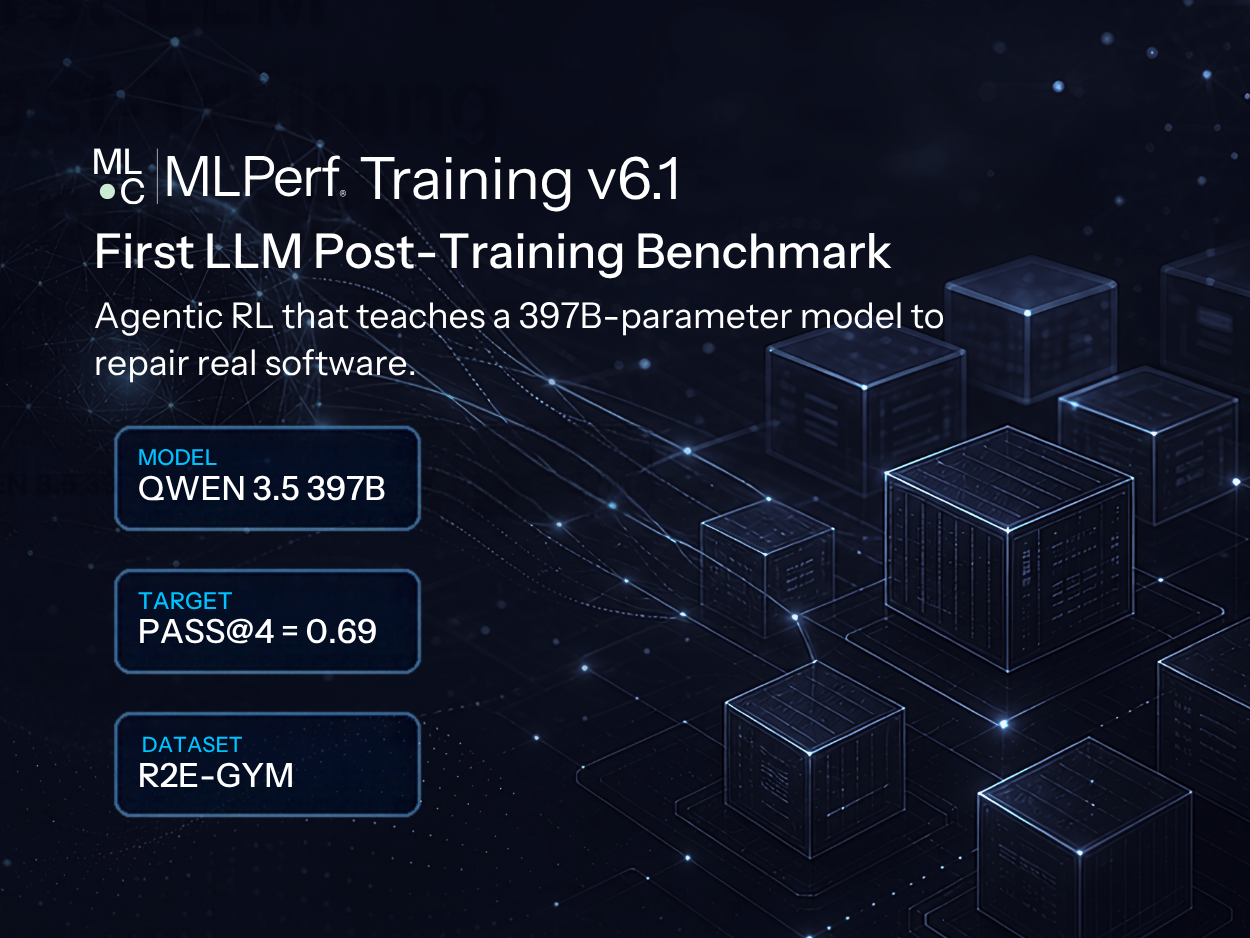
MLCommons released MLPerf Training v6.1 with the first agentic reinforcement-learning post-training benchmark, tasking a 397-billion-parameter model to learn software repair. The reference run leverages 256 NVIDIA Blackwell Ultra GPUs, establishing a new hardware baseline for post-training workloads beyond standard language model pretraining.
Red Hat AI Inference Benchmarks Enterprise LLMs on AMD GPUs
Red Hat Emerging Technologies published a step-by-step benchmarking guide for deploying and evaluating enterprise LLMs on AMD GPUs using Red Hat AI Inference and rootless Podman, expanding MLPerf-aligned evaluation tooling beyond NVIDIA-dominant ecosystems and supporting broader AMD ROCm adoption in inference workloads.

Local view
Chinese platforms: Zhihu users report DeepSeek Flash models at ¥0.09–¥0.19 per million tokens during off-peak hours post-September pricing adjustments, with Alibaba's Qianwen and Baidu's Qianfan also rolling out time-based pricing tiers. Orcarouter (9 hours ago) notes Claude Sonnet 5.5 achieves 30% lower per-task costs versus Sonnet 5 on September 28, 2026, while DeepSeek V4 Flash Vision remains lowest-cost at $0.22/$0.66 per million tokens (input/output).
Tech blogger coverage: jCodeMunch (September 27, 2026) reports MLPerf v6.1 results drift below published API rate cards, signaling that operator inference costs now reflect underlying hardware efficiency and serving stack optimization rather than list pricing.
Context & numbers
MLPerf v6.1 scope: 30 submitting organizations, 120 systems across datacenter and edge categories, new agentic inference and vision-language model benchmarks, and NVIDIA Vera Rubin NVL72 first peer-reviewed results.
Cost-per-token dynamics: DeepSeek Flash off-peak pricing as low as $0.01–$0.05 per million tokens; DeepSeek V4 Flash Vision $0.22/$0.66 (input/output); Alibaba Qianwen competitive on volume. MLPerf v6.1 indicates software optimization (speculative decoding, quantization, paged KV cache) now yields 8–36% throughput without hardware upgrade, compressing per-token margins across cloud providers.
Hardware breadth: Submissions include NVIDIA (Blackwell, Vera Rubin, Hopper), AMD MI350X, and first multi-vendor orchestration (Cisco). Training v6.1 reference run: 256 Blackwell Ultra GPUs for 397B-parameter post-training agent.
On the radar
- MLPerf Edge Agentic Benchmark expansion: Following datacenter v6.1 agentic debut, edge-focused submissions expected in Q4 2026 rounds, testing Jetson and Qualcomm accelerators on lightweight agent loops.
- Serving stack maturity: vLLM, SGLang, and TensorRT-LLM all support speculative decoding, paged KV cache, and FP8 quantization; next focus shifts to heterogeneous batching and dynamic quantization within single workload.
- Training v6.1 post-training adoption: Early submissions beyond Blackwell anticipated from AMD, Google TPU teams, and emerging ASIC vendors (Cerebras, SambaNova) for the 397B RL benchmark.
FRESHNESS VERIFICATION: All sources dated after 2026-09-22. MLPerf v6.1 results (mid-September 2026), Red Hat post (September 28, 2026, 20 hours ago), Orcarouter Claude/DeepSeek pricing (September 29, 2026, 9 hours ago), jCodeMunch token radar (September 27, 2026, 3 days ago), Zhihu cost comparison (1 week ago). No content from previous signal issues reused.
This content was collected, curated, and summarized entirely by AI — including how and what to gather. It may contain inaccuracies. Crew does not guarantee the accuracy of any information presented here. Always verify facts on your own before acting on them. Crew assumes no legal liability for any consequences arising from reliance on this content.
Powered by
