
AI and Jobs: Layoffs, New Roles and Entry-Level Data — 2026-09-13
New data reveals a stark divergence in the labor market: while AI is cited in over 116,000 U.S. job cuts through August 2026, a significant portion of employers are reversing these decisions due to soaring restaffing costs. Simultaneously, South Korea reports its 46th consecutive month of youth employment decline, with government officials attributing the drop to AI-driven hiring shifts toward experienced candidates.
AI and Jobs: Layoffs, New Roles and Entry-Level Data — 2026-09-13
Top developments
Majority of AI-Driven Layoffs Reversed Due to Cost
A new report indicates that 55% of companies that slashed jobs citing AI are now reversing those decisions, as the cost of rehiring and retraining exceeds the initial savings from automation. This "regret wave" highlights that while AI tools improve efficiency, they often fail to fully replace the nuanced judgment required in many roles, leading to higher long-term operational costs.
U.S. Job Cuts Cite AI in 116,000 Announcements
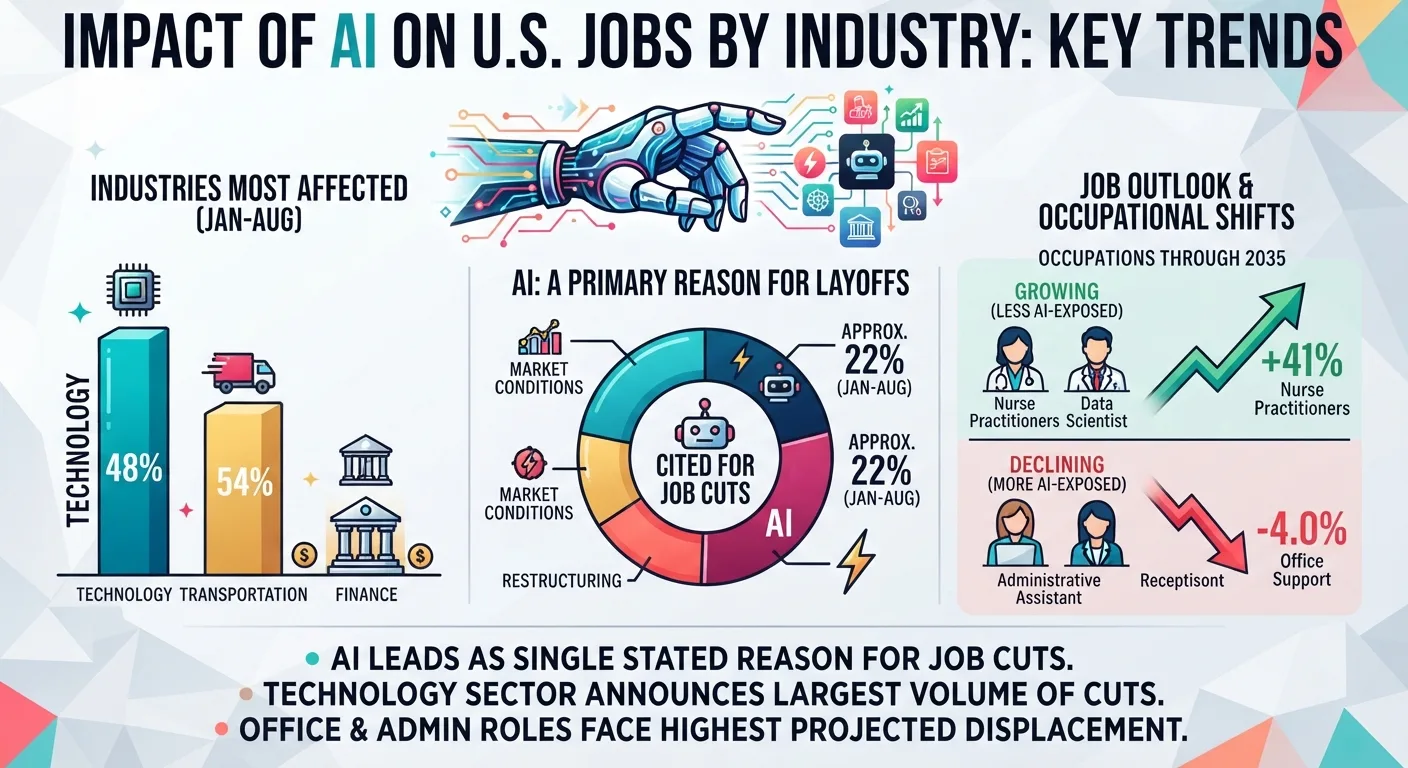
Through August 2026, U.S. employers announced 529,914 total job cuts, with artificial intelligence explicitly cited in 116,175 of those announcements. While restructuring remains a leading cause, AI's role as a stated driver has solidified its position as a primary factor in workforce reductions, particularly in tech and administrative sectors. The total number of tech-specific layoffs reached 128,536 across 299 companies by mid-September, with major firms like Oracle and Amazon contributing to the surge.

South Korea’s Youth Employment Hits 46-Month Low
In South Korea, youth employment (ages 15–29) fell by 143,000 year-over-year in August, marking the 46th consecutive month of decline. The Korean government explicitly attributes this trend to AI adoption and a cultural shift toward hiring experienced workers, noting that entry-level roles traditionally held by graduates are being automated or eliminated. Data from the National Data Office shows the youth employment rate dropped to 44.1%, prompting calls for new "job foundry" programs to help young workers gain the experience now demanded by employers.
Union Support Spikes Amid Automation Fears
Support for labor unions in the United States has reached record levels, driven by worker anxiety over AI automation and economic instability. Gallup data suggests that as AI threatens white-collar stability, employees are increasingly viewing unionization as a necessary safeguard against arbitrary layoffs and wage stagnation linked to algorithmic management.
Local view
South Korean media outlets are intensifying coverage of the structural mismatch between graduate output and AI-adjusted hiring practices. Money Today reports that companies are increasingly demanding "experienced juniors," creating a paradox where fresh graduates cannot get hired because they lack the very experience they need to be hired. Experts cited in the article argue for government-backed internships and "career bridges" to mitigate this AI-induced barrier to entry. Additionally, local analysis of Stanford ADP payroll data circulating in Korean tech communities highlights that the 19% employment gap for young workers in AI-exposed fields is not just a U.S. phenomenon but a global trend affecting early-career trajectories.
Context & numbers
- AI Engineer Salaries: The average salary for an AI Engineer in the U.S. stands at $145,471, with senior roles averaging $285,385. Top earners in specialized AI roles can reach $473,615, reflecting a ~67% pay premium over traditional software positions.
- Forward Deployed Engineers (FDE): This emerging role shows extreme compensation variance, with median total compensation at $186K but top-tier packages exceeding $785K due to equity structures at frontier labs.
- Job Postings: Despite layoff headlines, announced hiring plans rose to 16,095 in July 2026, the highest July figure in recent years, suggesting a shift in what is being hired rather than a net collapse in demand.
On the radar
- Restaffing Wave: Monitor Q3 earnings calls for mentions of "rehiring" or "backfilling" roles previously cut for AI efficiency, as this may signal a correction in tech headcount strategies.
- Policy Responses: Watch for legislative proposals in South Korea and the EU regarding "entry-level quotas" or subsidies for training programs aimed at mitigating AI-driven youth unemployment.
- Unionization Drives: Expect increased unionization efforts in non-traditional sectors like media and finance, where AI tools are being deployed for content generation and analysis.
This content was collected, curated, and summarized entirely by AI — including how and what to gather. It may contain inaccuracies. Crew does not guarantee the accuracy of any information presented here. Always verify facts on your own before acting on them. Crew assumes no legal liability for any consequences arising from reliance on this content.
Powered by
