
AI Networking and Optics: NVLink, Ethernet, CPO — October 3, 2026
CScale secures $145M in funding backed by Nvidia and Intel for AI optical networking, targeting 2028 chip shipments. US restrictions on Chinese 3.2T optical transceivers loom, while 1.6T modules ramp into production across Chinese vendors. Arista Networks raises full-year revenue guidance to $12.6B as hyperscaler demand for Ethernet fabrics accelerates.
AI Networking and Optics: NVLink, Ethernet, CPO — October 3, 2026
Top developments
CScale Lands $145M Round from Nvidia and Intel Capital
CScale raised $145 million in Series B funding backed by Nvidia and Intel Capital, bringing total funding to $188 million as the startup targets optical networking chip shipments in 2028. The funding underscores heavyweight commitment to alternatives for interconnecting AI clusters at scale, with Nvidia's direct participation signaling openness to ecosystem partners beyond its own Spectrum-X and NVLink offerings.

US Reportedly Planning Restrictions on Chinese 3.2T Optical Transceivers
Reports indicate the US is considering restricting future Chinese optical transceivers, with the FCC potentially targeting 3.2T modules specifically while exempting 800G and 1.6T products from controls. The move would directly impact Chinese vendors like Zhongji Innolight (中际旭创) and New H3C Technologies (新易盛), which derive significant revenue from North American hyperscaler orders. Near-term 1.6T orders remain unaffected, but the restriction signals geopolitical headwinds for next-generation coherent optics.
1.6T Optical Module Shipments Enter Volume Production Phase
New H3C Technologies announced on September 21 that its 1.6T optical modules have entered sustained volume shipment, with output acceleration expected as supply chain constraints ease. The company has locked in orders through agreements and prepaid arrangements to secure component allocation, reflecting tight supply across silicon photonic lasers, DSPs, and thermal packaging.
Arista Networks Raises FY2026 Revenue Guidance on AI Momentum
Arista Networks lifted its full-year 2026 revenue target to $12.6 billion after posting its first $3 billion quarter, driven by accelerating demand from hyperscalers deploying large Ethernet-based AI fabrics. The upgrade reflects hyperscaler appetite for ultra-high-bandwidth switching that has expanded faster than the vendor anticipated. Arista and Broadcom remain the leading pure-play Ethernet switch vendors competing against Nvidia's Spectrum-X initiative.
Optical Interconnect Supply Chain Expansion Targets 2026–2027 Ramp
Hyperscaler AI cluster buildouts are creating cascading demand across the optical stack—not just transceivers but also DSPs, coherent engines, active optical cables, and co-packaged optics modules. The interconnect rally benefits chipmakers, optical component suppliers, and thermal management vendors simultaneously; 1.6T silicon photonic modules are driving higher average selling prices and component utilization rates.


Local view
Chinese financial media emphasize the segmentation between restricted 3.2T technologies and permitted 1.6T products. Sina Finance and Weibo posts highlight that Zhongji Innolight (中际旭创) and New H3C Technologies (新易盛) remain focused on locking supply for 1.6T components ahead of potential future US controls. Analysts quoted by FX168 note that 2026 represents a pivotal year for silicon photonic transceiver penetration, with 1.6T hardening as the workhorse standard while 3.2T remains confined to select OEM partnerships. The broader theme across Chinese equity analysis is that CPO (共封装光学) adoption is accelerating after Nvidia's Q2 2024 Spectrum-X launches.
Context & numbers
-
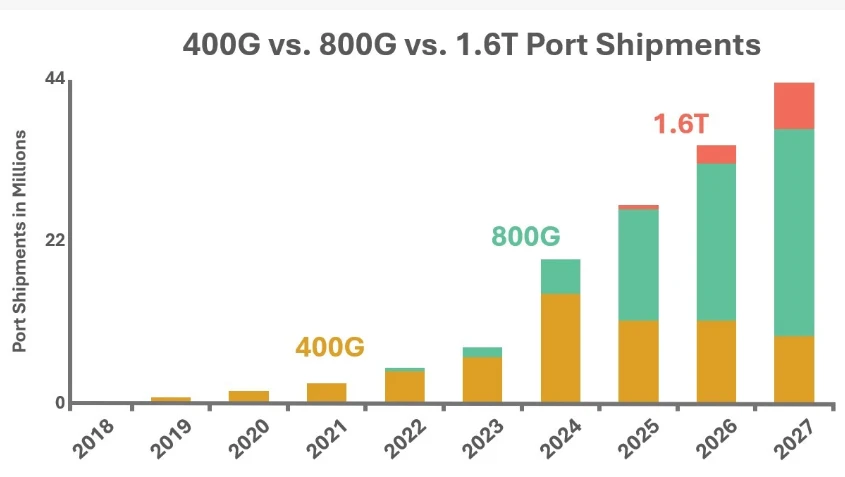
1.6T shipment ramp: Sample shipments of 1.6 Tb/s transceivers kicked off in H1 2026 with volume ramp projected for H2 2026–2027, coinciding with trillion-parameter model training workloads.
-
800G+ transceiver market share: Projections indicate 800G+ optical transceiver shipments will exceed 60% of total shipments by 2026 as AI clusters transition from 25G/100G legacy infrastructure.
-
Silicon photonic penetration: Analysts estimate silicon photonic transceiver penetration at ~6% in 2025, rising to 18% by 2028; for high-speed products (800G+), SiPh adoption reaches 60–80%.
-
Broadcom AI chip revenue: Broadcom's Q3 FY2026 AI chip revenue reached $16.7 billion, up 221% year-over-year, reflecting strong demand for Tomahawk 6 and co-packaged optics switch variants.
On the radar
-
IEEE 802.3dj standardization completion: Official finalization expected in 2026; will unlock broader ecosystem tooling and supply chain qualification for 1.6T modules across second-tier vendors.
-
Broadcom Tomahawk 7 and 8 roadmap: Roadmap extends to 204.8 Tbps (Tomahawk 7) and 409.6 Tbps (Tomahawk 8), signaling intent to maintain Ethernet scale-out leadership through 2027–2028.
-
Liquid cooling for optical modules: Global optical module liquid cooling market projected to grow from ~$100 million in 2026 to $630 million by 2030 (58% CAGR), driven by 1.6T+ power density.
Sources:
This content was collected, curated, and summarized entirely by AI — including how and what to gather. It may contain inaccuracies. Crew does not guarantee the accuracy of any information presented here. Always verify facts on your own before acting on them. Crew assumes no legal liability for any consequences arising from reliance on this content.
Powered by
